

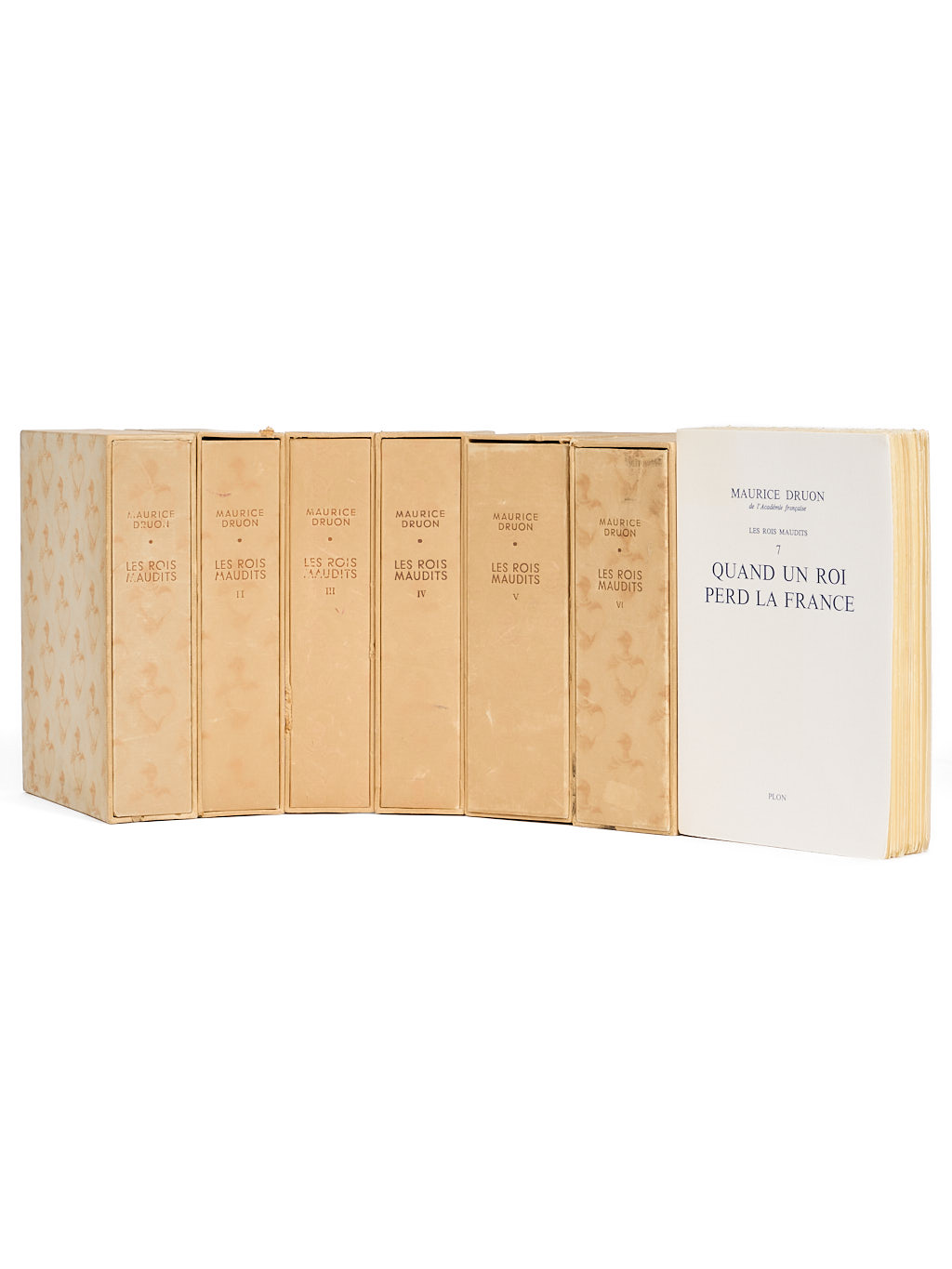
Les Rois maudits
One of the first 50, 80 and 70 copies on vélin pur fil (vols. I, II, III and IV), white Lana vellum (vols. V and VI) — all hors commerce — and on pur fil Lafuma paper (vol. VII, no. 33).
Maurice Druon was steeped in literature from birth: he was the nephew of the writer Joseph Kessel, the great-grandson of Antoine Cros, third and last king of Araucania (in present-day Chile), and the great-grandnephew of the poet Charles Cros. His novel Les Grandes Familles earned him the Prix Goncourt in 1948, securing his place in literary Paris. But true fame came only with the historical saga Les Rois maudits.
Druon’s fresco opens at the beginning of the fourteenth century, during the largest trial history has recorded: that of the Templars. Jacques de Molay, Grand Master of the Order, dies at the stake, hurling his terrible curse at the King of France, the Pope and the great men of the kingdom: “Cursed! All of you cursed, to the thirteenth generation of your line!”
Druon never hid the fact that his series was the result of “workshop” collaboration: among the collaborators he thanks in his preface are Gilbert Sigaux, Matthieu Galey, Pierre de Lacretelle, José-André Lacour and Edmonde Charles-Roux, alongside a few lesser ghostwriters. The principal collaborator was Georges Kessel, brother of Joseph Kessel. A historian and journalist, he had married the actress Janine Crispin in 1938, who appeared in the 1973 television adaptation of Les Rois maudits.
Thirty years later, the American author George R. R. Martin published A Song of Ice and Fire, adapted from 2011 under the title Game of Thrones, with the worldwide success now well known. Martin has cited Les Rois maudits as the ultimate model of the genre and his primary source of inspiration. Martin published three volumes (A Game of Thrones in 1996, A Clash of Kings in 1998 and A Storm of Swords in 2000); the first French edition, published by Pygmalion, appeared between 1998 and 2000.
A precious and ideal set of the complete series on deluxe paper, including the seventh volume, which appeared seventeen years after the sixth and finally brought the series to its definitive close.
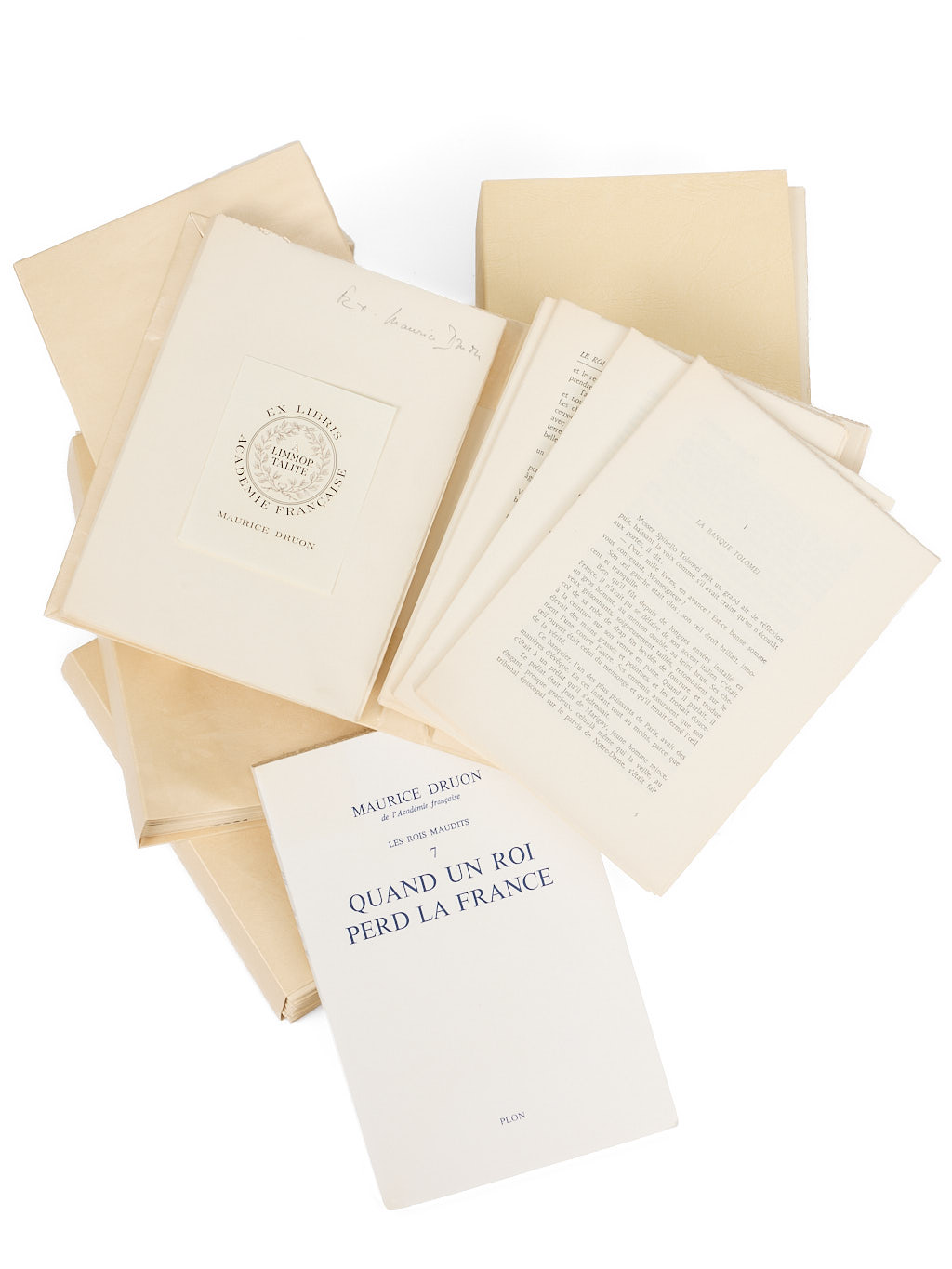
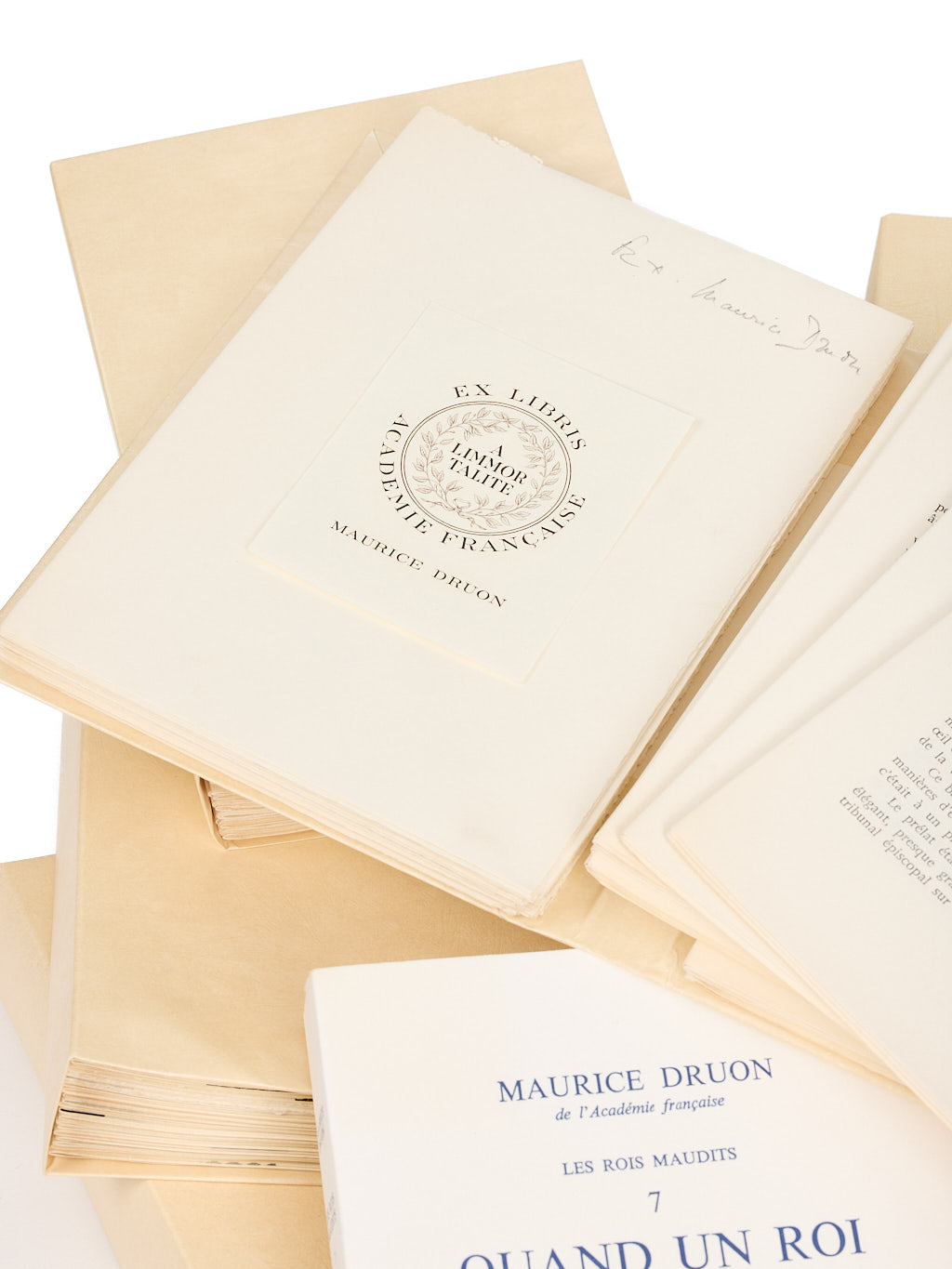
This is the author’s own copy, Maurice Druon.
Provenance: Estate of Maurice Druon (Paris, Millon, 2022, lot); with bookplate added to the first volume.