

[Les oiseaux vont mourir au Pérou] GARY & SEBERG
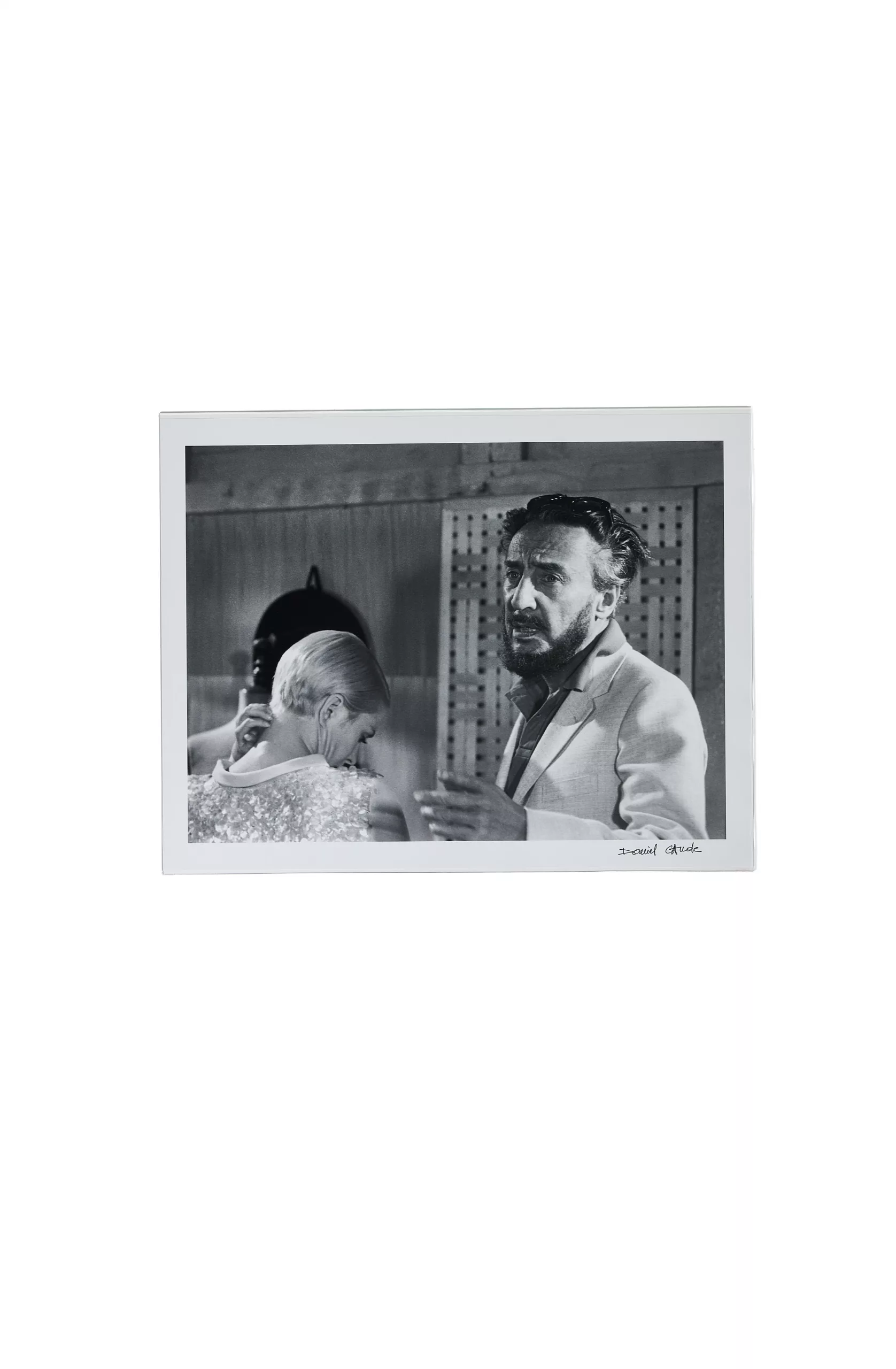
Set photograph, taken in 1967 during the shooting of Romain Gary's first film as director, Les Oiseaux vont mourir au Pérou.
In the spring of 1967, Romain Gary embarked on a new project: becoming a director himself, “though he had always been disappointed to see his own works adapted for the screen (…) Adapting one of his works, becoming a director, directing Jean… three intertwined desires that he would now put into practice” (Kerwin Spire, in Monsieur Romain Gary, écrivain-réalisateur, p. 142 ff.). He chose one of his short stories, Birds in Peru, as the basis for the screenplay: a role tailor-made for Jean Seberg, playing a young woman who is nymphomaniac yet frigid.
Filming took place in three locations: the Boulogne studios, quai du Point-du-Jour, in early October 1967; then the small town of Huelva in Spain, from mid-October (specifically the Playa de Mazagón, with white sand stretching as far as the eye could see), for a month; and finally a last stop in Madrid for the night scenes on the beach — 50 square meters reconstructed in the studio — before the film was “in the can,” bound for the Eclair studios in Orly and final editing.
On April 3, 1968, the film censorship board met behind closed doors after a private screening. At the conclusion of their deliberations, Romain Gary was notified of the film’s complete and outright ban. The stated grounds: “an offense against public morality and a disturbance of public order… whereas the film treats female frigidity in tragic terms extending to suicide… whereas six out of ten female neuroses are caused by frigidity… Les Oiseaux se cachent vont mourir au Pérou risks driving women suffering from frigidity to suicide…” Stupefaction. Romain Gary, who had privately met with de Gaulle in December, appealed to the highest authorities. The next day, a screening was arranged at the Ministry of Information, then headed by Georges Gorse. “At the end of the 95 minutes, the minister remained silent. Beside him, his chief of staff frantically chewed on the arm of his glasses, unable to hide how painful he had found them. Stoic, the minister turned to Romain Gary with a dubious grimace. Gary pleaded his case. And the minister came around: ‘I’ll set aside their opinion. I will grant you the release visa. But you will cut the more daring scenes, and the film will remain banned to those under eighteen.’ A deal was struck. A firm handshake between the two men. Release date: June 19, 1968.”
The set photographer was Daniel Cande (real name Daniel Unbekandt), who from 1965 specialized in theater, dance and opera photography, as well as a few films. The complete set of performance photographs taken by Daniel Cande between 1965 and the early 2000s is held by the performing arts department of the Bibliothèque nationale de France.
For Universal Pictures, he took a number of photographs during the shooting of Gary’s film and of its principal cast, Jean Seberg, Pierre Brasseur, Maurice Ronet, Jean-Pierre Kalfon, Danielle Darrieux…