

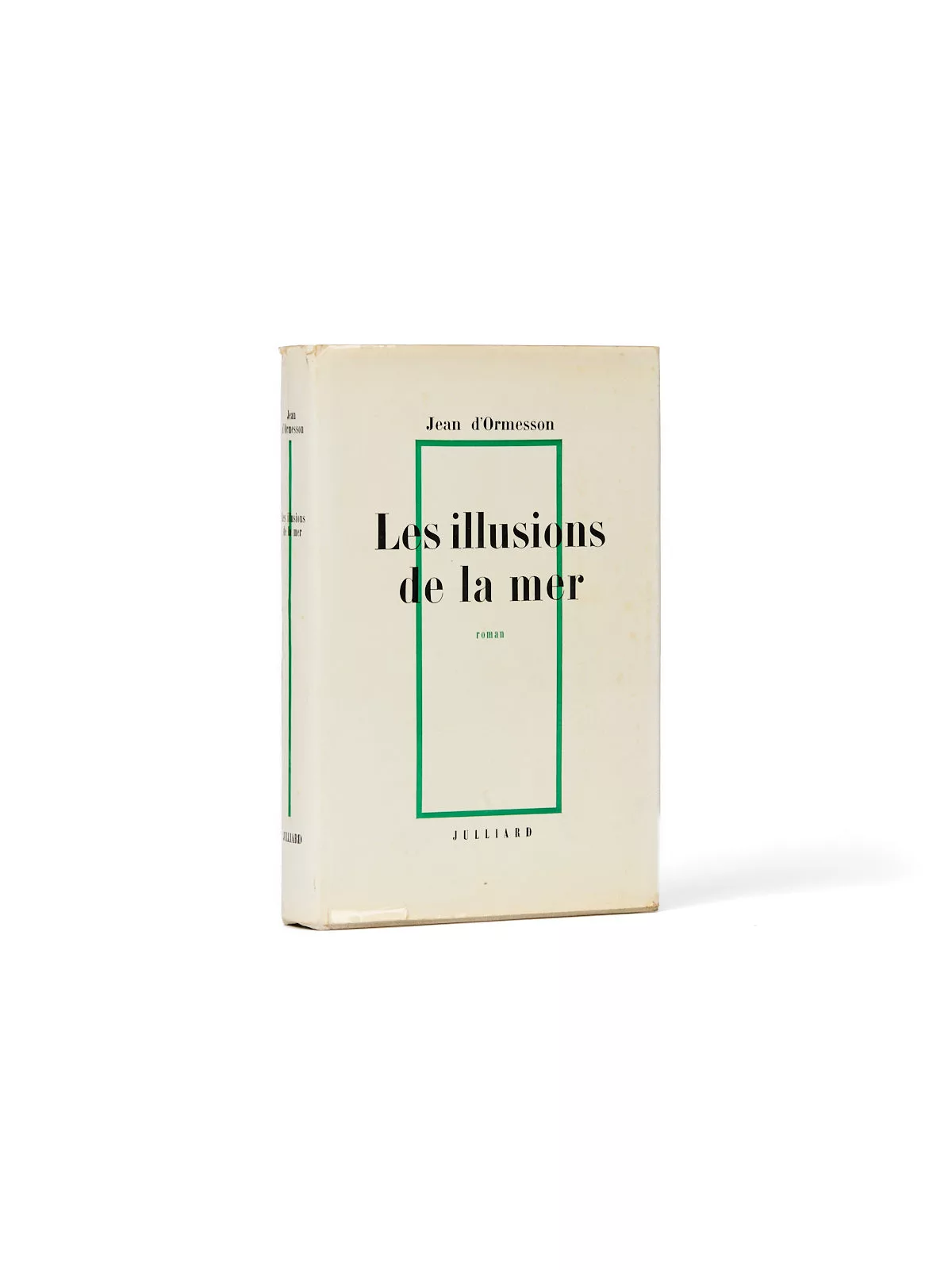
Les Illusions de la mer
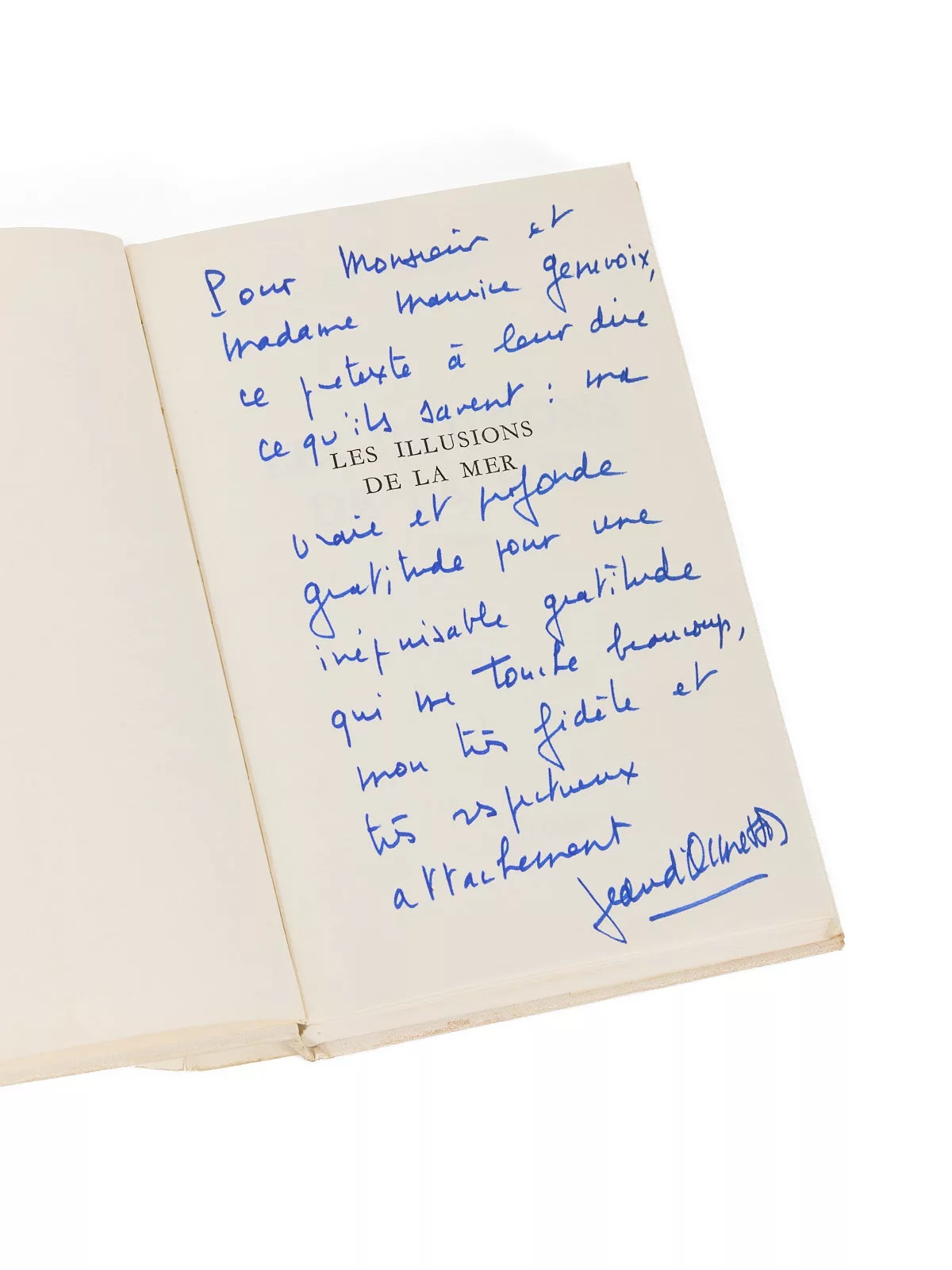
Signed presentation inscription: “Pour Monsieur et Madame Maurice Genevoix, ce prétexte à leur dire ce qu'ils savent : ma vraie et profonde gratitude pour une inépuisable gratitude qui me touche beaucoup, mon très fidèle et très respectueux attachement, Jean d'Ormesson.”
Jean d’Ormesson’s fourth novel, Les Illusions de la mer prefigures the work to come: it already shows his fondness for Greece and the Adriatic, family histories, travel, women, journalism and literature. “Too long,” however, according to Paul Morand, who criticized it in his Journal inutile: “(…) This is a book that must have been very entertaining to write, but tedious to read. A mixture of Jules Verne and Anatole France.” Yet serious enough for Claude Gallimard to persuade d’Ormesson to leave his longtime publisher, René Julliard, for the respectable catalogue of the rue Sébastien-Bottin. There, three years later, he would publish La Gloire de l’Empire, his first great success, which opened the doors of the Académie française to him in 1973 — with the support of Paul Morand, who noted in his Journal: “That said, I am glad to have helped him win [this] grand prize at the Académie.”
It was first with Jean d’Ormesson’s uncle, Wladimir d’Ormesson, writer and diplomat, member of the Académie française from 1956 to 1973, that Maurice Genevoix formed a close friendship. The nephew, Jean d’Ormesson, would carry on the relationship. He held immense and affectionate admiration for Maurice Genevoix, both as a writer and as a man; the day after Genevoix’s death in September 1980, he paid tribute to him, movingly recalling the happiness of having known him: “He knew his own worth: he was not proud. He could be sharp, incisive, but never unkind. He had tenderness for forests, animals, his native Loire, his Sologne, for those who suffer and who die; men loved him in return. He knew everything: he was the opposite of a pedant. He understood everything. But he knew how to live. All honors passed over him without touching him. This man of the woods and this warrior was an intellectual. He bore witness to everything a generation of Frenchmen had known of sorrows and joys: the simple and happy life, the love of the land, war and peace, remembrance.”
A fine copy attesting to the young novelist’s regard for his elder. The inscription, strictly contemporary with the novel’s publication, marks the beginning of a relationship that would only grow in quality and friendship.
From the library of Maurice Genevoix (inscription and bookplate).