

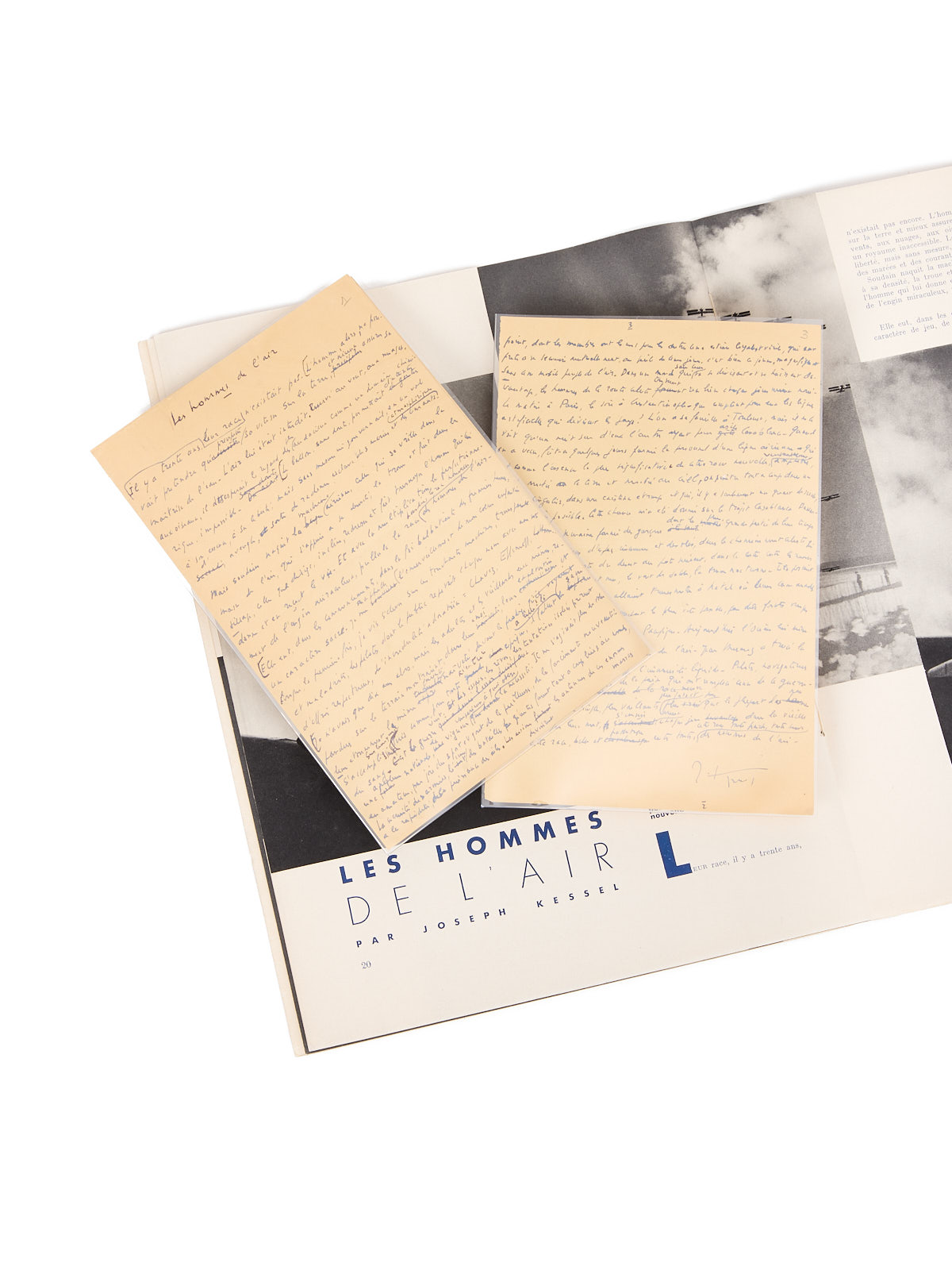
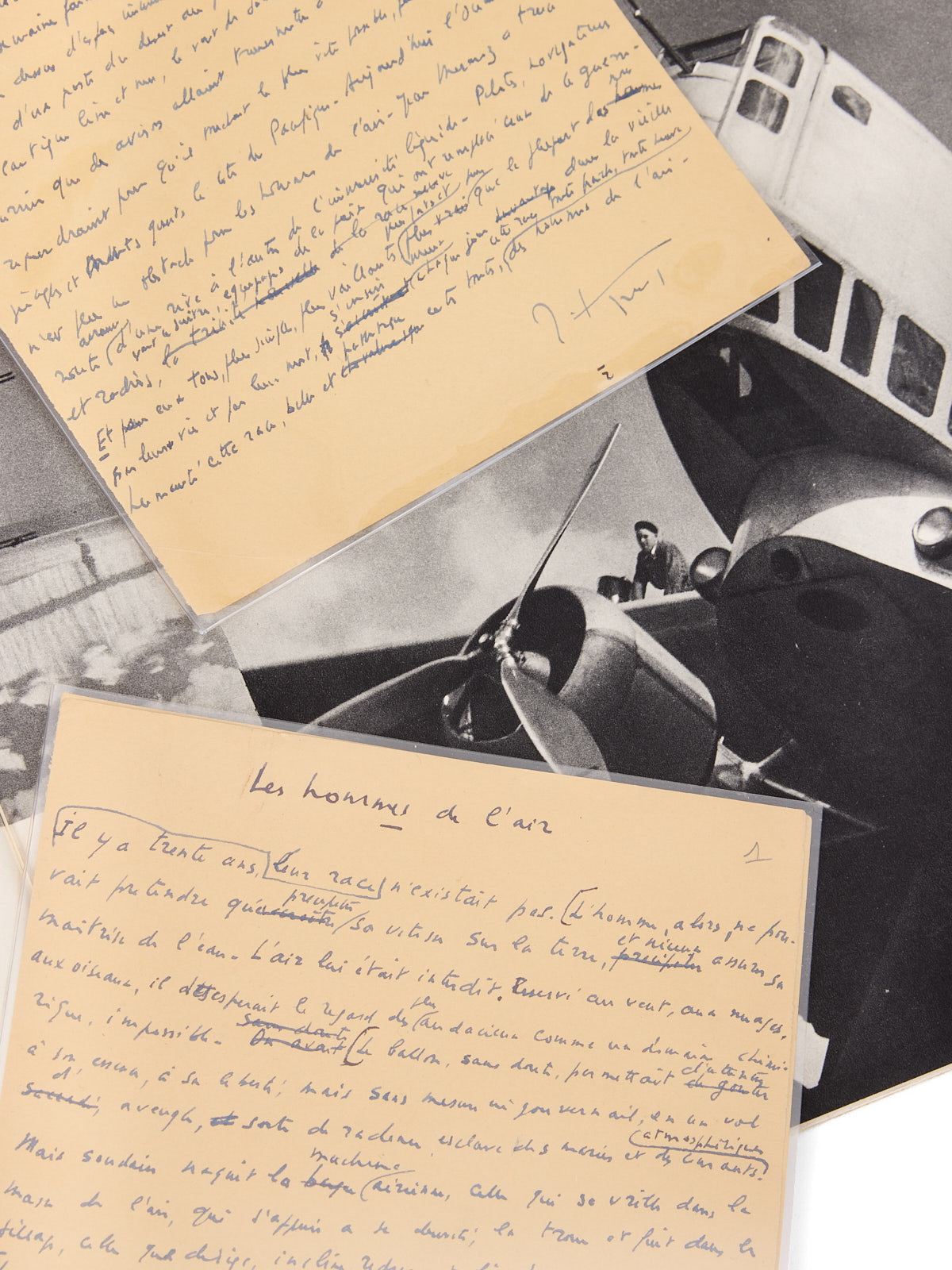
Les Hommes de l’air
This text, which appears to be unpublished in book form and has otherwise gone unnoticed, was published in 1935 in the review Art et Médecine (no. 8, October 1935). The manuscript bears some fifty autograph corrections and reveals significant, previously unrecorded variants from the published text.
Joseph Kessel’s first contact with aviation extended over eighteen months, from mid-1917 to the end of 1918: having entered the artillery school at Fontainebleau in April 1917, Kessel volunteered for artillery observation duty in the air service. Enlisted at the end of June in the training center at Plessis-Belleville, he emerged as a qualified aspirant and was assigned at the end of 1917 to squadron S.39, based at Jonchery, west of Reims. Cited in army orders as a “courageous and tenacious observer,” he succeeded on several occasions in driving off German aircraft in July 1918, earning him the Croix de guerre with palm. Memories of this military life and combat experience fed into the plot of L’Équipage, his novel published in 1923.
Ten years later, it was as a journalist that Kessel again turned his attention to the work and life of aviators, with a three-week report on the pioneers of the Aéropostale: he was in fact the first passenger aboard the Latécoère 26 flown by Émile Lécrivain on the Casablanca–Dakar route. A memorable experience for Kessel, made possible by his meeting, in December 1928, with Antoine de Saint-Exupéry, and then with Didier Daurat’s team running the Latécoère operations in Toulouse: the pilot Marcel Reine and his radio engineer Édouard Serre, “precise as a theorem, gentle as a woman, polite to the point of refinement,” offered to take him aboard toward the west coast of Africa. Within a week, in January 1929, Kessel was already airborne, taken along by his new friends on one of the Aéropostale routes. From Toulouse to Saint-Louis du Sénégal, it was a wild journey, one of the finest Kessel ever experienced, aboard the pride of the Aéropostale, the Latécoère 26 with its open cockpit. Seated at the rear in a wicker chair, he later wrote of “three weeks of passion and sandy wind,” with extraordinary stopovers, strips of runway lost in the desert, whitewashed forts serving as billets, and long evenings with the mechanics talking of aerial exploration and adventure itself.
Kessel would later return to these aviators in his remarkable volume of memoirs and portraits, Des Hommes, published in 1972, describing them as “centaurs of metal, leather-helmeted angels, familiars of the stars and clouds”; a moving chapter elevates them to the rank of mythological heroes.
At Montaudran, on the very site of the former Latécoère company, there is today a museum called “L’Envol des pionniers.” Kessel is mentioned in the permanent exhibition, and a panel reproduces his evocation of a stopover at Mendoza airfield in Argentina: “Nothing equals, for me, in intensity, depth and purity, the pleasure of these brief halts, these unexpected encounters, on vast fields where engines turn and where, for a few moments before resuming their journey, the race of men of the air comes to rest.”
These lines, drawn from Vent de sable, find several echoes in Les Hommes de l’air: “pilots, navigators and radio operators (…), crews of peace who have replaced those of war (…). If there is a vast people that knows no borders, that differences of language and measure do not divide, whose members hold each other in loyal and manly esteem, ready to help one another at the risk of their lives, it is truly this magnificent and ceaselessly mobile people of the air (…). On the Casablanca–Dakar route, I spent two weeks among young men for whom most of their time was spent above immense and desolate spaces, in the aerial passage that carried them from one desert outpost to the next, struggling against the winds of the Atlantic, the pitiless Moors, the sandstorm, the night mist. Today the Ocean itself is no longer an obstacle for these daring men.”
A very fine manuscript.
Accompanied by issue no. 8 of the review Art et Médecine, in which the text occupies pages 20 to 31, illustrated with fine photographs of these men — and women — of the air.
Alain Tassel, “Le ‘centaure du métal’ ou la figure de l’aviateur dans l’œuvre de Joseph Kessel,” Studi Francesi, 164, 2011; Laurence Ignazi, Le regard de Joseph Kessel sur les pionniers de l’aviation militaire et civile, Paris, Sciences de l’Homme et Société, 2024.