


Les Hain-Teny
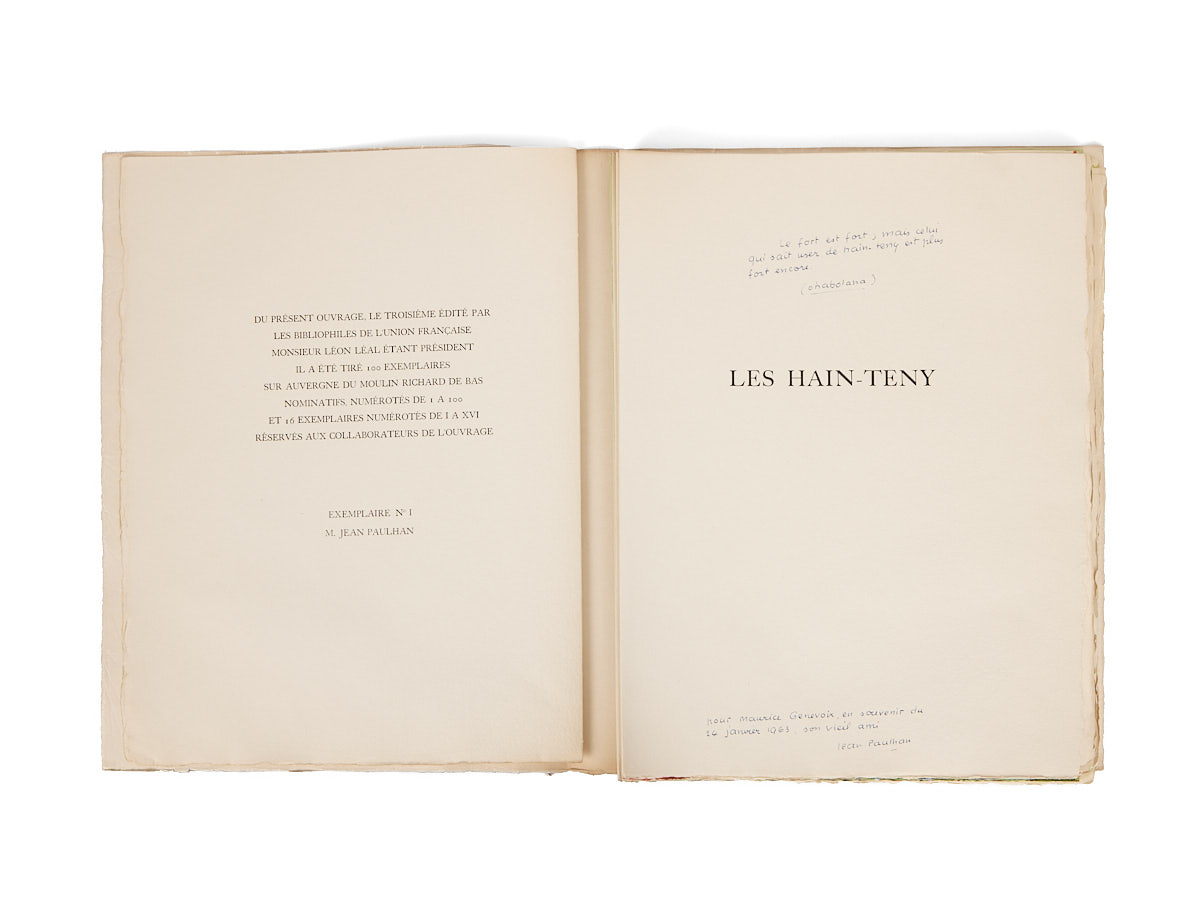
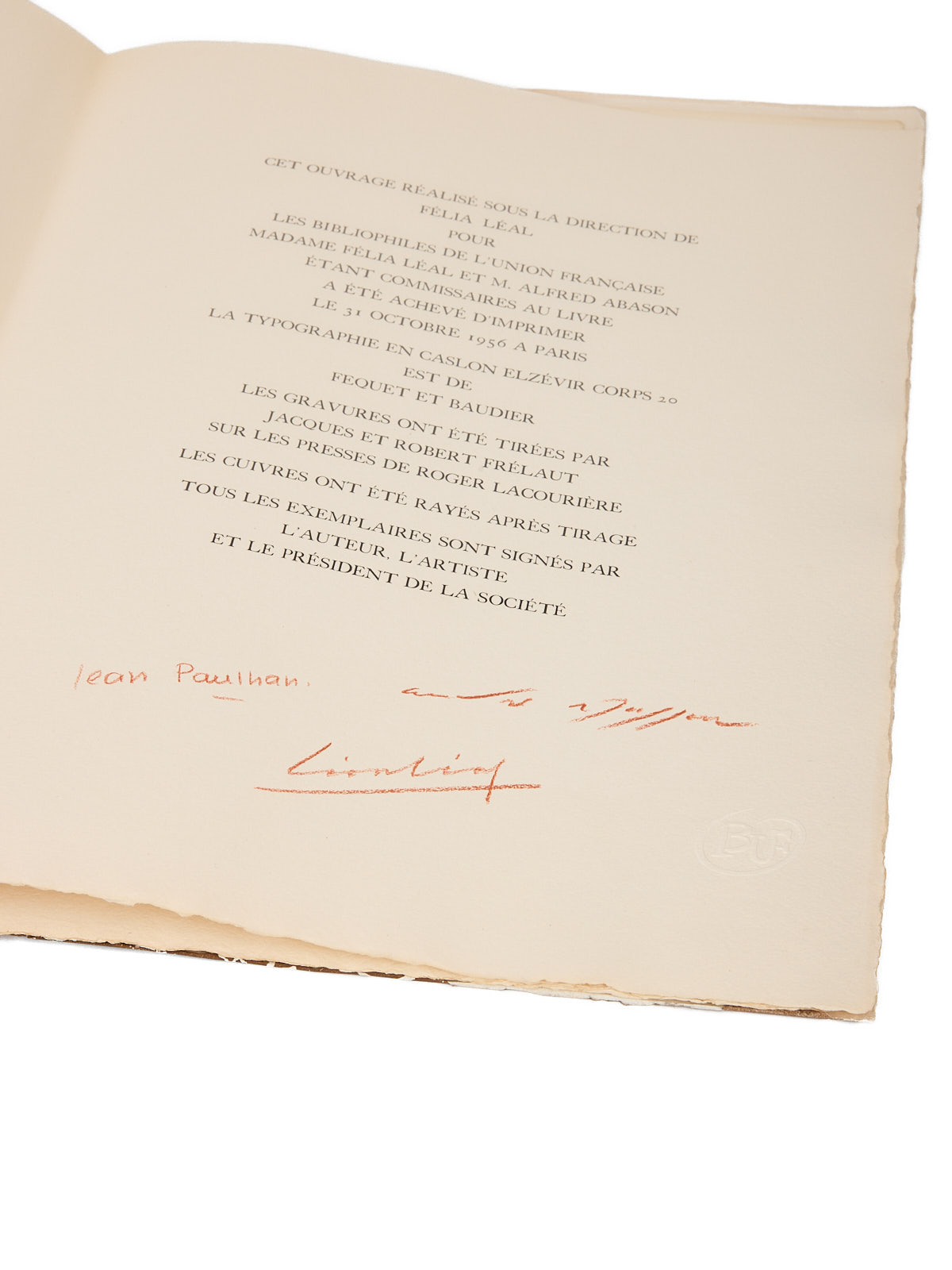
Limited to 116 numbered copies on Auvergne paper from the Moulin Richard de Bas (including 100 nominative copies and XVI reserved for the collaborators), signed by the author, the illustrator and Léon Léal, president of the Société des bibliophiles de l'Union française.
Copy no. I, the nominative copy for Jean Paulhan.
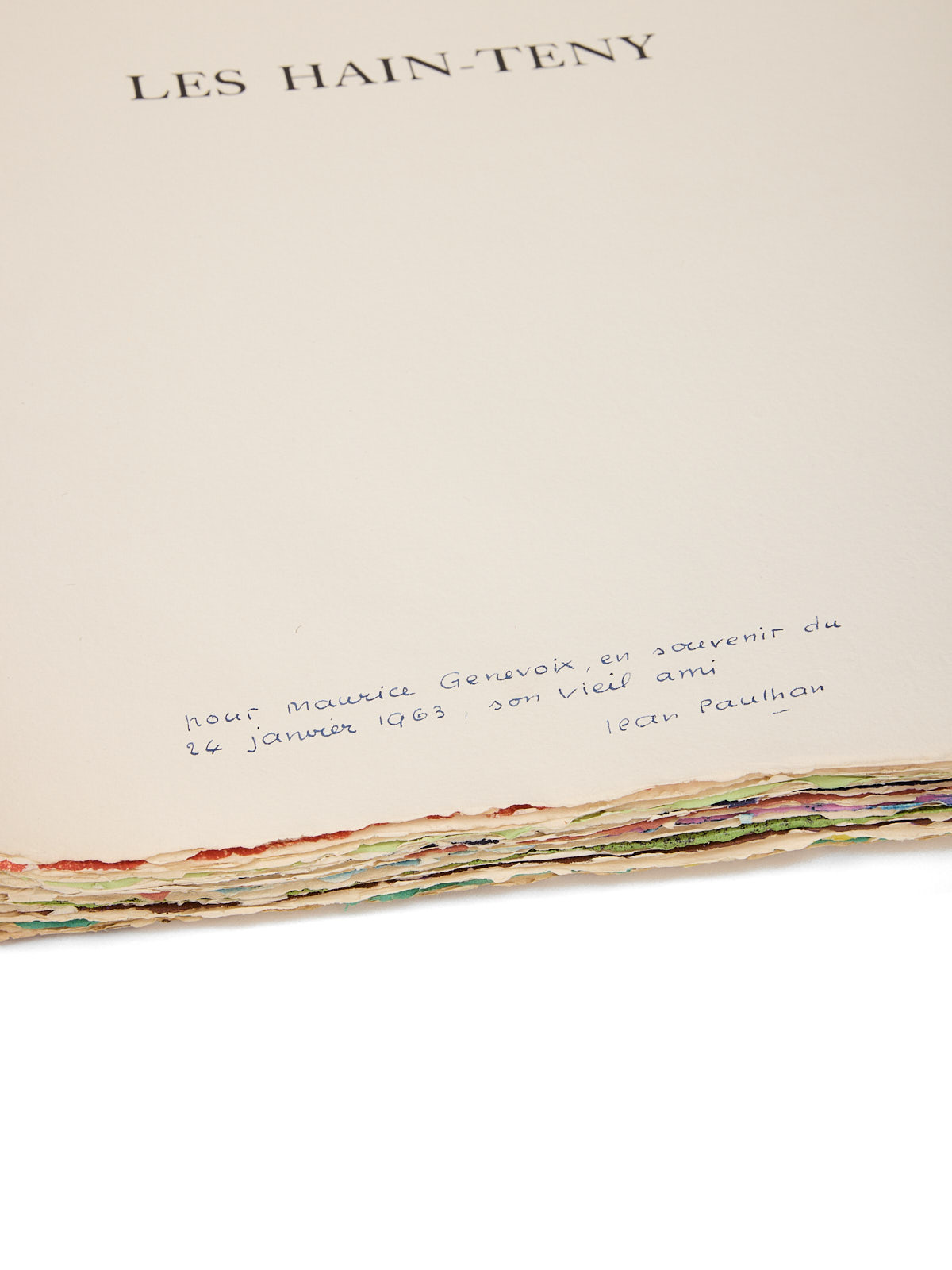
Signed presentation inscription: “Le fort est fort ; mais celui qui sait user de hain-teny est plus fort encore (ohabolana). Pour Maurice Genevoix, en souvenir du 24 janvier 1963, son vieil ami. Jean Paulhan.”
Three years spent in Madagascar led Jean Paulhan to collect hundreds of Malagasy proverbs, to classify them, catalogue them on index cards, and translate them: these are the hain-teny. A literary genre rooted in Madagascar’s oral tradition, drawn from an enigmatic and often erotic popular poetry used in friendly verbal jousts, the hain-teny also served a social function in resolving conflicts. Paulhan first introduced them in 1912, with an article, “Les hain-teny merinas,” published in the Journal asiatique (t. XIX, January–February 1912, pp. 133–162), and he would go on to produce two major editions, one with the orientalist publisher Paul Geuthner in 1913, the other with Gaston Gallimard in 1938–1939. The 1939 introduction is reproduced here for this illustrated edition, in which Paulhan refines his definition of the Hain-Teny: “It is a singular love that the Hain-Teny treat: neither the sensual, contemplative love of Arabic poetry, nor romantic passion, nor mere caprice. It brings to mind rather the jousts of courtly love. It is a quarrelsome, meticulous love, forever evoking some dispute that a proverb then resolves.” As was Paulhan’s habit, he prefaces his dedication with a maxim; here, an ohabolana (a Malagasy proverb).
Although Paulhan had reviewed Raboliot, winner of the 1925 Prix Goncourt, in La Nouvelle Revue française (t. XXVI, no. 148, January 1, 1926, pp. 121–122), the letters Maurice Genevoix sent him are only documented from 1960 onward. Their friendship was probably strengthened, if not born, through the Académie française. Genevoix was elected in 1946; Paulhan in 1963.
The dedication expressly refers to this moment, since January 24, 1963 is the date of Paulhan’s election to the Académie, to the seat of Pierre Benoit. He was received by Maurice Garçon on February 27, 1964. Among other contributions to the Académie française, Jean Paulhan wrote the entry “Jules Renard” for Gloires de la France, a volume by the forty members of the Académie française (Paris, Librairie académique Perrin, 1964), with a foreword by Genevoix, who had served as permanent secretary since 1958, a post he would hold for fifteen years, until 1973.
Paulhan’s gift to Genevoix of his own nominative copy, no. I, cannot have been an act without significance; it stands as a genuine tribute linking several worlds that might otherwise seem distant, if not incompatible. One may see in it the crossing of formative roots — the soil of Madagascar and that of the Nièvre — a shared reflection on language dear to both writers, and the mutual respect owed to their academic institution, shared by two men of the same generation (Paulhan born in 1884, Genevoix in 1890) who had both lived through two world wars and fought on the front in the first: one a sergeant in the 9th Zouaves, wounded in December 1914, the other a lieutenant in the 106th Infantry Regiment, wounded in 1915.
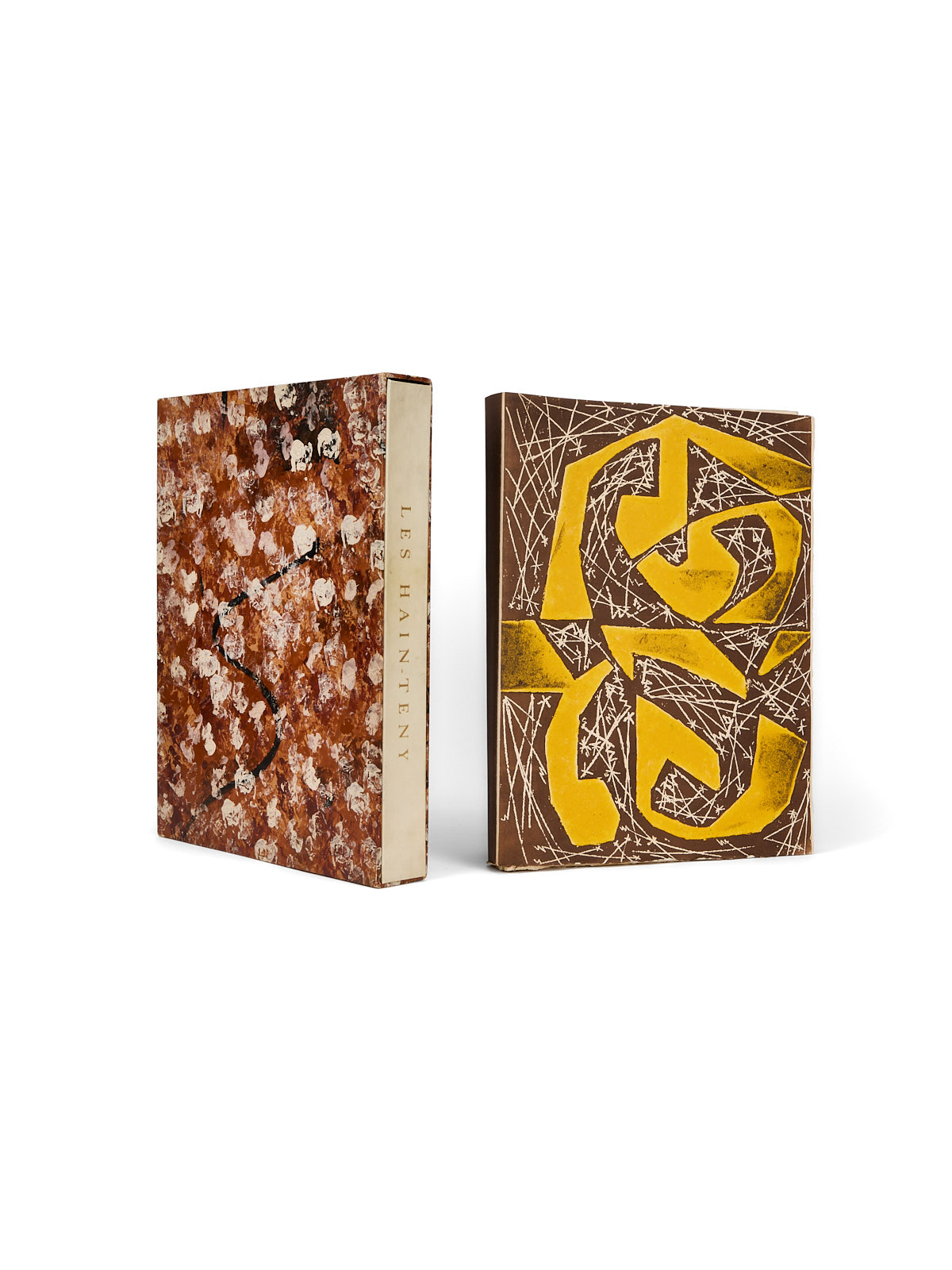
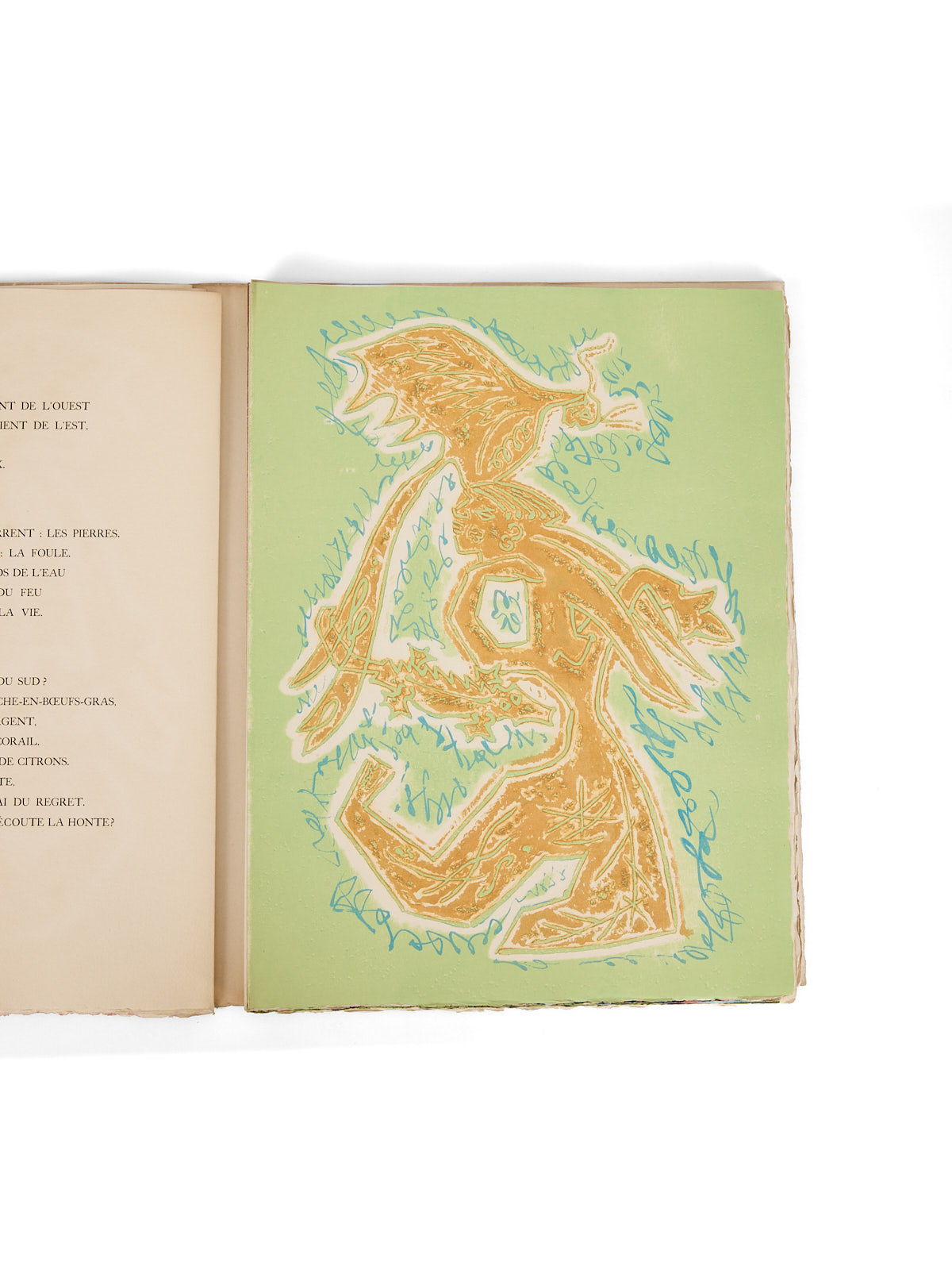
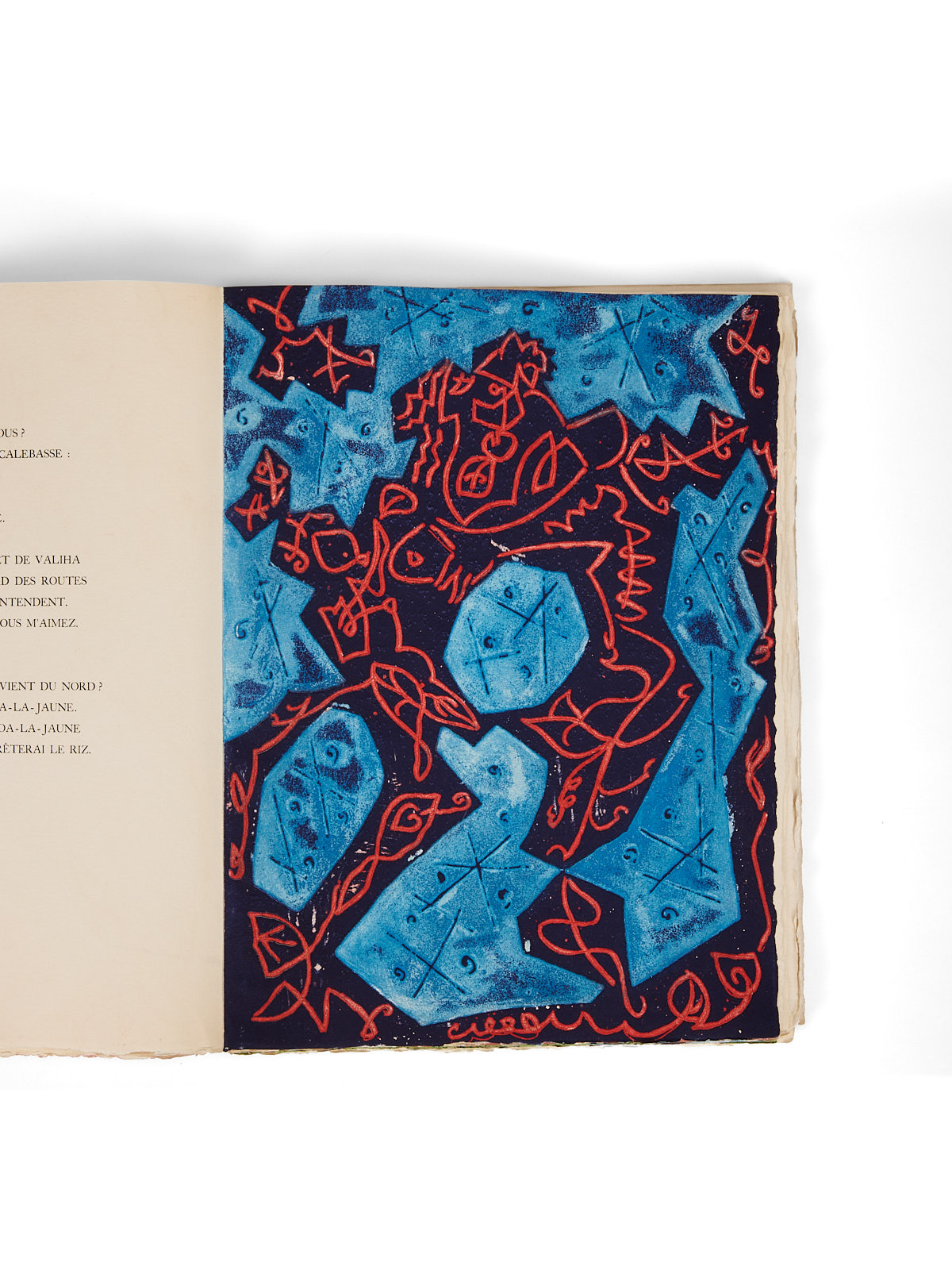
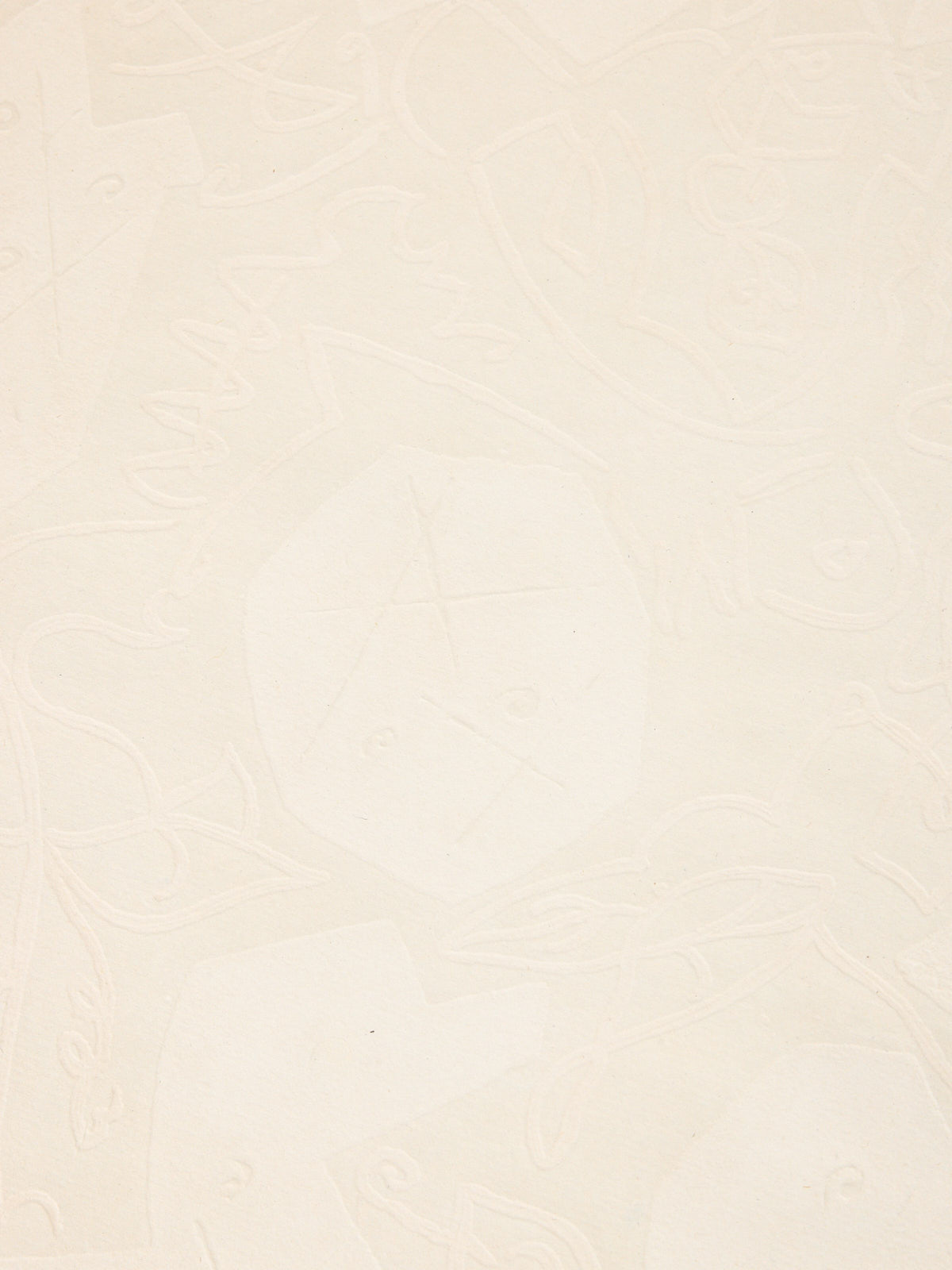
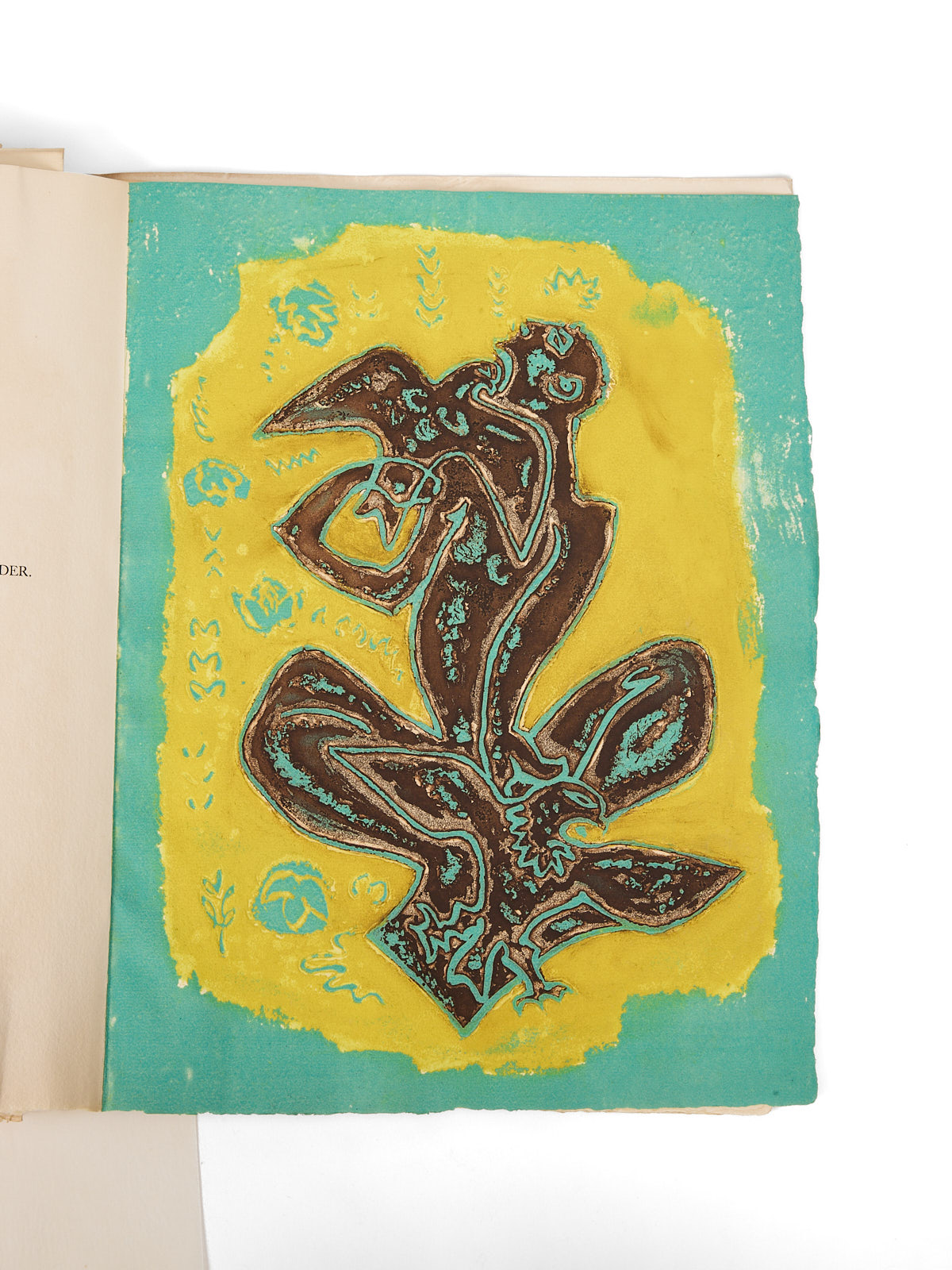
Nearly fifty years after they were first gathered, these “poems built on the framework of proverbs” reappear alongside images by André Masson, who had first worked them out in colored pencil. Jean Paulhan admired them and recognized real daring in their author. “[I am] touched and delighted that my polychrome engravings for the H.T. pleased you. But I must say that the daring you are kind enough to credit me with seems to come largely from the demands of the process — the requirements of the material. I am coming to believe that matter often makes use of the painter, just as the bow makes use of the archer, according to Zen doctrine,” the painter replied, in a letter dated January 16, 1957. Masson, moreover, painted the chemise and slipcase of each of the 116 copies individually, reinforcing the uniqueness of every set. Paulhan, never sparing in his praise, hailed this work: “the greatest French painter,” he wrote to various correspondents.
For the history of this book, see the numerous letters from Félia and Léon Léal to Jean Paulhan; Berne-Joffroy, Jean Paulhan à travers ses peintres, 1974, no. 426; Chapon, Le Peintre et le Livre, p. 165; Levaillant, André Masson, Royaumont, 1985, p. 18; Masson-Giraud-Badin, 67; Monod, 8907; Saphire-Cramer, no. 36; Bakoly Domenichini-Ramiaramanana, Du ohabolana au Hainteny, 1983; Bernard Baillaud, Les Écrits de Jean Paulhan, Bibliographie, Société des lecteurs de Jean Paulhan, 2025, p. 414.
We thank Bernard Baillaud for his bibliographical guidance and assistance, invaluable in the preparation of this entry.