

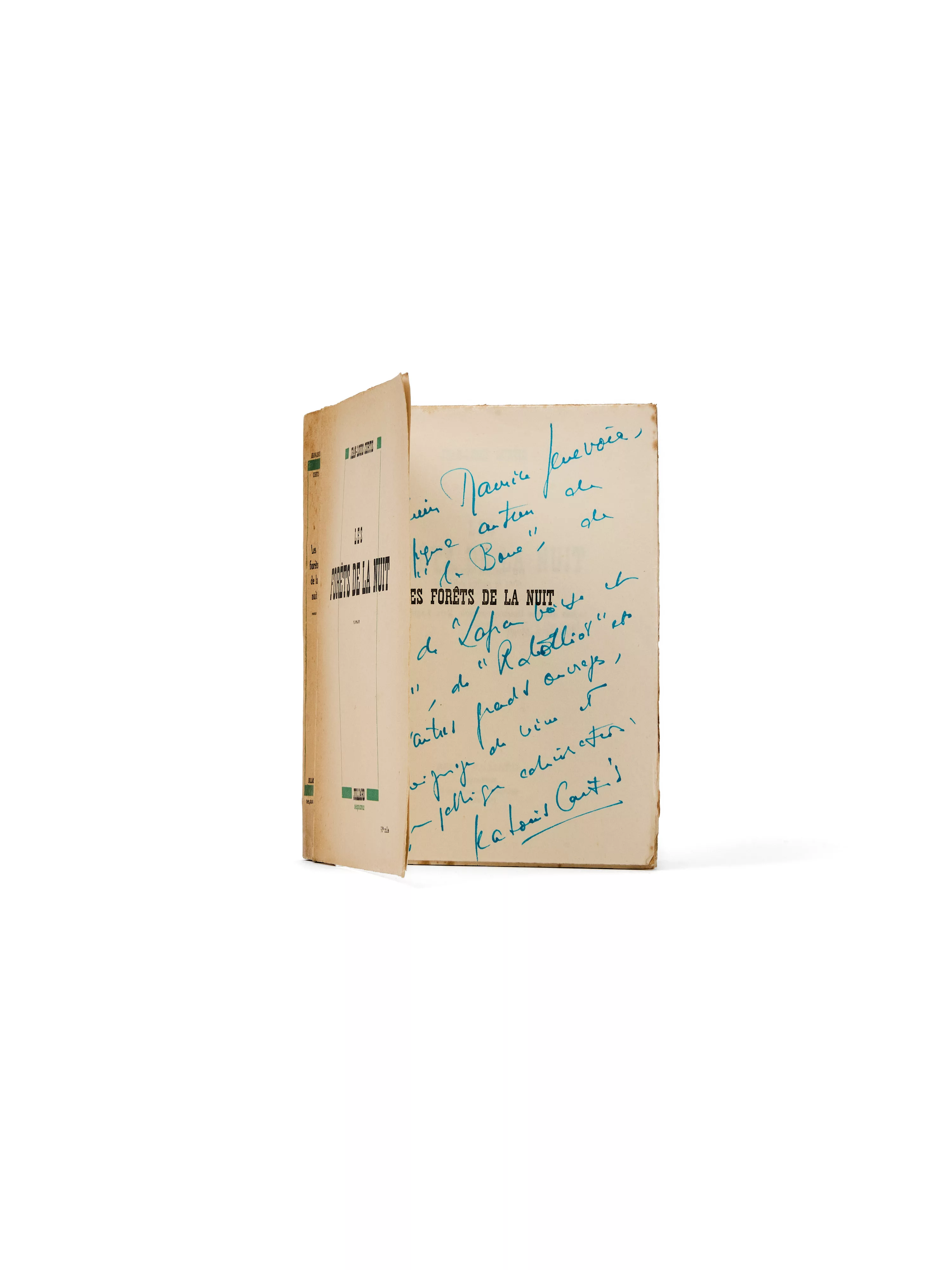
Les Forêts de la nuit
Presentation copy inscribed by Curtis to Maurice Genevoix:
“À Monsieur Maurice Genevoix, le magnifique auteur de ‘La Boue’, de ‘Rroû’, de ‘Laframboise et Bellehumeur’, de ‘Raboliot’ et de bien d'autres grands ouvrages, ce témoignage de vive et sympathique admiration, Jean-Louis Curtis.”
Jean-Louis Curtis (1917–1995), a young student at the École Normale Supérieure from Béarn, won the prize for his first novel, Les Forêts de la nuit, an account of the Occupation years. Blending Resistance fighters, collaborators and those who merely waited, the book stood out for its refusal of Manichaeism and its limpid style, which made a strong impression in the immediate postwar years and continues to resonate today: Michel Houellebecq pays tribute to Curtis in La Carte et le Territoire (Prix Goncourt 2010), citing two of his books, La France m’épuise and La Quarantaine, as very successful works.
The award of the prize to Curtis was also notable for its turbulent context. Sacha Guitry and René Benjamin, reinstated on the jury after their suspension, challenged the legitimacy of the Académie and created a rival prize, which Guitry dubbed “le prix Jules et le prix Edmond,” awarded to Haedens’s Salut au Kentucky. Only eight jurors took part in the official vote, which crowned Curtis. The dissident prize was awarded only once, in 1947: a lawsuit put an end to the venture, Benjamin died that same year, and Guitry eventually resigned.
This Goncourt also confirmed the triumph of René Julliard, publisher of the winning novel for the second year running after Gautier in 1946. Curtis went on to a lasting literary career, culminating in his election to the Académie française in 1986: he is one of the fourteen Prix Goncourt winners to have become members of the Académie française.