

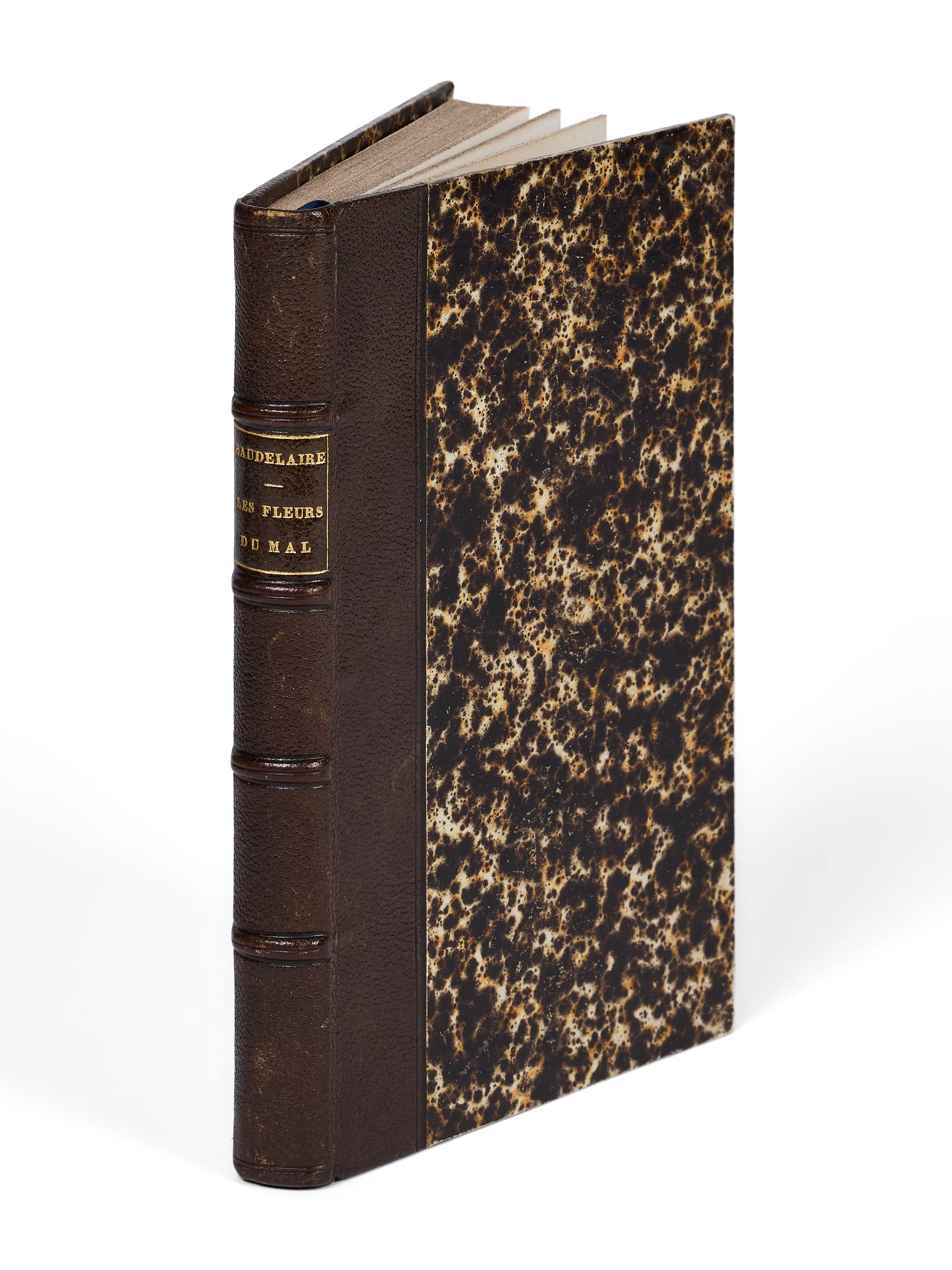
Les Fleurs du Mal
On the provenance:
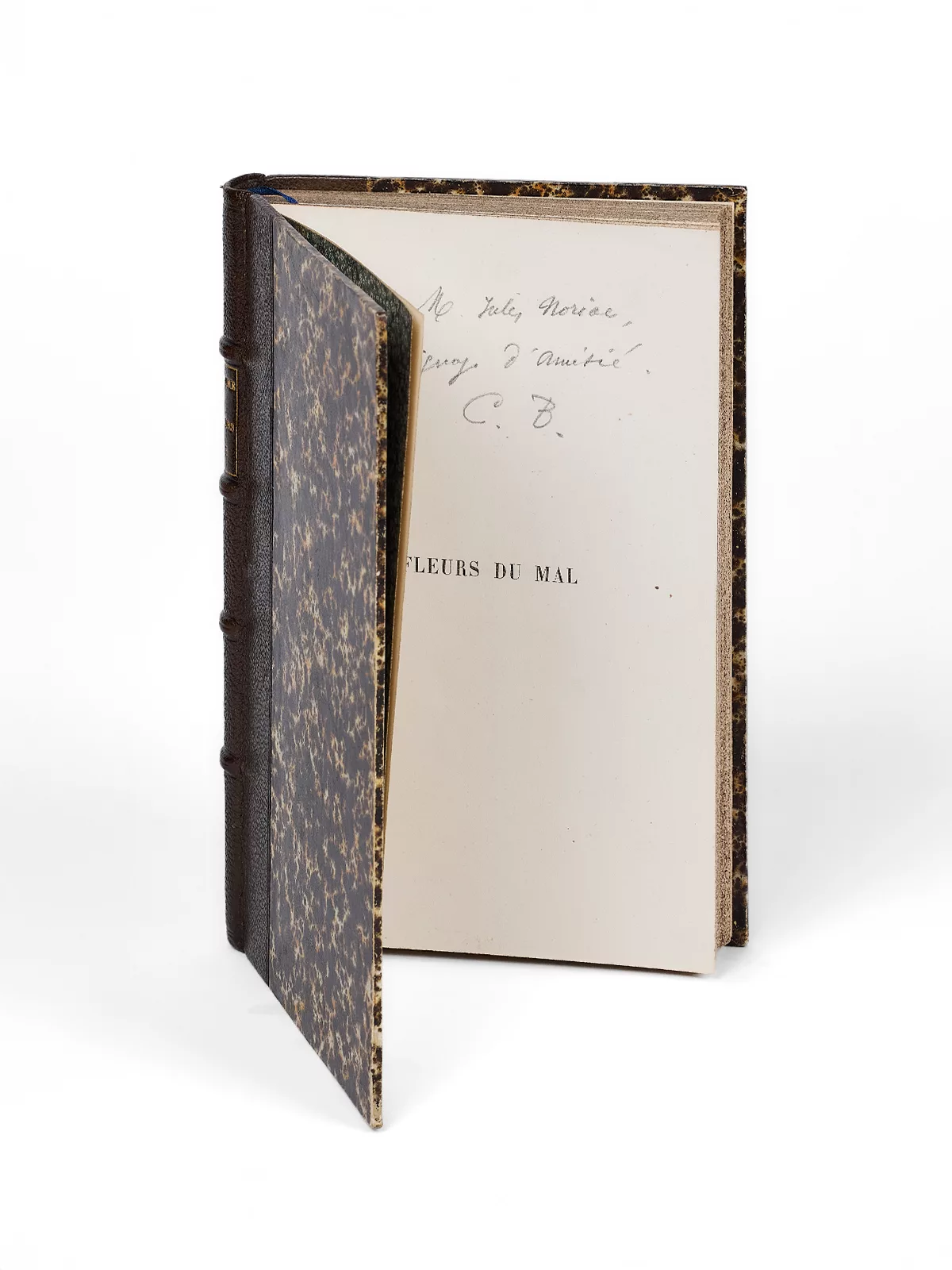
Jules Noriac was one of the driving forces behind La Revue fantaisiste, the most celebrated — and shortest-lived — journal of mid-nineteenth-century poetic avant-garde. It was his pen that opened the first issue: Catulle Mendès and Leconte de Lisle, the review’s two founders, entrusted Noriac with the editorial.
Baudelaire published nine poems in the review, among his best known, along with several of the portraits from his Réflexions sur quelques-uns de mes contemporains. His last contribution, in the final issue of November 1861, was a translation of Edgar Poe’s tale Eleonora.
In detail:
Jules Cayron — Noriac’s real name — had previously founded a theatrical periodical in Bordeaux, Les Coulisses. He published several light works: La Monographie du préjugé, Le Manuel du courriériste, and Le 101e Régiment, which made him famous. La Bêtise humaine confirmed his success in 1860 and reinforced the enthusiasm of literary youth for him. It was following this publication that Leconte de Lisle invited him to collaborate on his fledgling review.
“All the poets of the day came to La Revue fantaisiste… it counted among its contributors most of the celebrated journalists of the time, Jules Noriac, Charles Bataille, Charles Monselet and Aurélien Scholl, poets as well! Their presence among us was doubtless a sign of the future reconciliation between the newspaper article and poetry, between the chroniclers and the Parnassians” (La Légende du Parnasse contemporain).
Jules Noriac thus signed the editorial letter of the first issue (15 February 1861), the same issue in which Catulle Mendès discussed the performance of Wagner’s Tannhäuser in France and the publication of the composer’s works, coming very “à propos for the man and his work, so poorly judged until now.” Wagner wrote to Noriac on 24 March 1861, thanking him for the “encouragement he had received from the younger generation.”
Foremost among them was Charles Baudelaire, who had written to Wagner on 17 February a long letter expressing his admiration in words that have become famous: “I owe you the greatest musical pleasure I have ever experienced.”
Baudelaire’s Tannhäuser, published in the meantime, was noted in the sixth issue (1 May) of La Revue fantaisiste: “M. Ch. Baudelaire writes a vigorous and convinced defense of Richard Wagner and Tannhäuser.” From May onward, Baudelaire began an intensive collaboration with Mendès and Noriac, contributing numerous studies of his contemporaries that stand as true poetic manifestos: the Réflexions sur quelques-uns de mes contemporains (Eugène Delacroix, Pierre Dupont, Auguste Barbier, Leconte de Lisle, Léon Cladel, Théophile Gautier, Pétrus Borel, Victor Hugo), along with nine poems, including “Le Crépuscule du soir,” “L’Horloge,” “La Chevelure,” “L’Invitation au Voyage” and “Les Veuves.”
It was at this moment that Noriac — and everyone else — discovered in the review’s pages the masterpieces added to Les Fleurs du mal. La Revue fantaisiste positioned itself as their standard-bearer, drawing a line between two kinds of poets — the avant-garde and the rest, the former mostly published by Poulet-Malassis, their regular publisher. Thirty years later, a new battle of Hernani would rage between ancients and moderns. Before the next one: “Twenty-five years later, another review, La Vogue, led by a new generation, would close out this modernity begun and claimed by La Revue fantaisiste. Poetic modernity of the late nineteenth century in France is embodied in these two reviews. Each one revolves around a central figure: Baudelaire on one side, Rimbaud (who called Baudelaire the “true god”) on the other” (Jean-Baptiste de Proyart, in Notice for La Revue fantaisiste).
Les Fleurs du mal:
It was precisely in the midst of the “Wagner tumult,” and at the moment of the birth of La Revue fantaisiste, that Les Fleurs du mal appeared, in the first week of February.
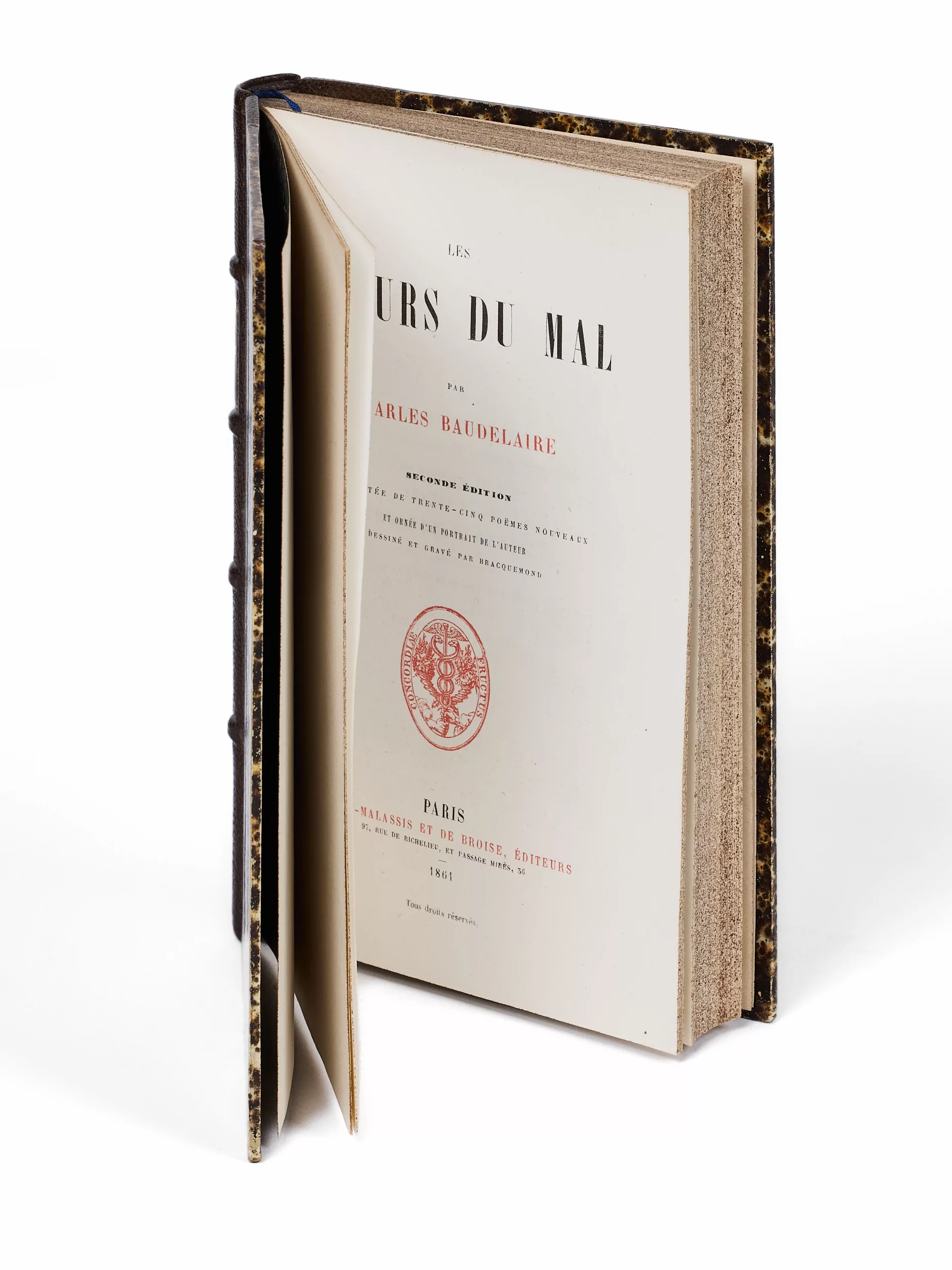
Far more than a second edition, this version of Les Fleurs du mal is the culmination of Baudelaire’s major work and the only version retained by literary history.
For four years, Baudelaire had worked intensively on his major collection. He initially thought simply to replace the six poems suppressed by censorship, but as early as November 1858 he informed Poulet-Malassis that “instead of six flowers, I will make twenty.” This marked the beginning of a complete rewriting and recomposition of the collection, which changed considerably: thirty-five new poems were added — some among the most important.
1,500 copies of this edition were printed (400 more than the first edition of 1857). One may assume that roughly the same number received an inscription — perhaps fewer, 50 to 70 copies being a commonly accepted figure.
Fifty-five copies of the first edition of Les Fleurs du mal with a documented inscription are known today, all in black ink except for a few in black pencil — the latter because they were inscribed later, as with the copy given to the lawyer Chaix d’Est-Ange, or the one given to Bracquemond, whose inscription is followed by this note from the poet: “The second edition, ‘completely reworked,’ contains more than 35 new poems. This first edition therefore has no other merit than containing 6 poems condemned by judgment of 20 August [sic] 1857.”
This Bracquemond copy, bound at the time by Lortic, was given by Baudelaire during his stay at the Hôtel de Dieppe, where he had to sit for the engraver, who was working on the frontispiece portrait for the forthcoming edition, after an initial refusal by the poet: “Bracquemond had already produced an allegorical image (a skeleton-tree behind flowers), which Baudelaire rejected, calling it ‘Bracquemond’s horror’” (Claude Pichois and Jean Ziegler, Baudelaire, Fayard, 2005, p. 534).
It was therefore a very simple portrait of the author, made after Nadar’s photographic portrait and improved after this sitting, that was drawn and then etched by Auguste Delâtre.
Once printed, Auguste Poulet-Malassis was able to publish Les Fleurs du mal in the first week of February 1861.
Inscribed copies of the 1861 edition of Les Fleurs du mal:
How many inscribed copies of the 1861 edition exist? No official census has been made, so their number can only be estimated. Our archives, kept over some fifteen years, record 28 copies. There must obviously be many more — probably as many as for the 1857 edition. Even so, the archives show that Poulet-Malassis wished to curb Baudelaire’s enthusiasm for an expanded press run. It is not impossible that considerably fewer inscriptions were made for the second edition of Les Fleurs du mal. The current census points in that direction.
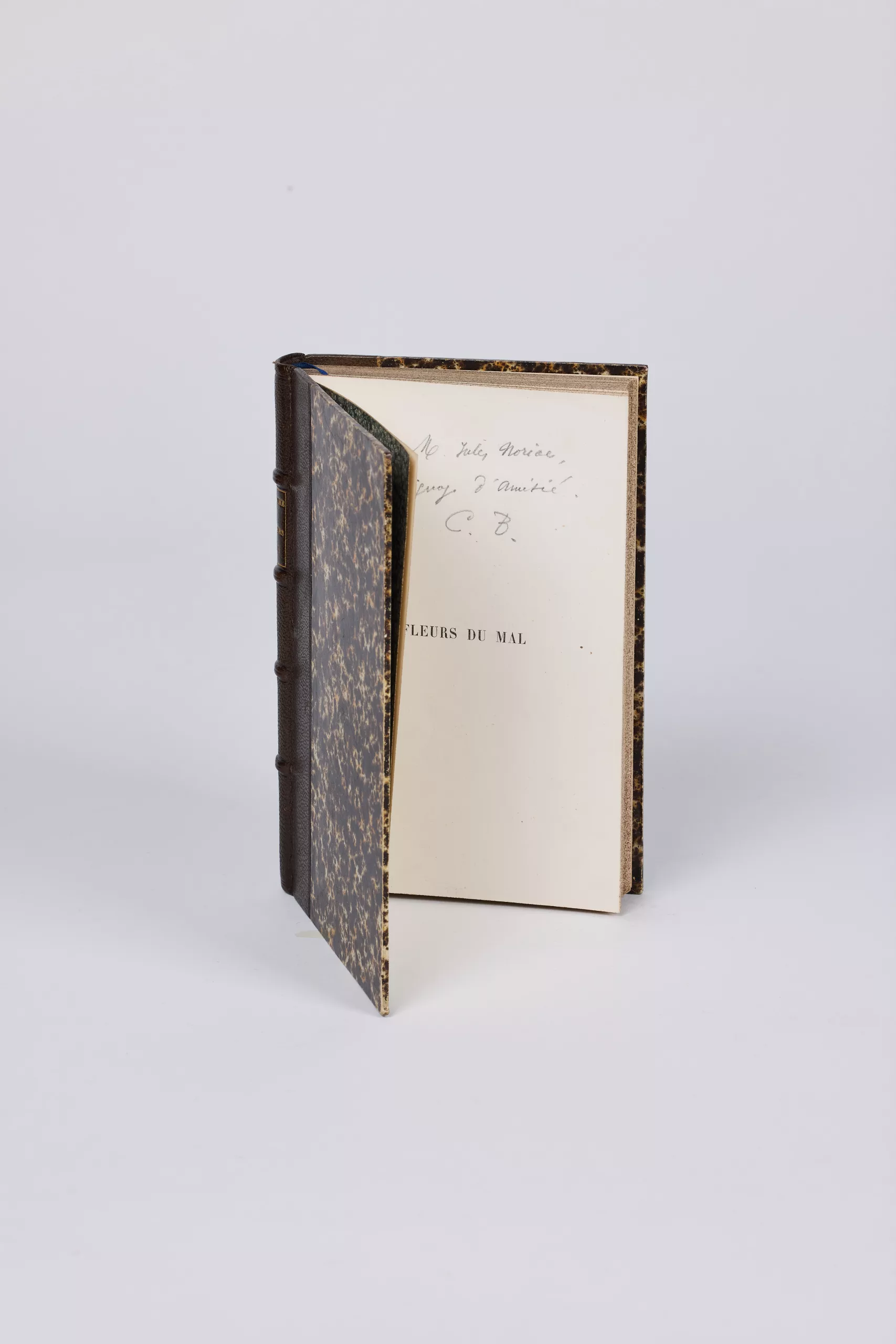
The Jules Noriac copy was previously unknown to us and does not appear in any archive of copies offered on the market, until its recent discovery.
Of the 28 copies we have recorded, only 8 are in contemporary bindings. Ours, in half brown morocco, unsigned, is of good quality. It was probably commissioned by Jules Noriac as soon as the volume appeared and was inscribed by Baudelaire. It is certainly its first — and only — binding. The interior leaves are very fresh, with a solidly constructed textblock.
Only a handful of recipients (fewer than ten) appear to have received copies of both editions: “Besides Paul de Saint-Victor, we may mention that Marie Daubrun, Théodore de Banville, Leconte de Lisle, Victor Hugo, Edmond Texier, Frédéric Dulamon and Auguste Préault were perhaps the only recipients who received an inscribed copy of both first editions, the other recipients of the second edition apparently being different. As for the text of the inscriptions themselves, we will not comment on it, merely noting that it is almost always very restrained, and that Baudelaire seems fond of the formula ‘témoignage d’amitié’” (Goujon and Bogousslavsky).
Baudelaire had indeed given his publisher a long “distribution list” for his book: about forty names to whom the poet wished to send it. But Auguste Poulet-Malassis, understandably more attentive to financial matters, proposed to scale back the author’s wishes, opposing new deluxe-paper printings or refusing several complimentary copies with a view to obtaining articles in return: “useless,” “useless, unless he promises.”
This list of dedicatees, sold at auction (in Collection Baudelaire, Osenat, November 2018, lot 16), concerns only the “minor figures” to whom the poet wished, for editorial strategy reasons, to send his book. Jules Noriac does not appear on it: proof of the close relationship between the two men, since this list contains only “professional” mailings and none to close friends and important acquaintances, who were the subject of a separate and much shorter list.
This closeness is confirmed in another “Distribution list for my books,” drawn up shortly before his candidacy for the Académie française, in which Charles Baudelaire gives about a hundred names classified under three headings: “Académie,” “Amis,” “Presse.” Jules Noriac appears there, included in the second section, that of his “friends,” alongside Champfleury, Flaubert, Leconte de Lisle, Rouland, Manet, Daumier, Gavarni, Nadar, Rops and Hetzel.
Among the various draft prefaces for his collection, later abandoned, Baudelaire wrote: “If there is some glory in not being understood, or in being understood only very little, I may say without boasting that, through this small book, I have acquired and deserved it all at once. Offered several times in succession to various publishers who rejected it with horror, prosecuted and mutilated in 1857 as the result of a most bizarre misunderstanding, slowly rejuvenated, expanded and strengthened over some years of silence, then disappeared once more through my own carelessness, this discordant product of the Muse of the last days […] dares today to face […] the sun of foolishness.”