

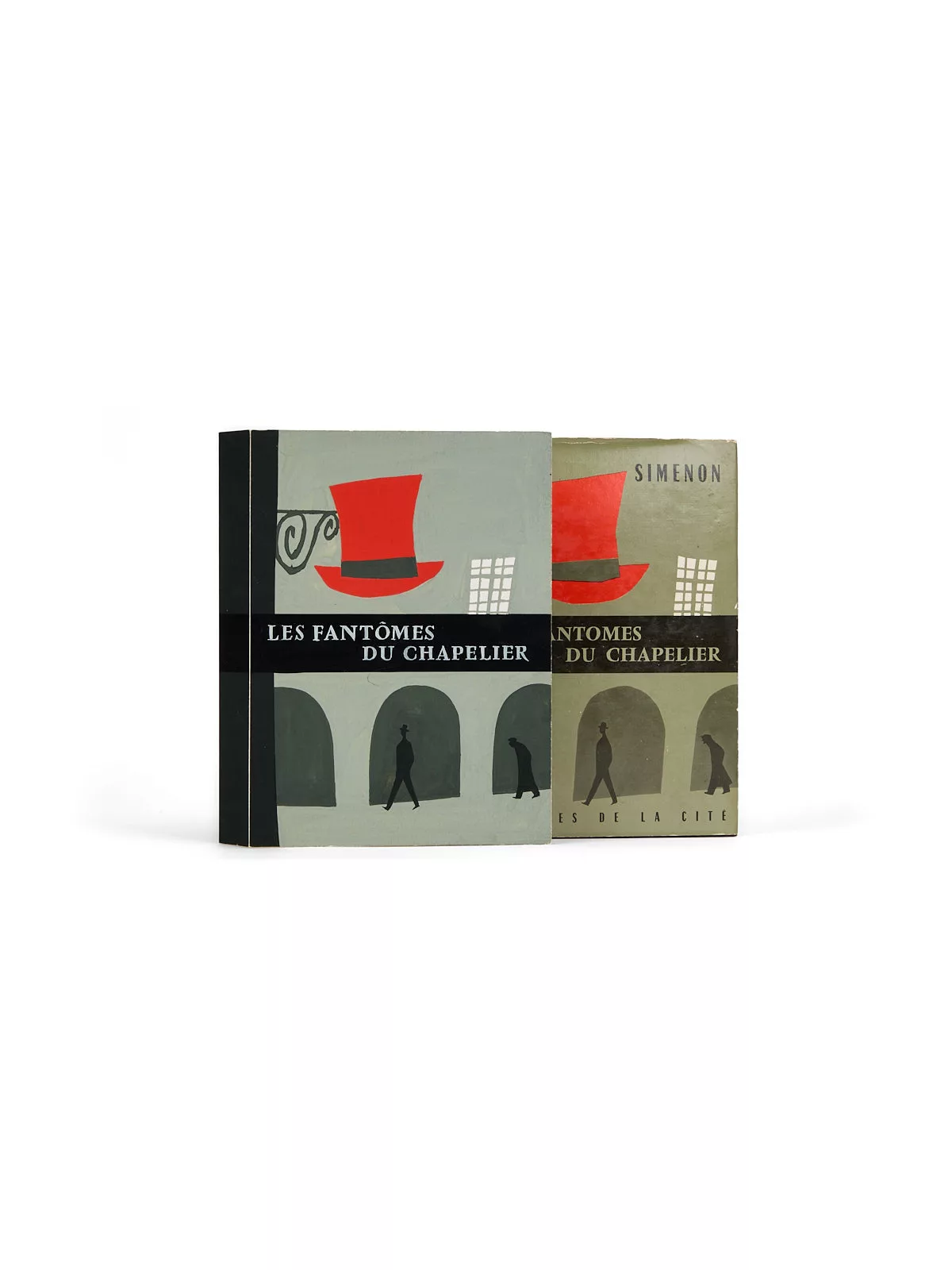
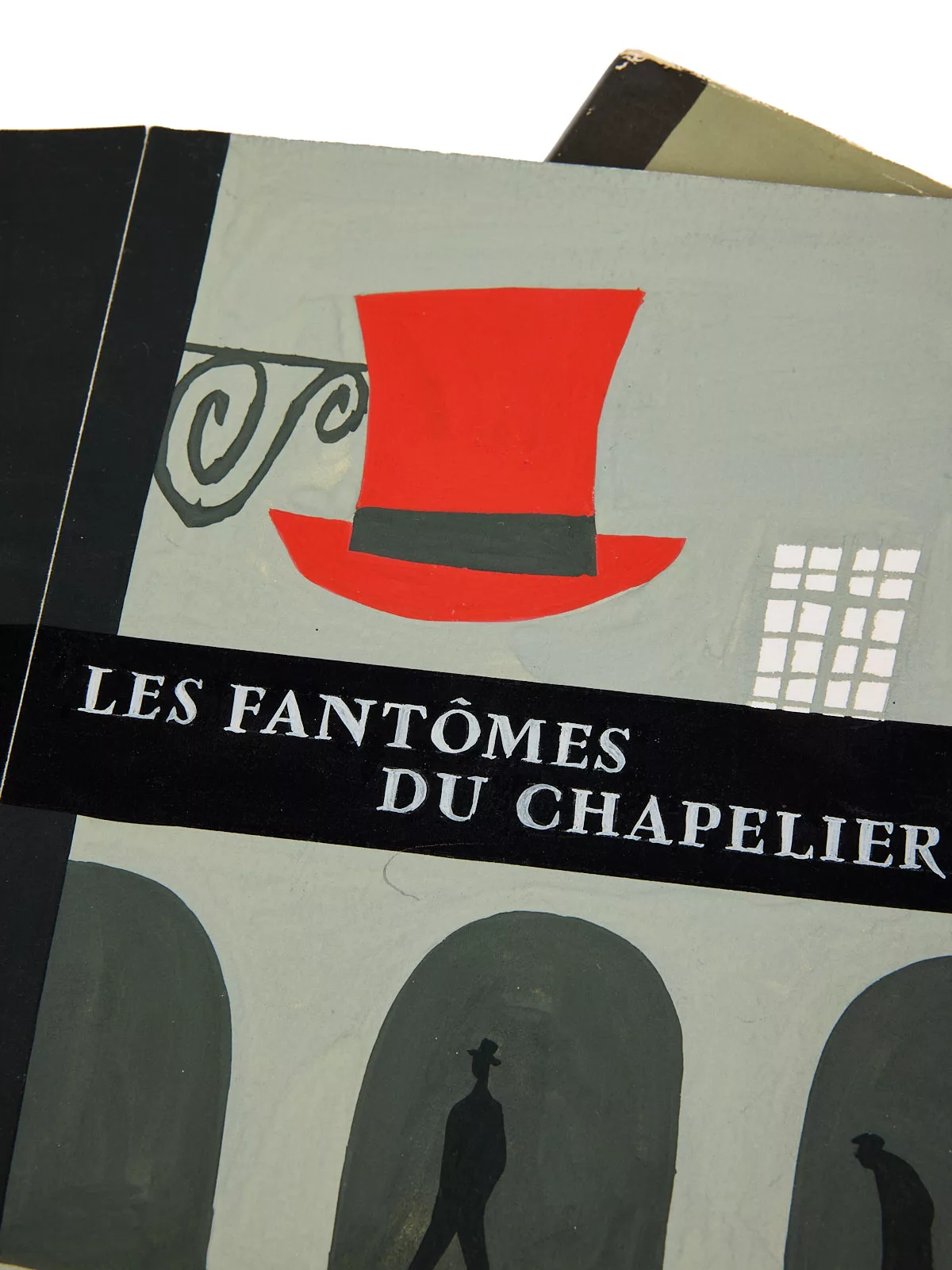
« Les Fantômes du chapelier »
It bears a manuscript note on the verso, “oui,” in Simenon's hand, thus approving the illustrator's proposal.
In March 1947, Simenon wrote a short story entitled “Le petit tailleur et le chapelier,” which would not be published until 1950 (in the collection Maigret et les Petits Cochons sans queue). At the end of the following year, he revised the story’s ending and produced a new text, “Bénis soient les humbles”; in its English version this story was awarded “best crime story of the year” by Ellery Queen magazine. In December, Simenon decided to draw on both texts to write a longer novel, which he completed on 11 December 1948 in Tumacacori, Arizona.
The book — one of Simenon’s “romans durs” — was published by Presses de la Cité in 1949, with a new printing in 1961 for the publisher’s hardback series. Between 1957 and 1962, Jean Jacquelin illustrated the 27 dust jackets designed to replace the photographic covers that had until then adorned Simenon’s novels.
By this date, Jacquelin was already a well-known poster artist. A major exhibition was devoted to him in 1993 at the Bibliothèque Forney, accompanied by a richly illustrated catalogue (Jean Jacquelin affichiste et dessinateur publicitaire). His work at Presses de la Cité, undertaken at the instigation of director Sven Nielsen, was carried out in collaboration with Simenon, who would approve — or not — each design, sometimes suggesting ideas of his own. Several of the artworks are annotated by Simenon on the verso, as is the case here.
Simenon met Sven Nielsen, owner of the Messageries du Livre and an aspiring publisher, in the spring of 1945. It marked the beginning of a long and solid friendship: Simenon would publish with Presses de la Cité for the following thirty-six years. In contrast to the sober Gallimard covers, Nielsen chose to illustrate the novels of “his” author with color dust jackets. First drawn, then from 1953 photographic, and then, beginning with Le Fils (1957), a return to publisher’s boards covered with a color illustrated dust jacket bearing a stylized motif or figure. This entire new series was executed by Jean Jacquelin until 1962, comprising twenty-seven titles:
Le Fils (1957, cover for the first edition); Le Nègre (1957, cover for the first edition); Strip-tease (1958, cover for the first edition); En cas de malheur (1958, cover for a reprint); L’Escalier de fer (1958, cover for a reprint); Dimanche (1958, cover for the first edition); Le Président (1958, cover for the first edition); Le Passage de la ligne (1958, cover for the first edition); La neige était sale (1959, cover for a reprint); Les témoins (1959, cover for a reprint); Le Veuf (1959, cover for the first edition); La Vieille (1959, cover for the first edition); Les volets verts (1959, cover for a reprint); Une vie comme neuve (1960, cover for a reprint); Trois chambres à Manhattan (1960, cover for a reprint); Les complices (1960, cover for a reprint); L’Ours en peluche (1960, cover for the first edition); Le temps d’Anaïs (1960, cover for a reprint); Lettre à mon juge (1960, cover for a reprint); La Mort de Belle (1960, cover for a reprint); Feux rouges (1961, cover for a reprint); Je me souviens (1961, cover for a reprint); Betty (1961, cover for the first edition); Le Train (1961, cover for the first edition); Les Fantômes du chapelier (1961, cover for a reprint); La Porte (1962, cover for the first edition); Les Autres (1962, cover for the first edition).
Accompanied by the book edition, with its dust jacket. This copy comes from the personal archives of the illustrator, Jean Jacquelin, with the estate stamp.