

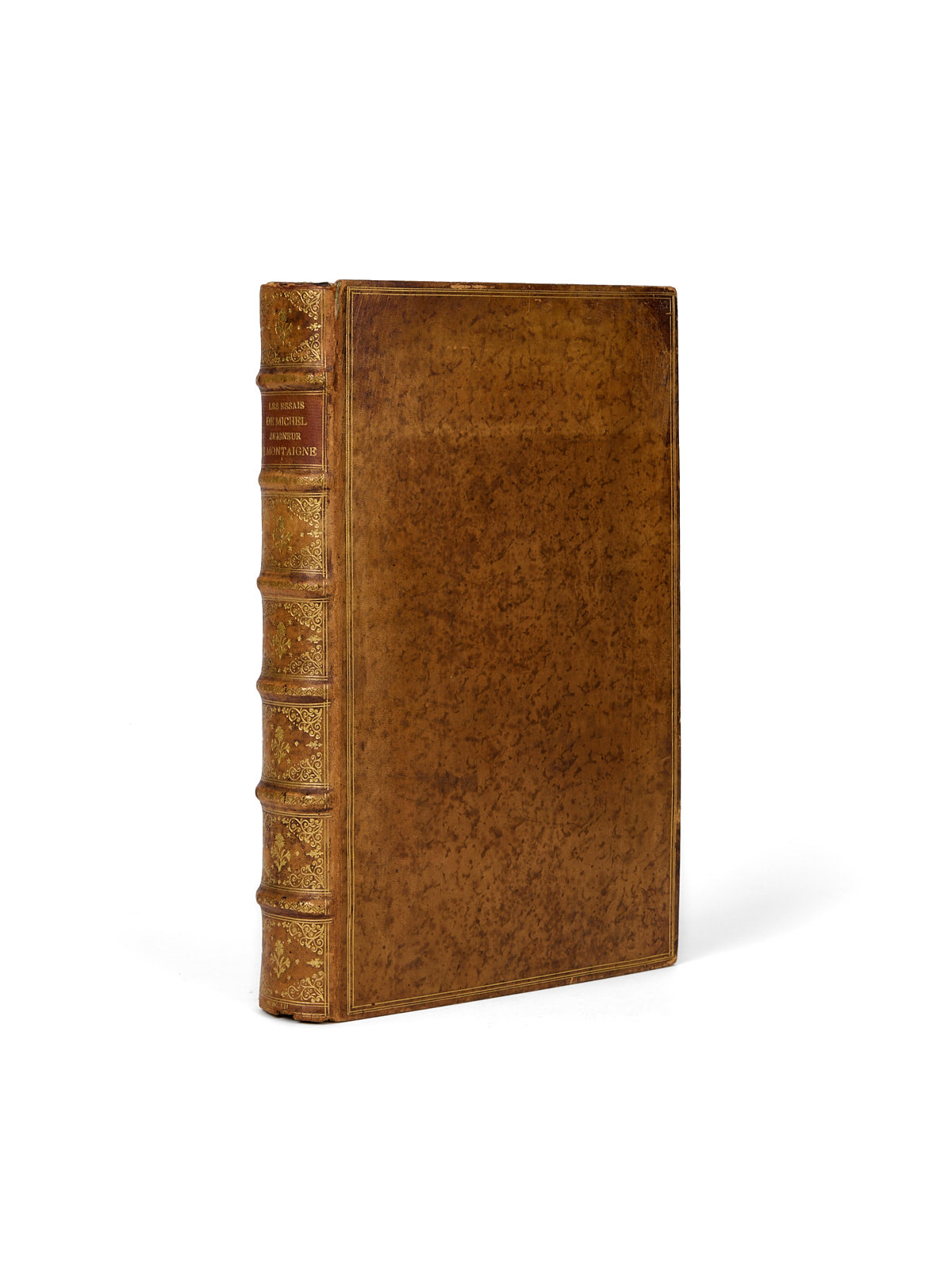
Les Essais
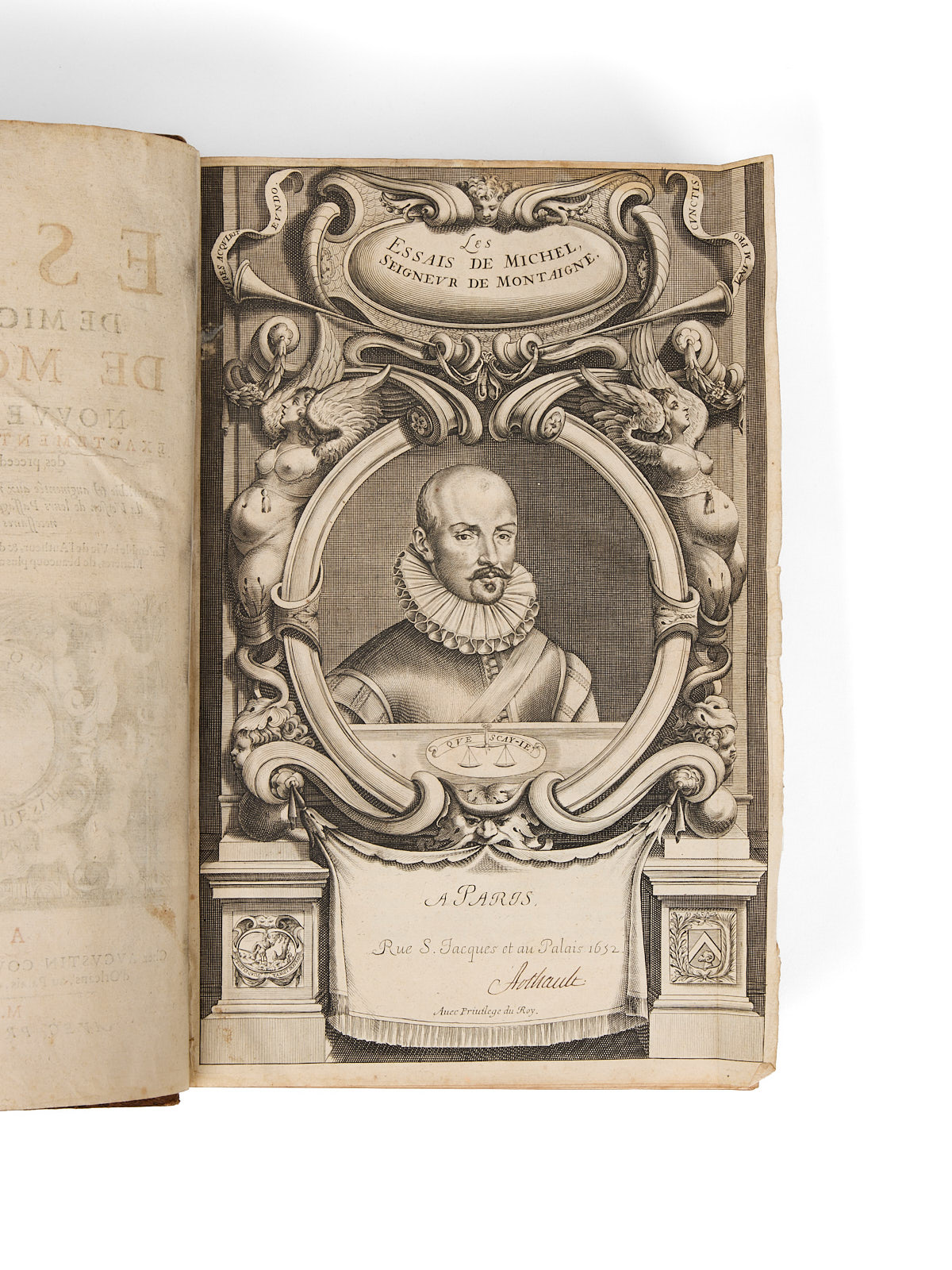
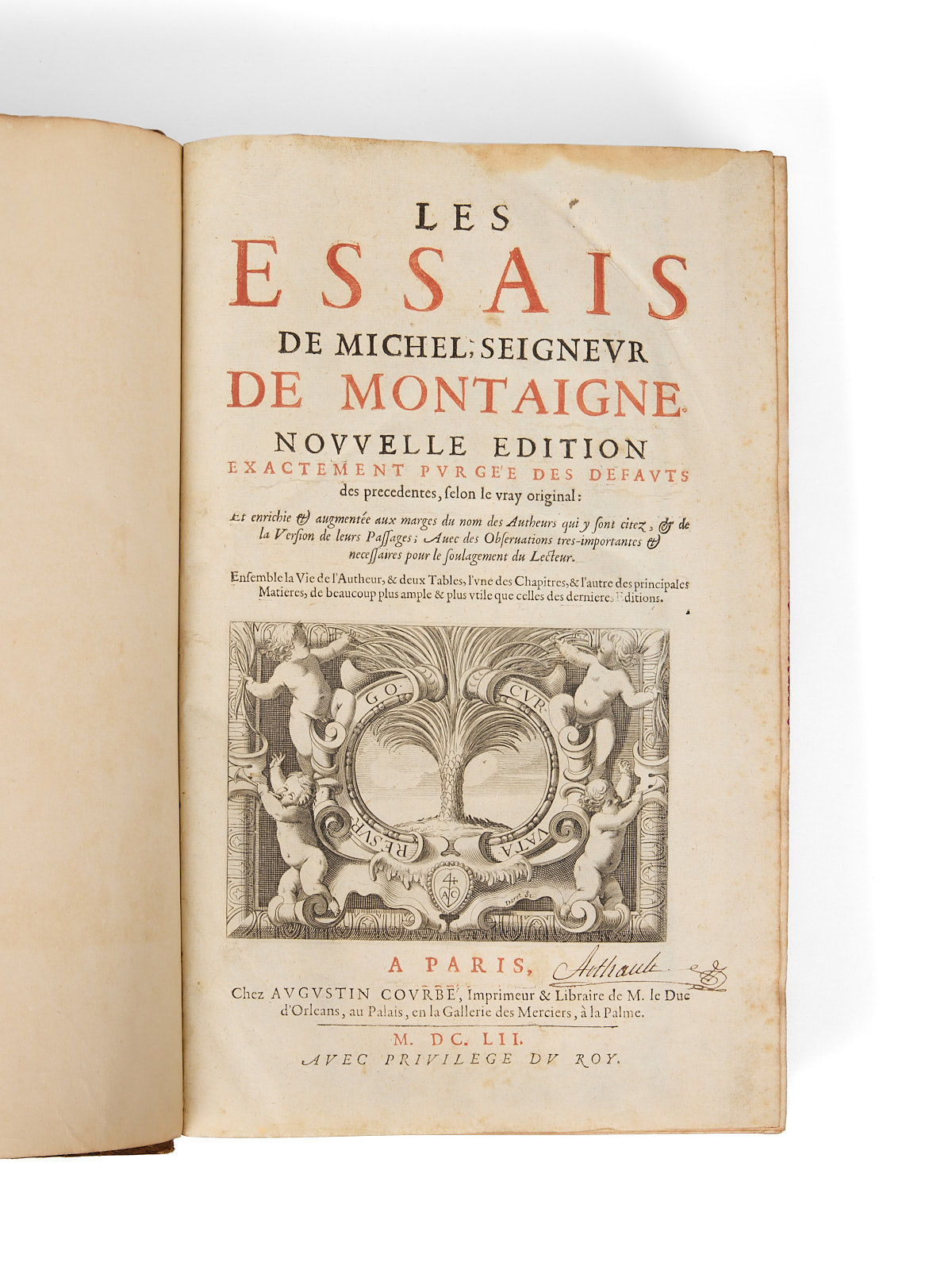
Manuscript ownership inscription on the title page of [François] Arthault, civil and criminal lieutenant — the highest magisterial office under the Ancien Régime — at the bailliage of Avallon, in Burgundy. While the office was split into two separate charges in Paris, it was commonly combined in the provincial towns. This royally appointed magistrate presided over all civil and criminal matters within his bailliage, the equivalent of a modern administrative district.
A striking provenance from a high-ranking magistrate, made all the more piquant by its modern provenance: that of Georges Simenon.
“It may come as a surprise to learn that, from the age of sixteen, my bedside book was Montaigne, a few pages of whom I would read before falling asleep. […] After that I had two other bedside books: the Bible, and then the Gospels, even though I was — and still am — what one calls an unbeliever […]” (in Dictées, Un banc au soleil). Two other formative readings would follow: Gide’s Journal and Stendhal; Simenon confirmed these four “foundational” readings in a long interview given in 1967 to Michel Polac (ORTF, INA archives).
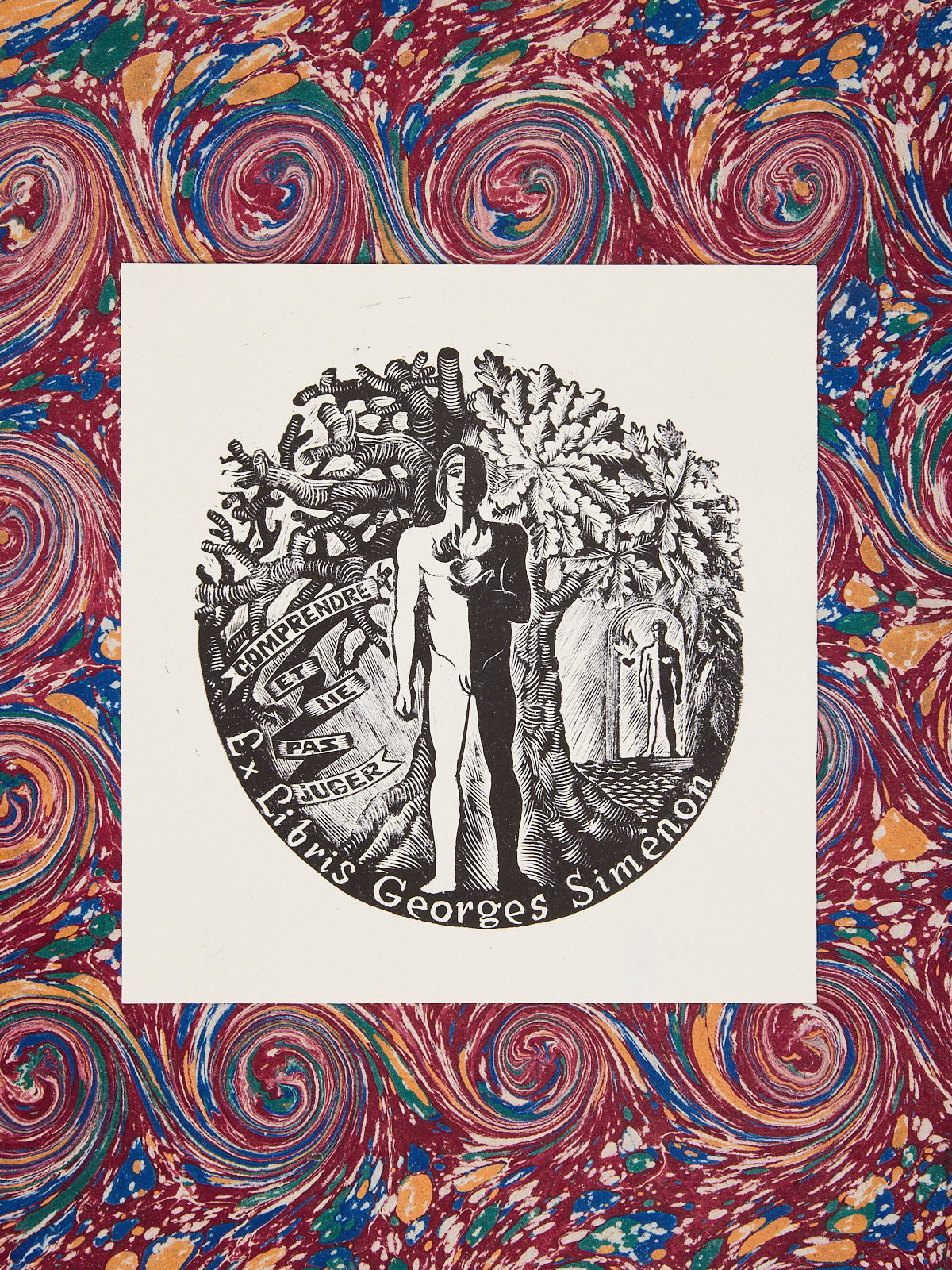
He confirmed this reference again in an interview with Raphaëlle Sorin in November 1981: “I began these Mémoires on 16 February 1980, for my daughter. I wrote eight hours a day, sitting at the little desk over there. Shut up in my memories, without notes. In the evening, from having my legs bent for so long, I could barely walk […]. I have always admired Montaigne who, during the siege of his city, Bordeaux, was only concerned with his kidney stone illness. He suffered from it and said so. I had written Pedigree, in 1941, because a doctor gave me only two years to live. These Mémoires intimes are the ‘Pedigree’ of my daughter, of her mother, and of her three brothers.” From Montaigne, Simenon borrowed the idea of painting “naked man” as he truly is, hence the maxim summarizing his detective’s working method: “understand and do not judge.” Pierre Assouline recalls this anecdote: “Do you see that waitress attending to the customers in this restaurant? She’s apparently the owner’s daughter, or maybe not! And there begins the Simenon novel: with doubt!” “But while he questions people and their reality, trying to understand them, he never allows himself to pass judgment. He even made his motto, ‘Understand and do not judge,’ the bookplate of all his books.” (in Le Monde, 21 August 2024).
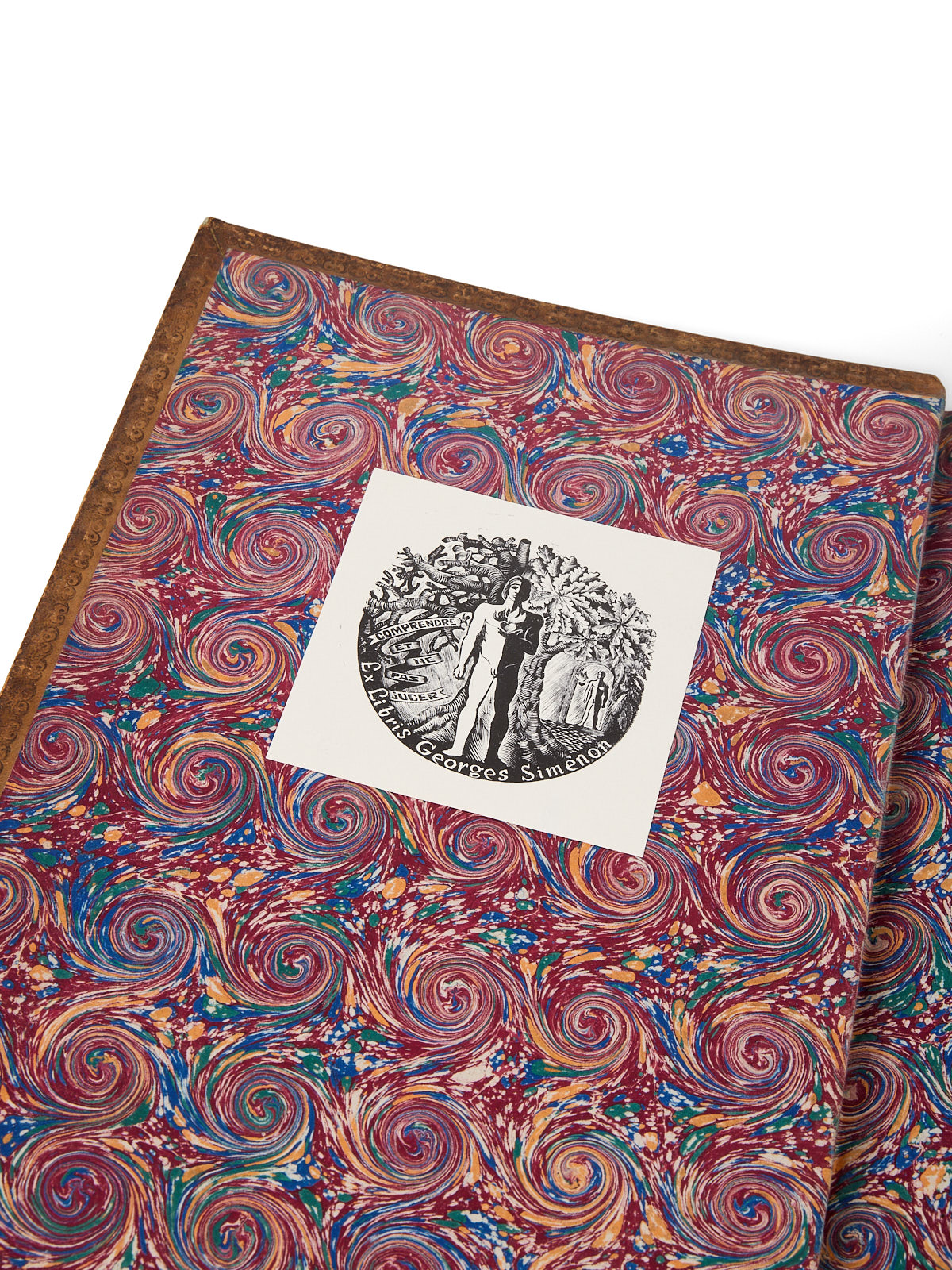
On this point, Pierre Assouline moves a little too quickly: while this formula did indeed adorn a bookplate designed in the 1960s by the Russian engraver Victor Chapil (whose original woodblock is preserved at the Fonds Simenon in Liège, Belgium), first reproduced in Mathieu Rutten’s Simenon (1986), Georges Simenon never truly made it his own. It appears on a few copies, though it is unclear whether by his own initiative or a later hand.
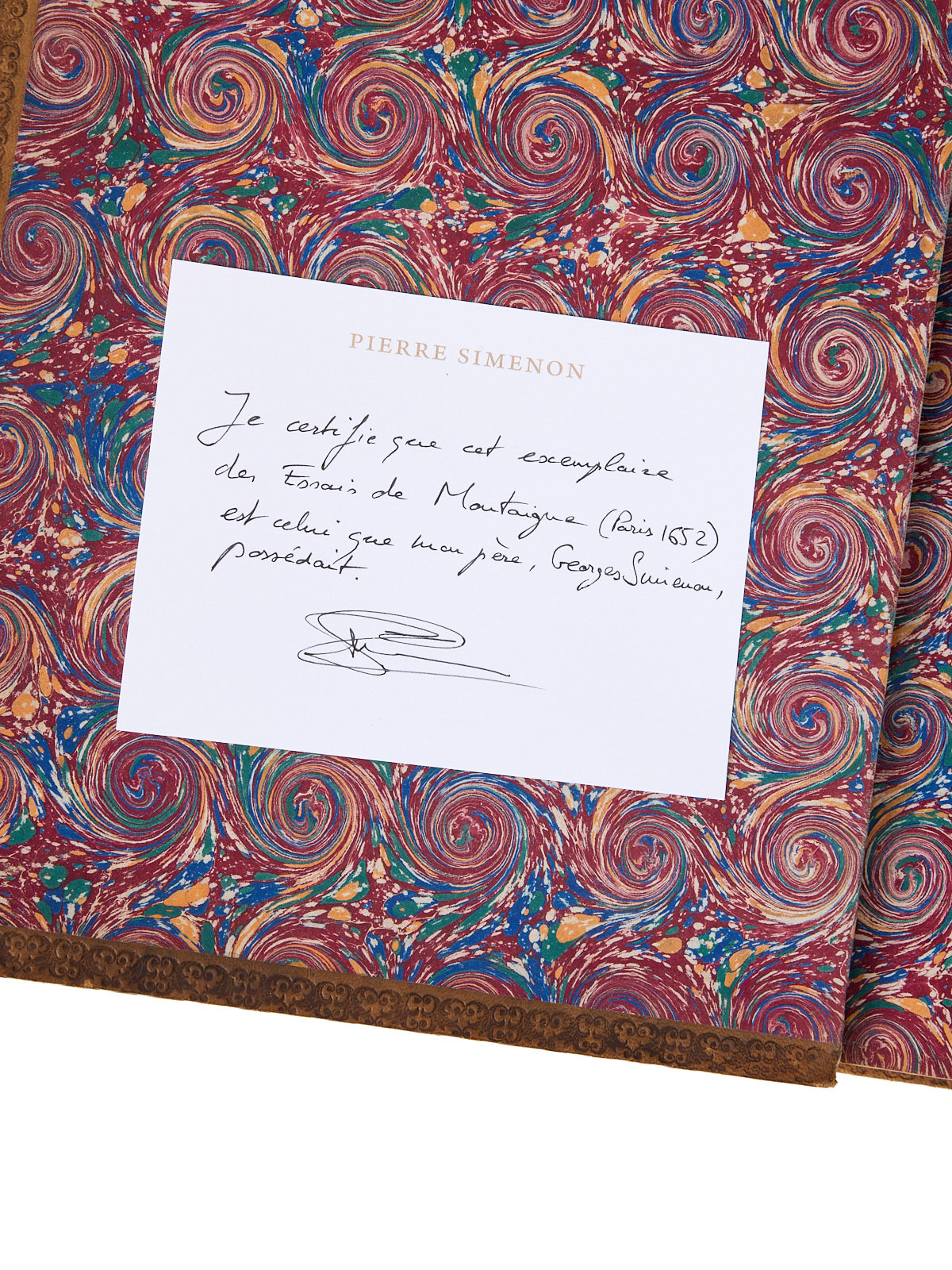
Nonetheless, we include the bookplate in question, mounted on the endpaper, along with a far more relevant autograph attestation: “I certify that this copy of the Essais de Montaigne (Paris, 1652) is the one that belonged to my father, Georges Simenon. Pierre Simenon,” on his headed calling card.