

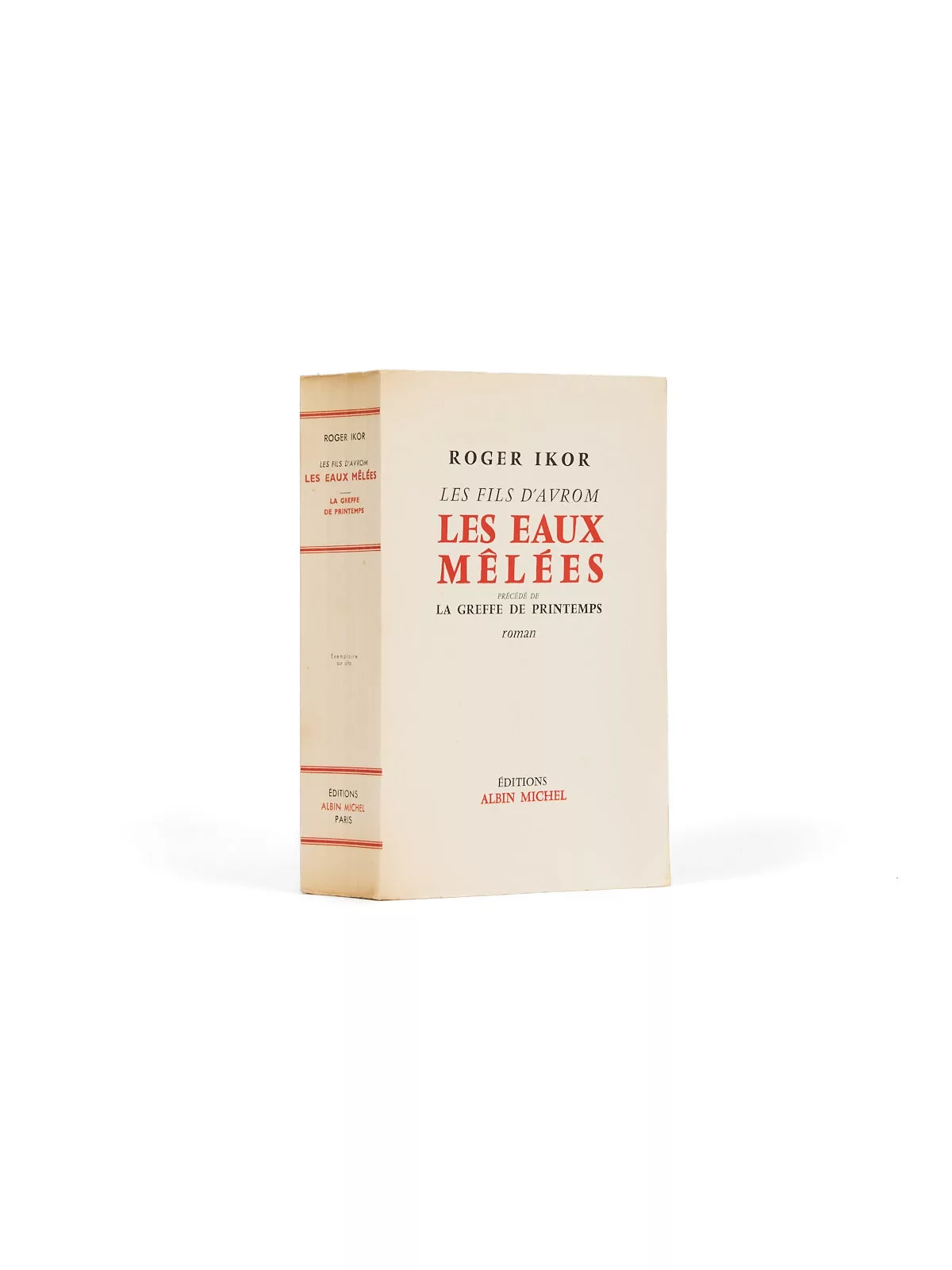
One of 10 nominative copies on alfa paper reserved for members of the Académie Goncourt, this one for Armand Salacrou: “afin de lui rappeler un voisinage à mes yeux trop bref et trop silencieux à la Cité universitaire, et lui témoigner une admiration littéraire qui remonte bien plus haut que mes premiers essais. Roger Ikor, 21/12/55.”
Prix Goncourt 1955. A teacher of classics, Roger Ikor (1912–1986) won the prize for Les Eaux mêlées, the story of an Alsatian Jewish family. The book follows La Greffe de printemps, published in January of the same year; the two texts form the first and second parts of a single work entitled Les Fils d’Avrom, tracing the identity dilemmas of the postwar years and the settling in France of a Lithuanian Jew and his family, from the beginning of the twentieth century to the early 1950s.
While the prize consecrated the ambition of a vast saga of integration, the book also provoked strong controversy in the Jewish press. Several critics accused Ikor of caricaturing the Jewish condition, of weakening its memory, or of yielding to the clichés of assimilation. The journal Targoum published a rebuttal in which a young writer, André Schwarz-Bart, took part. He would no doubt draw on this experience when writing Le Dernier des Justes, awarded the Prix Goncourt in 1959, which nonetheless did not escape the same criticisms — sometimes expressed in almost identical terms.
The controversy surrounding Les Eaux mêlées thus illustrates the acute tensions running through the postwar period: how to write Jewish identity, between memory, transmission and the outside gaze? The 1955 Goncourt marks an important stage in this literary and identity debate, foreshadowing by contrast the stormy reception of Schwarz-Bart’s masterpiece.
A precious nominative copy of the limited edition on alfa paper, with 13 copies reserved for the author, the publisher and the members of the Académie Goncourt — this one presented to Armand Salacrou (1899–1989), a member of the Académie Goncourt since 1946. As in the previous year with Pierre Gascar’s two collections, the edition brings together the two volumes published during the year by the laureate.