

Les Dentelles de Montmirail
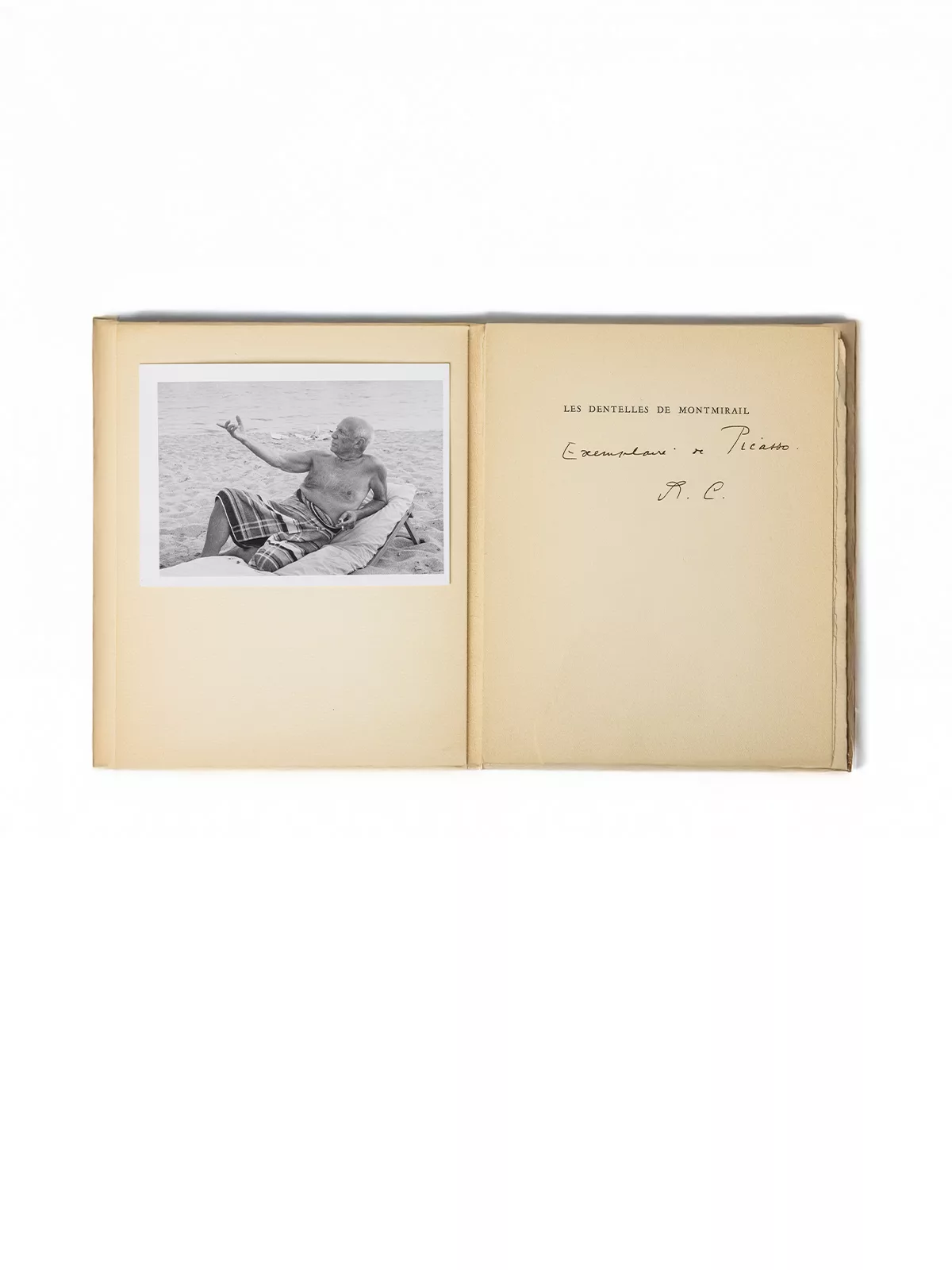
One of 50 copies on Arches paper, this copy justified in ink by the author: “Exemplaire de Picasso R.C.”
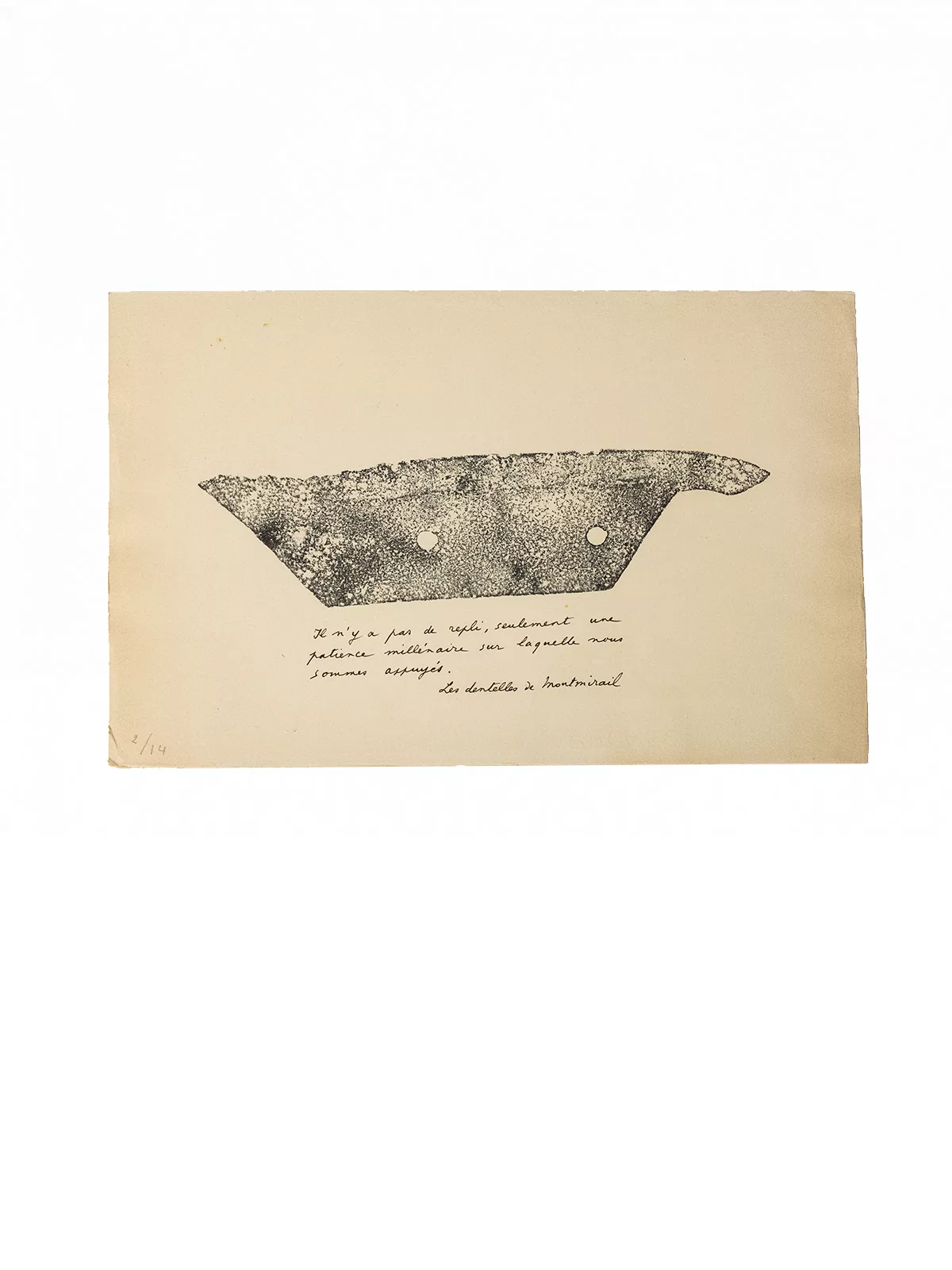
The stones and iron used for the impressions were found in the hills of the Vaucluse by René Char, PAB and Jacques Polge, on the site of the Dentelles de Montmirail massif (from the Latin “mons mirabilis,” meaning “admirable mount or mountain”). The site takes its name from the erosion that has shaped these mountains so that the rock, carved by time, resembles a lace ribbon with a unique silhouette. They lie at the foot of Mont Ventoux, in the Vaucluse, some thirty kilometres from Lisle-sur-la-Sorgue, where Char lived.
Les Dentelles de Montmirail was published that same summer of 1960; Picasso was then staying in Cannes with Jacqueline Roque, whom he would marry the following year.
This inscription is one of the earliest signs of a friendship and collaboration that would be strengthened by Braque’s death in 1963. Although their first contacts, through Éluard, dated from before the war, Char and Picasso did not begin to collaborate until 1958. After Éluard’s death, it was largely through Pierre André Benoit’s persistence that contact was renewed, and Picasso agreed — alongside the major illustrated books he produced with Broder — to collaborate on PAB’s tiny editions, using the celluloid process:
“[…] when PAB met Picasso in 1956, he was 35, Picasso 75. In May 1956, to illustrate an early text by René Crevel, a fellow traveler of the Surrealists, Picasso responded to PAB by returning through the post, without a word, the tiny celluloid plate engraved with a face. This became ‘Nuit.’ Why did Picasso, so famous and so sought after, finally respond to this young publisher from the Cévennes? Perhaps because PAB proposed texts by people close to Picasso, or who had been: Crevel, Tzara, René Char… But PAB also knew how to win him over by inviting him to experiment with new techniques: celluloid, then cartalégraphie. He appealed to Picasso’s taste for technical challenge, always emphasizing in his letters the playful, ‘amusing’ side of his proposals: ‘see if my project appeals to you,’ he wrote to him on 7 May 1958, sending him René Char’s poem ‘L’Escalier de Flore.’” (Picasso et le livre d’artiste, Exhibition 2018, preface).
In 1973, Char wrote the preface for the catalogue of the Picasso exhibition in Avignon, published just after the painter’s death on 8 April 1973.
In all, PAB produced seventeen books with Picasso between 1956 and 1974, making him the publisher with whom the artist collaborated most.