

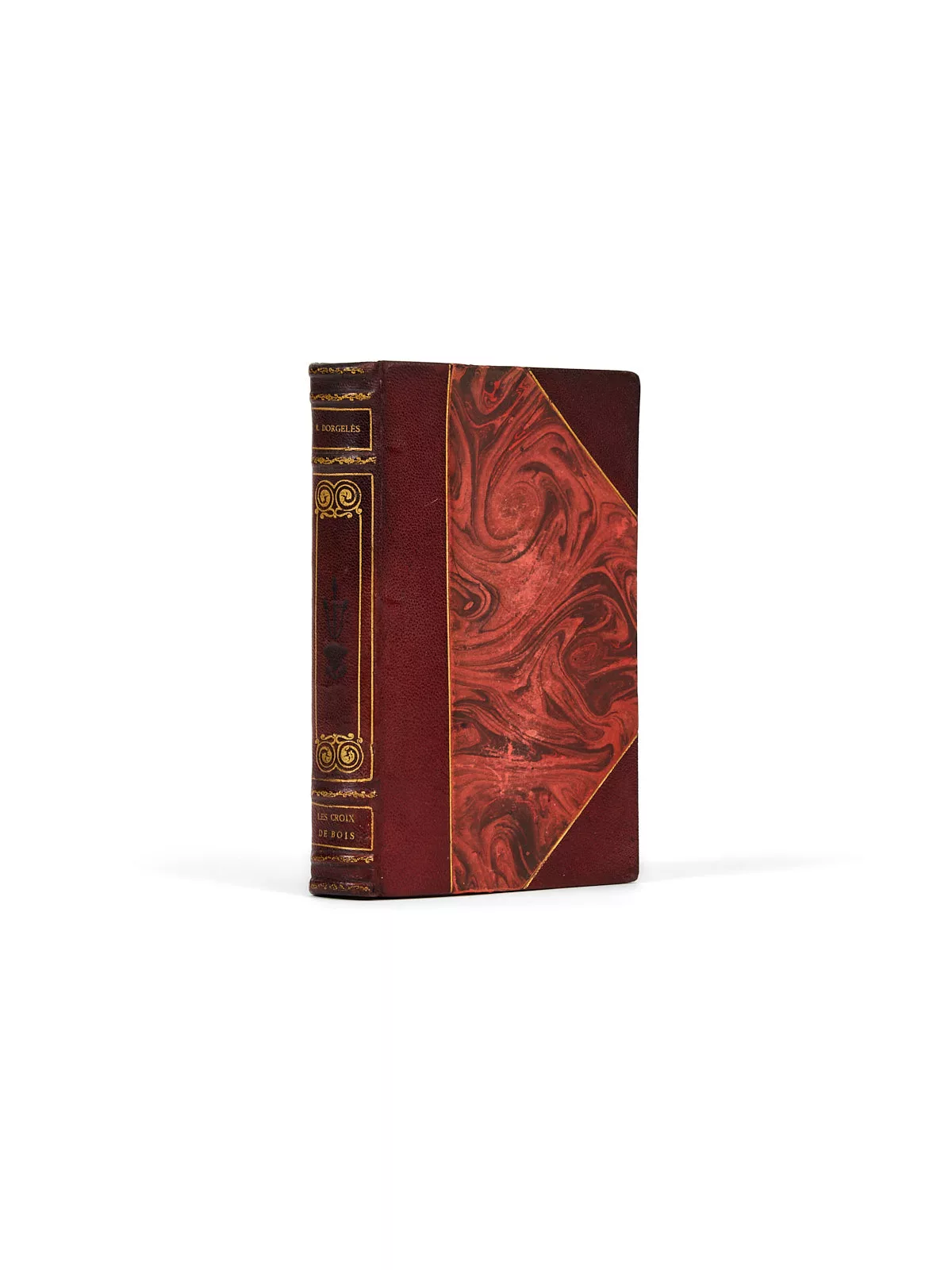

Les Croix de bois
One of 10 first copies on vergé pur fil paper, reserved for the author.
Inscribed and signed by Dorgelès to Madame Fargeton: “à Madame Fargeton, en m'excusant de l'avoir si souvent abasourdie de mes cris, amical hommage, Roland Dorgelès.”
A volunteer from August 1914, Dorgelès fought at the Battle of Berry-au-Bac, was wounded at Neuville-Saint-Vaast, decorated with the Croix de guerre, and later became a trainee pilot, writing his novel between flying sessions. Demobilized on April 1, 1919, the very day Les Croix de bois was published, he offered, chapter by chapter, a series of striking tableaux of soldiers’ daily lives. His protagonist, Gilbert Demachy, journeys through the horror of 1914–1918 toward death, in a spare, unsentimental narrative of devastating restraint. The wooden crosses of improvised battlefield cemeteries became the symbol of an entire generation.
The book was an immense success. Shortlisted for the 1919 Prix Goncourt, it narrowly lost to Proust’s À l’ombre des jeunes filles en fleurs, championed by Léon Daudet. The controversy was fierce: Albin Michel affixed a band to its copies reading “Prix Goncourt — 4 votes out of 10,” which led to a court conviction for false advertising. Dorgelès was ultimately awarded the Prix Femina instead.
This immediate reprint of the first edition corrects a typographical error on the title page of the first printing, which had announced a nonexistent frontispiece by Daragnès. Daragnès had in fact supplied only a cover design. The corrected title page now reads: “Couverture de Daragnès.” This reprint gave rise to a handful of deluxe-paper copies, including this extremely rare copy on vergé pur fil Lafuma, one of only ten recorded.
An exceptional inscription to Louise Fargeton, production director at Albin Michel, to whom Dorgelès mischievously alludes with reference to his “cries” — not those of battle, but those raised at the publisher’s upon discovery of the typographical error.
A fine copy in a contemporary binding.
An old marginal mark in the upper right corner of the last eight gatherings.