

[Les Consultations du Docteur noir] Stello
Stello was published in the Revue des Deux Mondes in three installments: on 15 October 1831, where this initial narrative is presented as the “fragment of a large book,” then on 1 December 1831 and 1 April 1832. Beginning 9 June 1832 (according to the Bibliographie de la France), no fewer than eight editions followed, each revised and corrected by the author, all published by Gosselin and Renduel. As Sophie Vanden Abeele-Marchal notes in her study of the genesis of Stello, Vigny recorded in his Journal on 20 May 1832: “I have finished correcting, myself and alone, the proofs of the first edition of Stello. This edition will be worth more than the manuscript, which I shall burn one of these days and which I keep, I know not why.”
Fortunately this did not happen, and Vigny even added eight final chapters that appear only in the printed edition [35 to 42]: “Un soir d’été”; “Un tour de roue”; “De l’ostracisme perpétuel”; “Le ciel d’Homère”; “Du mensonge social”; “Ordonnance du Docteur Noir”; “Effet de la consultation”; “Fin.”
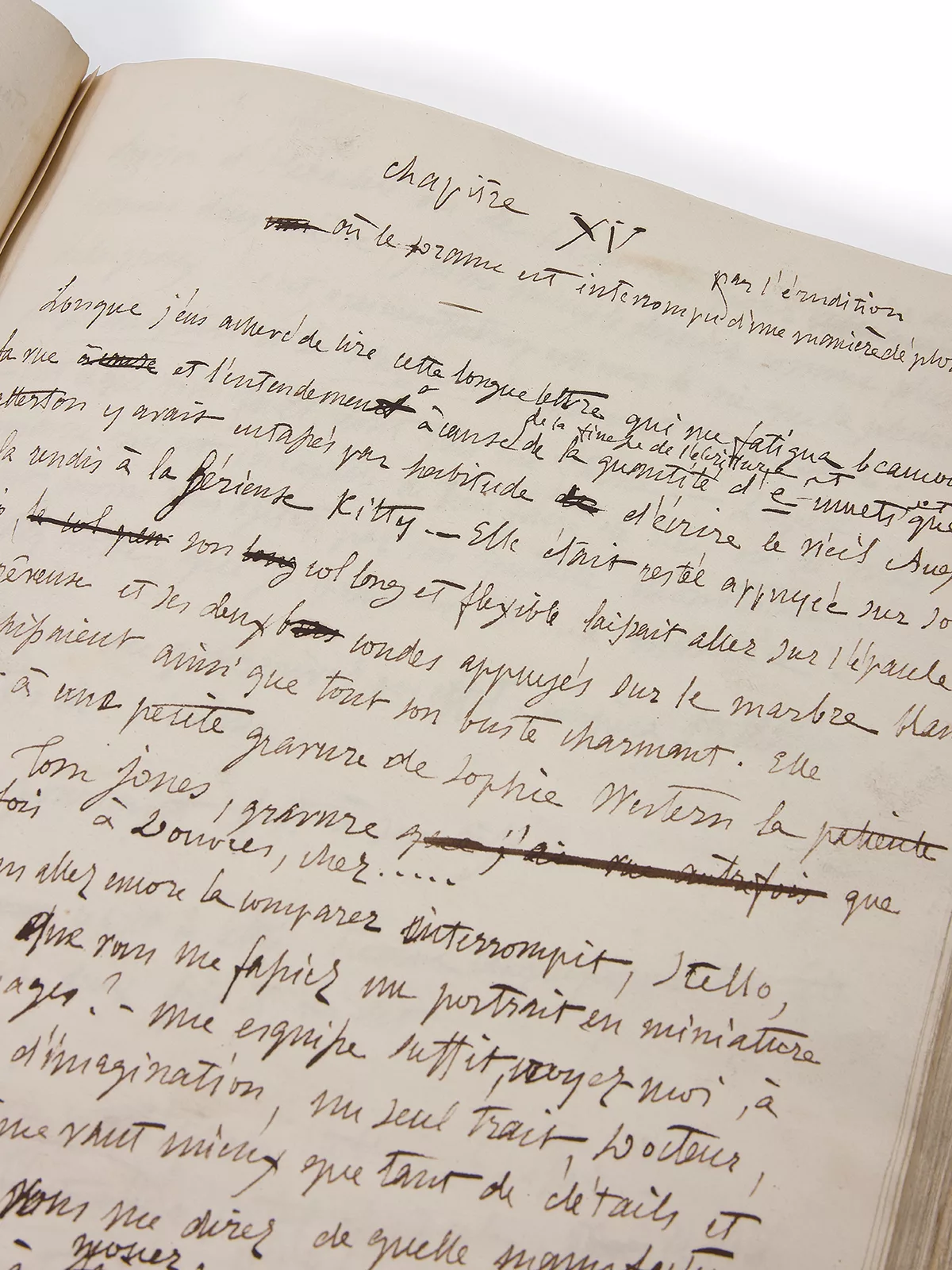
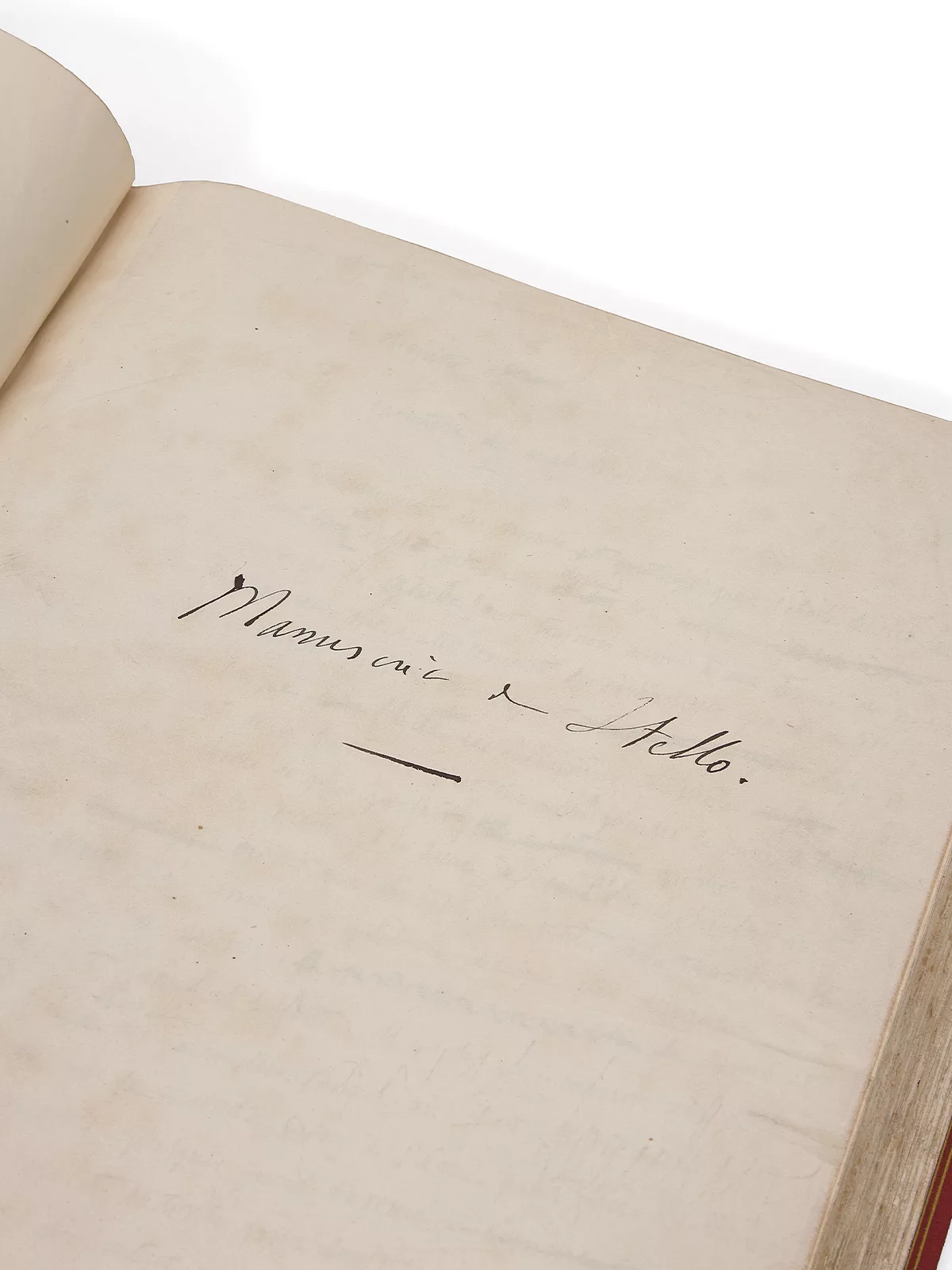
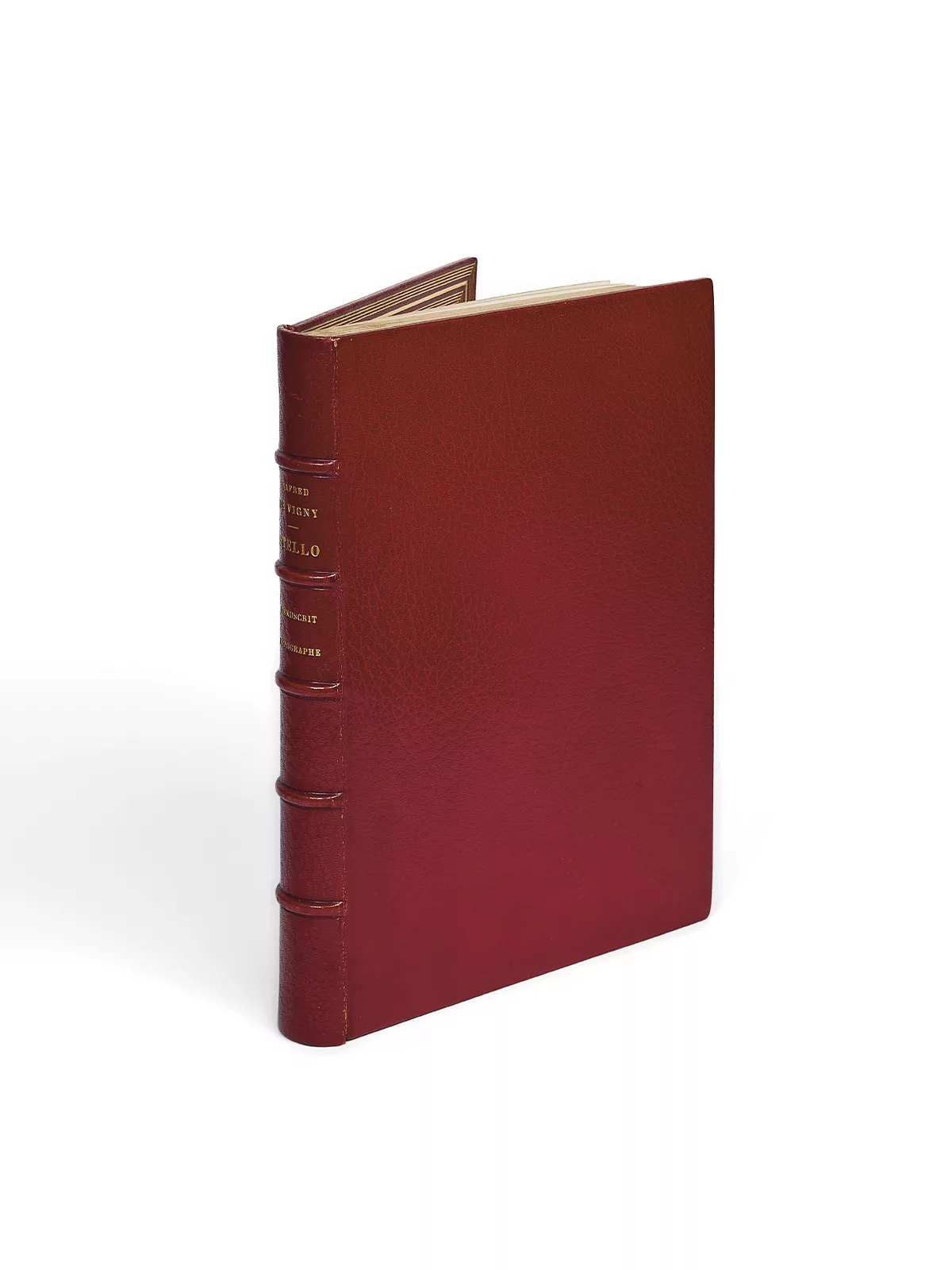
The manuscript is written in brown ink on the recto of large leaves of vélin paper, heavily marked with deletions, corrections and additions — sometimes on smaller leaves added in — and shows extensive work of composition and revision. Several versos bear crossed-out lines corresponding to abandoned page openings. The pagination, at the top right of the leaves, is discontinuous, sometimes doubled, with some inconsistencies (and a few binding errors). The numbering and titling of the chapters also show hesitation, of which the manuscript bears traces; the final chapters are unnumbered. A final “Table” lists all 42 chapters. The manuscript also bears the names of the typesetters among whom the copy was divided for printing.
The Bibliothèque nationale de France’s “Les Essentiels” presents this Romantic masterpiece as follows: “La Première consultation du Docteur noir, Stello ou Les Diables bleus is a novel-within-a-novel featuring Stello, a young poet afflicted with the strange malady of the “diables bleus,” which makes him want to enter politics — an urge the old Docteur noir sets out to cure by recounting the unhappy fate that three different political regimes (absolute monarchy, parliamentary monarchy and democracy) reserved for three poets (Gilbert, Chatterton and André Chénier), before prescribing, in a concluding ordinance, that “poetic life be separated from political life.” The work is distinguished by real virtuosity, blending revolt, pity and detachment in a style that adapts to each story: the first tale mischievously imitates the flowery style of a materialist eighteenth century, the second takes on an English air, while the third conveys the atmosphere of the Terror. Alongside the psychology of the poet, the work raises the question of his place in society and, more broadly, of whether a satisfactory government is possible, and of the role of art.”
From the libraries of Louis Barthou and Lucien Dhuys.
Detail of titles and double numbering:
At the head of chapter 1, “Caractère du malade,” Vigny noted: “This chapter must be placed instead of the other first chapter”;
II “Symptômes” (Vigny hesitated over the title: “Symptômes et choses singulières que Stello dit au Docteur noir”);
III “Conséquences des Diables-bleus”;
IV “Histoire d’une puce enragée” (four other titles crossed out, including “Comment le Roi eut une idée nouvelle”; the female heroine was named Madame de Châteauroux, corrected to Mademoiselle de Coulanges);
V “Interruption”;
VI (misnumbered VII) “Continuation de l’histoire que fit Docteur noir”;
VII [VIII] “Un credo” (two titles crossed out, including “Êtes-vous Poëte?”). [This first group is paginated 1–19, with a leaf 14 bis.]
VIII [IX corrected to 8, this shift continuing through the next four chapters] “Demi-folie”;
IX “Suite de l’histoire de la puce enragée”;
X “Amélioration”;
XI “Un grabat”;
XII “Une distraction” [This second group, headed “2e article” and paginated 1–21, was added to the previous one to form the first installment of the Revue des Deux Mondes (RDM)];
XIII [marked XII, the shift continuing through the following chapters] “Une idée pour une autre”;
XIV “Histoire de Kitty Bell”;
XV “Une lettre Anglaise”;
XVI “Où le Drame est interrompu par l’érudition d’une manière déplorable…”;
XVII “Suite de l’histoire de Kitty Belle. Un bienfaiteur”;
XVIII “Un escalier.” [This third group, paginated 1–42, corresponds to the second installment of the RDM.];
XIX “Tristesse et Pitié” (original title crossed out: “Dur comme la pensée”);
XX “Une histoire de la Terreur.” [This fourth group is paginated 1–15, with a 5 bis, and 18–24; it opens the third installment of the RDM.];
21 “Un bon canonnier”;
22 “D’un honnête vieillard”;
23 “Sur les hiéroglyphes du bon canonnier”;
24 “La Maison Lazare”;
25 “Une jeune mère”;
26 “Une chaise de paille”;
27 “Une femme est toujours un enfant”;
28 “Le Réfectoire”;
29 “Le Caisson”;
30 “La Maison de Mr de Robespierre, avocat au Parlement”;
31 “Un législateur”;
32 [XXXIII] “La Promenade croisée” [the beginning was bound in after the added chapter 32];
33 [XXXIV] “Un petit divertissement” [This fifth group, paginated 1–59 (plus 20 A and B and 40 bis) and 57–88 (plus 61 bis and 62 bis), constitutes and closes the third installment of the Revue des Deux Mondes].
Aguttes, 17.11.2020, no. 111; Classiques Garnier, “La Genèse de Stello,” p. 67.