

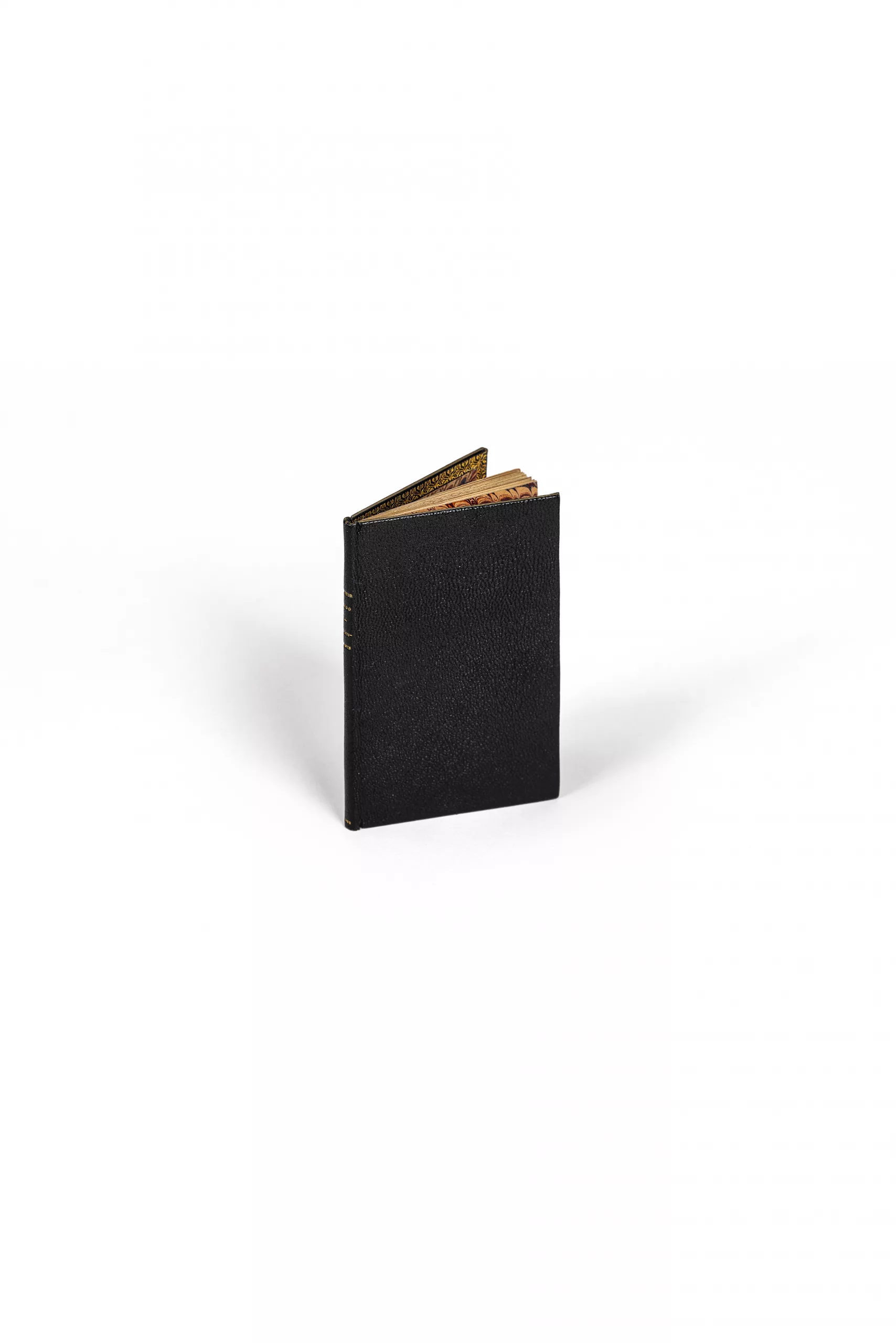
[Les Châtiments :] Joyeuse vie
Signed presentation inscription: “À Jules Janin, à Eraste, au grand esprit, au vaillant cœur, au charmant et puissant écrivain. Fratri fratellus. Victor Hugo Hauteville House, juin 1863.”
When Victor Hugo was forced into exile, Jules Janin began an important correspondence with him. Equally hostile to Emperor Napoleon III, Janin proclaimed his loyalty to Hugo in the Journal des débats in 1852 and devoted the third volume of his Histoire de la littérature dramatique (1858) to him. In return, Hugo dedicated one of his poems in Les Contemplations to Janin.
“Joyeuse vie” is an offprint extract from Les Châtiments, the vengeful collection published in 1853.
Exiled after the coup d’état of 2 December 1851, Hugo gave free rein in this collection to his hatred of Napoleon III, who had become for him the very symbol of tyranny.
A year later, having finished the collection, Hugo wanted extracts distributed quickly, in small format so that they could be sent out discreetly. On 13 December, his Belgian printer Samuel wrote to him: “I had to hastily produce two extracts, one which you already have [Nox], the other which I am sending you here, L’Expiation […] I am now working on the pieces you indicated [Joyeuse vie and À l’obéissance passive]; I will send you proofs… I printed four thousand extracts of the first two — two thousand of each piece.”
The last two apparently did not receive the same print run and were printed in far smaller numbers: only a few hundred for “Joyeuse vie” and probably fewer than a hundred for “À l’obéissance passive.” The haste of the latter’s typesetting and its lack of distribution are confirmed by the unfinished state of its title page: unlike the other three, it bears neither the general title Les Châtiments, nor the author’s name, still less the introductory preface. It is also the only one dated 1853; the other three are dated November and December 1852. According to Clouzot, the first two, “Nox” and “Joyeuse vie,” “were printed in 2,000 copies, the last two, ‘L’Expiation’ and ‘À l’obéissance passive,’ in a tiny number, for reasons that remain unclear.” This rarity is confirmed by Vicaire, who was only able to locate and record the first two. Carteret does not even mention them, and they are likewise absent from the great Zoumeroff collection.