

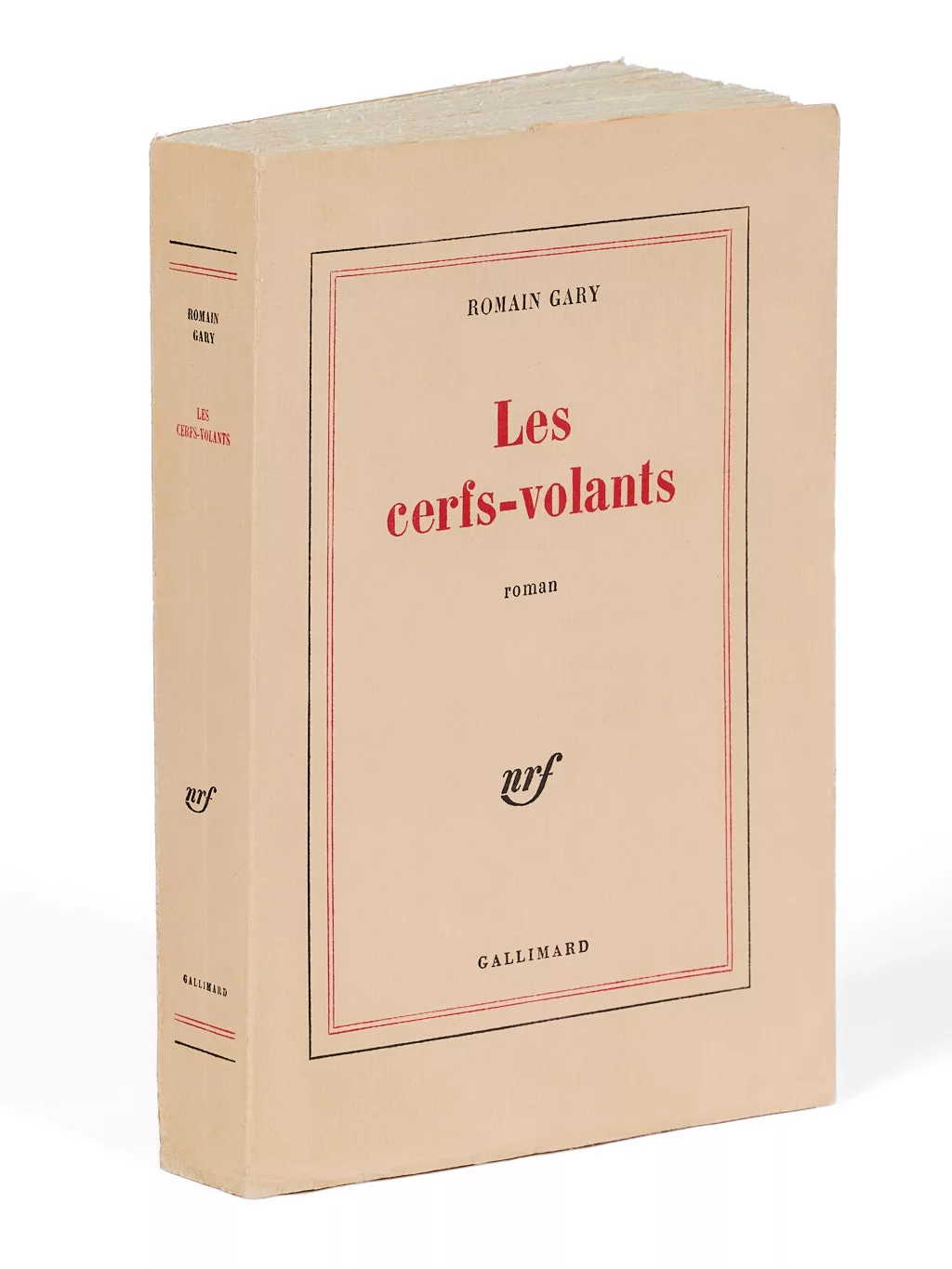
Les Cerfs-volants
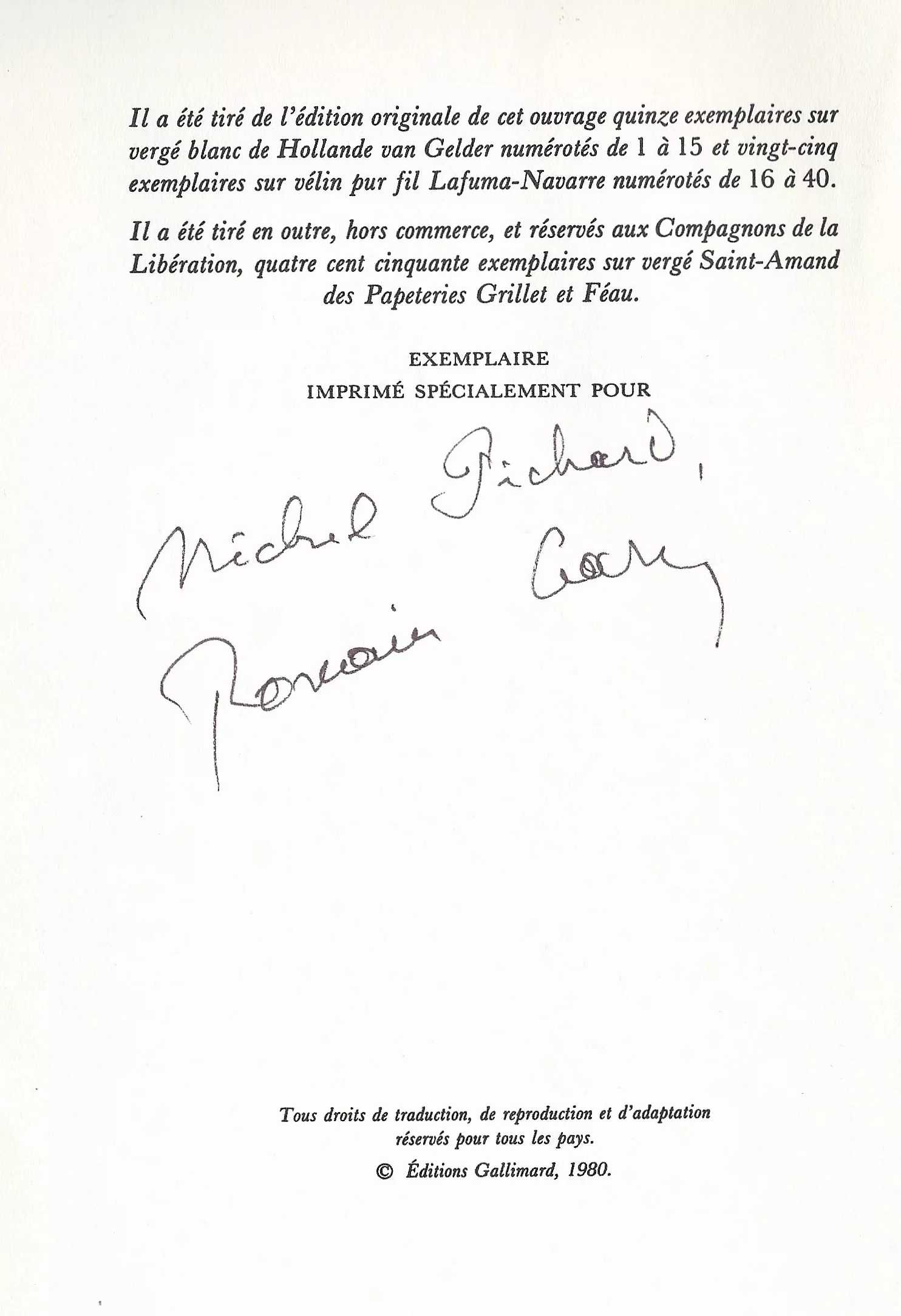
One of 450 copies on vergé Saint-Amand paper reserved for the Compagnons de la Libération. This copy is nominative, numbered and signed by Romain Gary — to one of the Compagnons.
Memory occupies a central place in Gary’s work, and it is fitting that his final novel — Gary took his own life on 2 December 1980, a little over a year after the suicide of his wife, Jean Seberg — is dedicated “To memory.”
Though set again against the backdrop of Nazism and the Occupation, this final novel is entirely governed by the love the author had despaired of ever encountering, much as in Clair de femme, said to have been inspired by a discreet affair with Romy Schneider.
A precious copy presented to Michel Pichard, Compagnon de la Libération and one of the earliest resistance fighters, who was assigned to the artillery school at Fontainebleau at the outbreak of war. During the retreat toward Bordeaux ahead of the German advance, Pichard, upon learning of the armistice signed on 22 June 1940, resolved to continue the fight and fled that same day toward the Atlantic coast: on the 24th he boarded the aviso La Boudeuse, which sailed for Casablanca, where he was assigned to the 63rd African Artillery Regiment of the armistice army at Meknès. Accused of desertion from the French army, he was sentenced to three months’ imprisonment and stripped of rank. He managed to escape in July 1941 and, after five days on foot across the Moroccan desert, secretly boarded a ship at Tangier bound for Gibraltar, from where he made his way to London, arriving in August 1941 and immediately enlisting in the Free French Forces. In July 1943 he became national head of the Bureau des opérations aériennes, a highly strategic post, and Charles de Gaulle awarded him the Croix de la Libération as early as June 1944. Settled in the United States after the war, Michel Pichard worked as an authorized signatory in a major New York bank.
Gary, for his part, as soon as de Gaulle issued his call, “escaped from France by plane, landed in Algiers, stayed in Meknès and Casablanca while waiting to find a British cargo ship that took him, as it would Pichard a year later, to Gibraltar: two weeks of sailing later, on 22 July 1940, he disembarked at Glasgow, from where he made his way to London. As soon as he arrived, he asked to serve in a combat unit under the name Romain Gary and was promoted to the rank of warrant officer in September.”