

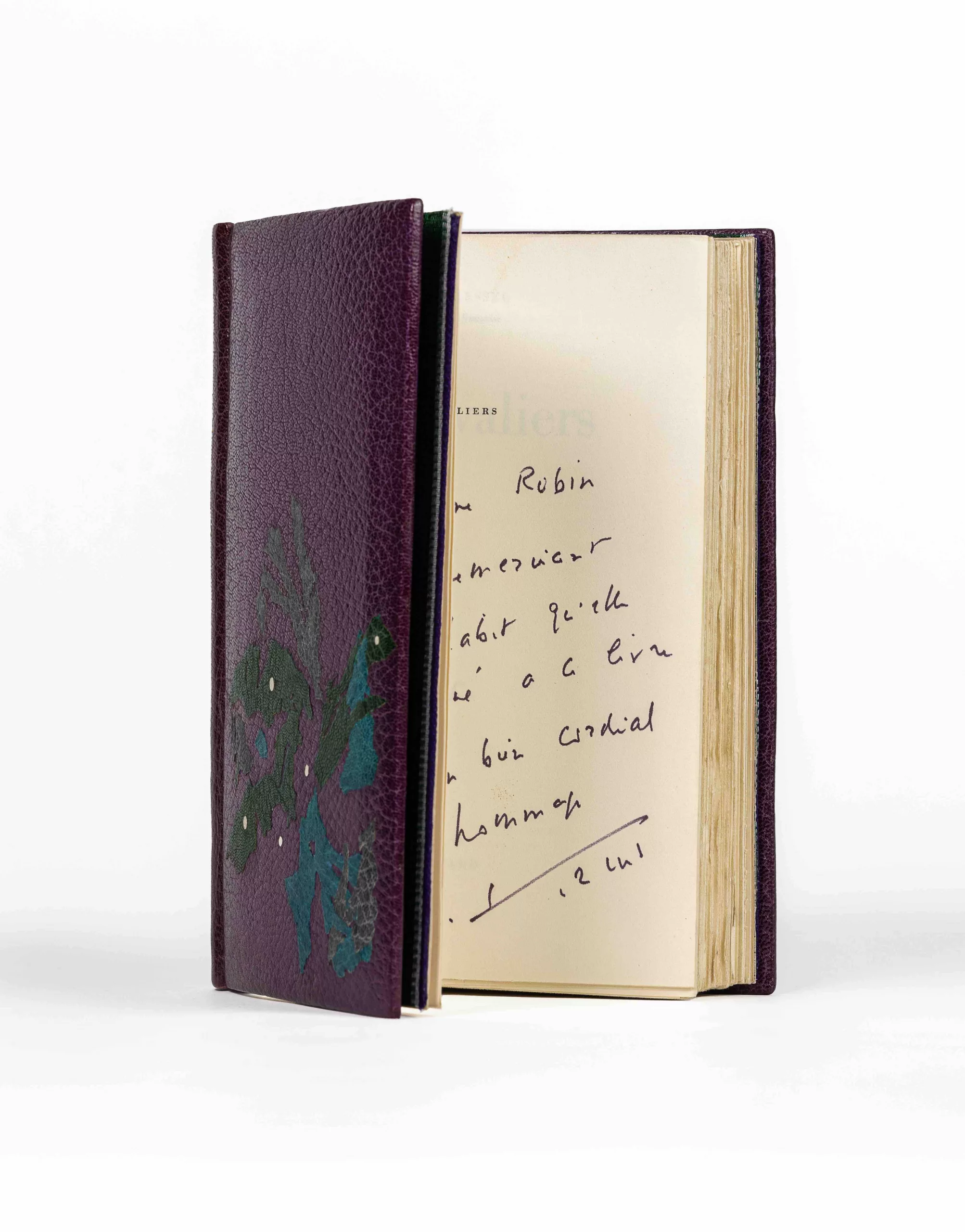
Les Cavaliers
Presentation copy inscribed by Kessel: “à Madame Robin, en la remerciant de l'habit qu'elle a donné à ce livre et en bien cordial hommage, Kessel.”
Preserved with the copy, an autograph letter signed by the bookbinder's daughter, dated February 1, 1971, presenting the copy in return to Kessel.
A fine and rare decorated binding, strictly contemporary.
“We were approaching the Chibar, the only pass through the august and monstrous massif of the Hindu Kush, through which, at an altitude of 3,500 meters, all traffic and trade between southern and northern Afghanistan passed.”
The opening of Les Cavaliers, as celebrated as that of Karen Blixen’s Out of Africa, is a photograph of landscape. Joseph Kessel undertook his journey to Afghanistan because he longed to rediscover the landscapes of his childhood, the steppes of Central Asia, and because he was forbidden from traveling to the Soviet Union. At the start of 1956, he found an occasion to make the trip fruitful: a film crew, made up of filmmakers Pierre Schoendoerffer and Raoul Coutard, was ready to shoot a film he would write on location, as they went.
This Afghan expedition would deserve a book of its own, of which Kessel gave a glimpse in Le Jeu du roi, both the logbook of the film being made and the crucible from which Les Cavaliers would one day emerge — “his most accomplished, most lyrical novel. It would take him several years to write this novel, in which for the first time an author revealed to the Western world the landscapes of the Hindu Kush foothills, the Tajik horsemen, the game of buzkashi and the giant Buddhas of Bamiyan. He invented a small, particularly dangerous female creature to electrify his mounted heroes. Born of his imagination, Zéré, the nomad, has delicate features, translucent green eyes and every talent needed to damn a man. Zéré’s perversity, her cruel love, her malevolent nature, and also her beauty, and the ease with which she captivates men, are not unlike, in Kessel’s own life, the qualities of his Irish wife Michèle, equally volcanic and armed with unsettling powers (…) The novel was not published until 1967. Its gestation lasted ten years, its writing a little more than six — nearly a record for Kessel, who, except for Le Tour du malheur, wrote his books in the blink of an eye.” (Dominique Bona, in Les Partisans).
La Passe du diable, the resulting film, was released on May 21, 1958, in a single theater on the Champs-Élysées, without any publicity. But in 1967, an unparalleled success greeted Les Cavaliers, whose publisher’s wraparound band rightly proclaimed: “Kessel’s far-off novel” — so flamboyant and admirable was Kessel’s Afghan adventure. If Le Tour du malheur is its biographical counterpart, Les Cavaliers forms the perfect distillation of Kessel the adventurer.
Jacqueline Breitel, Joseph Kessel’s secretary, later described the effort behind the novel’s composition: “Every day he handed me the previous day’s writing (…) I brought him a clean typescript, and the next day, in addition to the handwritten half-sheets, he returned it to me more than half crossed out. I estimate he rewrote Les Cavaliers four or five times. At least! When he received the eight-hundred-leaf manuscript on his desk, Gaston Gallimard was overjoyed: he considered it the finest novel by his protégé since L’Équipage, completed forty-three years earlier” (in Dictionnaire amoureux of Kessel).
The novel met with immense public and critical success: a unanimous tribute, for once without a false note, which few writers can claim to have received. Kessel was delighted. Les Cavaliers, his fourteenth novel, would also be the last he wrote, and everything smiled upon him — at least on the front of his works: Buñuel had just acquired the rights to Belle de jour, and Les Cavaliers became the object of a frantic bidding war among American studios: Columbia Pictures ultimately won, for the colossal sum of one hundred million old francs. John Frankenheimer directed the film, giving the roles of the young Ouroz and the old Toursène to Omar Sharif and Jack Palance. For Omar Sharif, an exceptional horseman fascinated by the world of horses, it was a golden role, following his portrayal of Ali, Prince of the Desert, in David Lean’s Lawrence of Arabia, released five years earlier.
Presentation copies of Les Cavaliers inscribed by Kessel — especially in a deluxe-paper copy — appear to be particularly rare.