

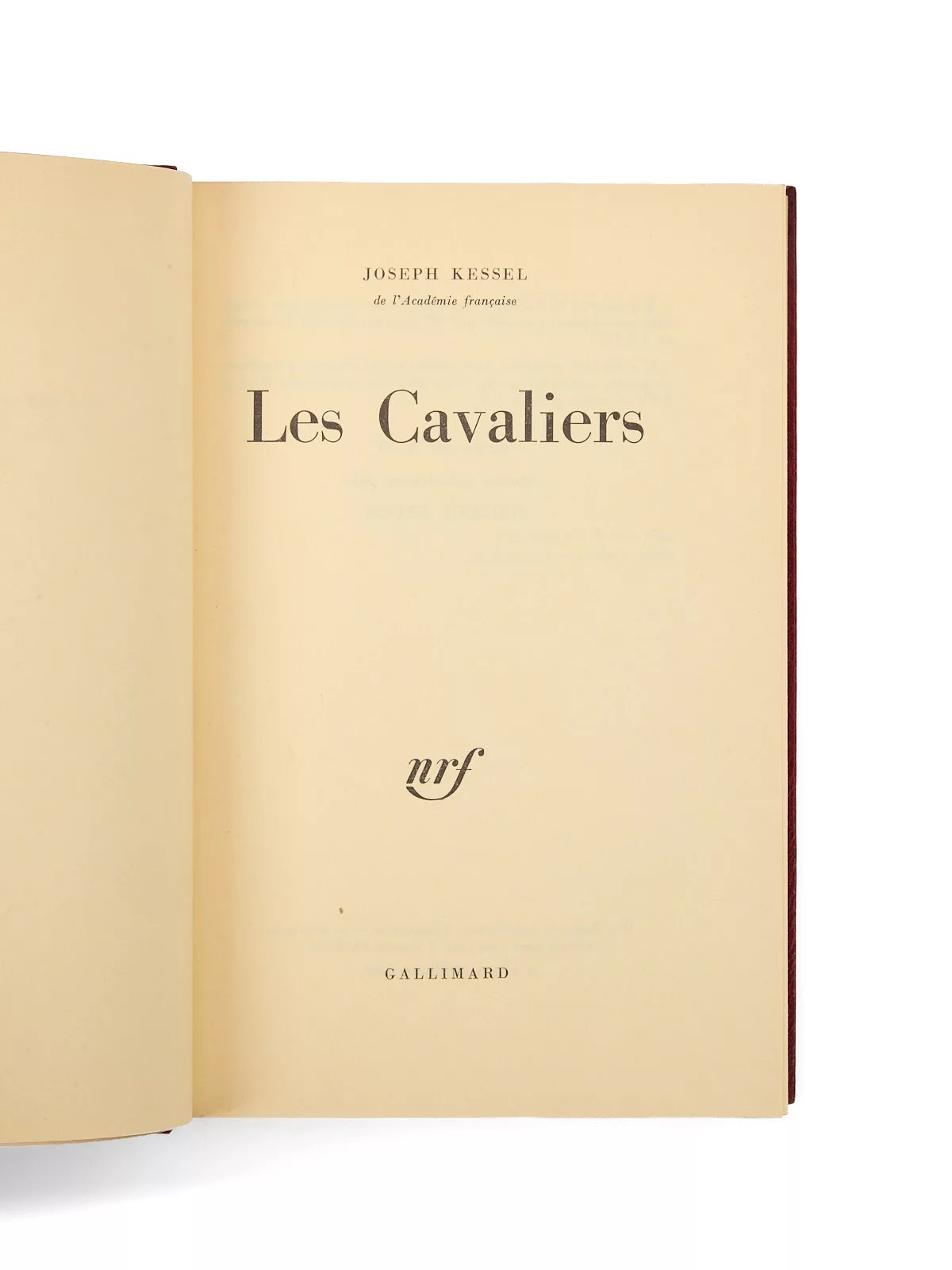
Les Cavaliers
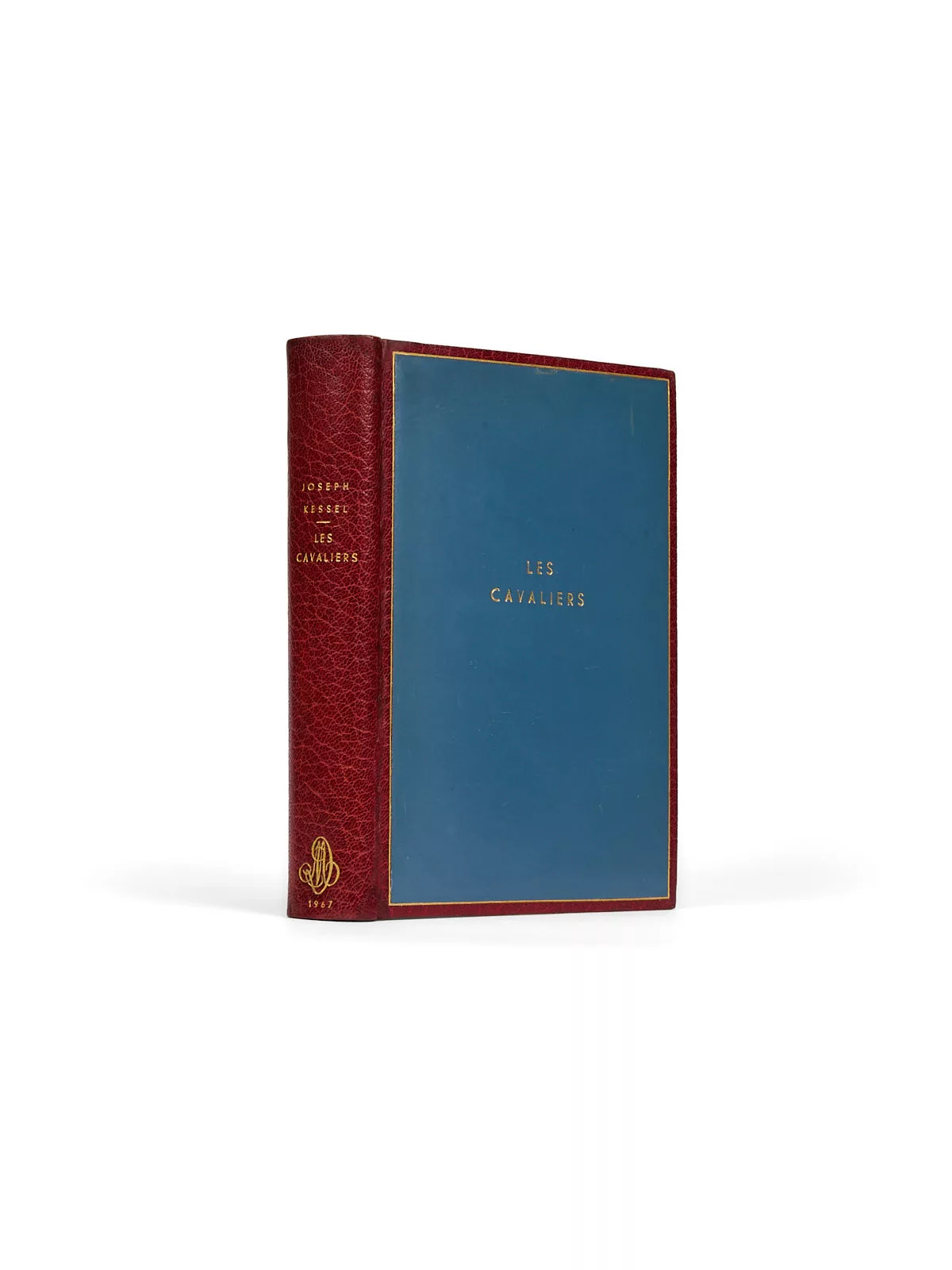
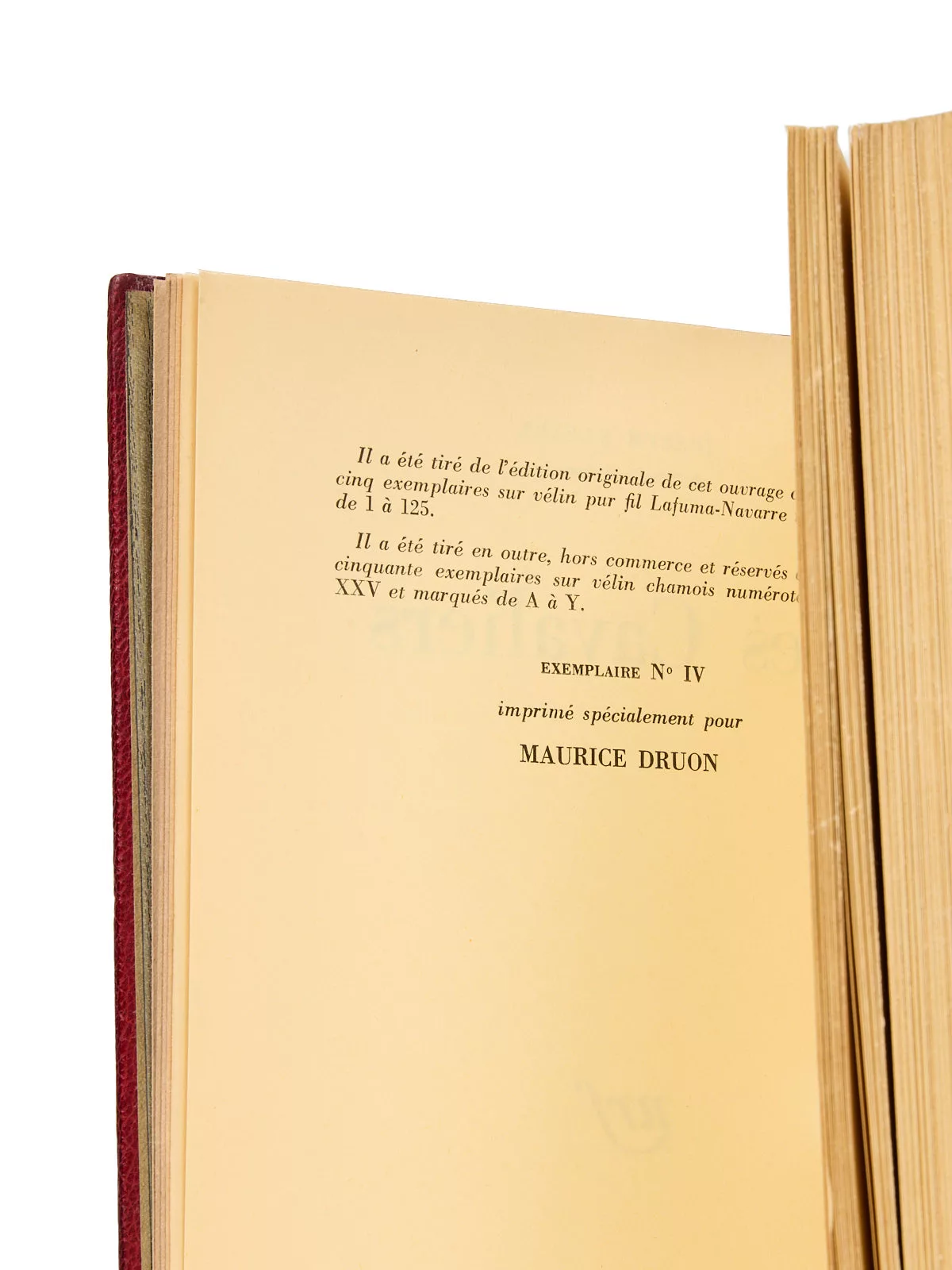
One of 50 hors commerce copies on chamois vellum, this one nominative for the author (no. IV).
“We were approaching the Chibar, the only passage through the august and monstrous massif of the Hindu Kush, through which, at 3,500 meters altitude, all traffic and transport between southern and northern Afghanistan flowed.”
The opening of Les Cavaliers is a photograph of landscape. It was because Kessel wished to rediscover the landscape of his childhood — the steppes of Central Asia — and because he was forbidden to travel to the Soviet Union, that Joseph Kessel undertook to visit Afghanistan. In early 1956 he found an opportunity to make the journey fruitful: a film crew, including the filmmakers Pierre Schoendoerffer and Raoul Coutard, was ready to shoot a film he would write on location, as they went along.
This Afghan expedition deserved a book of its own, of which Kessel gave a glimpse in Le Jeu du roi, the log of the film being made and the first lines from which Les Cavaliers would eventually emerge — “his most accomplished, most lyrical novel,” which took him several years to write. In it he created the character of Zéré: “Born of his imagination, Zéré the nomad has fine features, translucent green eyes, and every talent needed to damn a man. Zéré’s perversity, her cruel love, her malevolent nature, and also her beauty, and the attraction she so easily exerts on men, are not unlike, in Kessel’s own life, the qualities of his Irish wife Michèle, equally volcanic and armed with disquieting powers…” (Dominique Bona, in Les Partisans). The genesis took ten years, and the writing itself just over six — “a record for Kessel, who, except for Le Tour du malheur, wrote his books in no time at all.”
The resulting film, La Passe du diable, was released on 21 May 1958 in a single theater on the Champs-Élysées, without any publicity. But in 1967, Les Cavaliers met with unrivaled success; the publisher’s wraparound band rightly proclaimed it “Kessel’s distant novel,” so flamboyant and admirable was his Afghan adventure. If Le Tour du malheur is its biographical counterpart, Les Cavaliers forms the perfect distillation of Kessel the adventurer.
Jacqueline Breitel, Kessel’s secretary, later described the effort behind the novel’s composition: “Every day he handed me the previous day’s pages… I would bring him a clean typescript, and the next day, besides the handwritten half-sheets, he would return it to me more than half crossed out. I estimate that he rewrote Les Cavaliers four or five times. At least! When Gaston Gallimard received the eight-hundred-leaf manuscript on his desk, he was overjoyed: he considered it the best novel by his protégé since L’Équipage, completed forty-three years earlier” (in Dictionnaire amoureux de Kessel).
The novel met with immense success, both popular and critical, upon publication: a unanimous tribute, for once without a discordant note, of a kind few writers can claim to have received. Kessel was delighted. Les Cavaliers, his fourteenth novel, would also be his last, and everything seemed to favor him — at least on the front of adaptations: Buñuel had just acquired the rights to Belle de jour, and Les Cavaliers became the object of a frantic bidding war among American studios; Columbia Pictures ultimately won, for the colossal sum of one hundred million old francs. John Frankenheimer directed the film, giving the roles of the young Ouroz and the old Toursène to Omar Sharif and Jack Palance. For Omar Sharif, an outstanding horseman fascinated by the world of horses, it was a golden role, following Ali, Prince of the Desert, in David Lean’s Lawrence of Arabia, released five years earlier.
A precious copy, nominatively inscribed for Maurice Druon, who entered the Académie française a few months after the publication of Les Cavaliers. He was then its youngest member, seated a few chairs from his uncle, who had worn the green coat since 1962. Druon would later become its Dean, forty-two years later, after having served as its Permanent Secretary from 1985 to 1999. On 24 November 1967, he received his sword from Kessel’s hands at the Maison de l’Amérique latine, and on 7 December he was formally received under the dome.
On 11 August 1971, Druon accompanied Kessel — who usually disliked seeing his novels adapted for the screen — to the great boulevards for the film’s premiere. Frankenheimer had shot most of the scenes, notably the buzkashi sequence, in the mountains and valleys of Afghanistan, the country so close to Kessel’s heart, which Druon did not know himself but which his uncle had described to him countless times.
From the library of Maurice Druon (bookplate), with nominative limitation statement.
The binding bears the monogram “M.D.” at the foot of the volume, in a perfect and remarkable execution from the workshop of Alix mère, matching the most precious copies preserved in this manner by Druon: Le Tour du malheur (1950), Le Lion (1958, two volumes) and this copy of Les Cavaliers.
Only these three Kessel titles received this special treatment, evidence of the importance Druon placed on them.
Other nominative copies on this paper are known for Patrick Kessel, Gérard Bon, Albert Mermoud, Roger Grenier, Gaston Gallimard, Claude Gallimard, André Varay, André Andrée Mallet-Stevens, Charles Gombault, Paul Guilbert and Georges Walter. None of them bears an inscription: these nominative copies were simply distributed and made available at a time when Kessel himself was absent. In late March 1967, Michel Colomès and Igor Barrère, the two mainstays of the television program “Cinq colonnes à la Une,” invited him to travel to Afghanistan in the footsteps of Les Cavaliers, all the more so since Kessel had received an official invitation from King Zahir Shah of Afghanistan, who “would recall this epic with a tremor in his voice, telling him he had become the bard of the country of the Afghans and their horsemen” (in Dictionnaire amoureux de Kessel).
The team flew out of Orly in the last days of March, while the deluxe printing had not even been printed yet. Kessel traveled with his brother Georges and landed in Calcutta on 2 April. A long journey followed through Pakistan and Burma, before arriving in Afghanistan at the end of April. The very next day, Kessel was received at the royal palace, where Les Cavaliers had already arrived: “I had left France before my novel was published, and while I was crossing the jungles of Assam, Zahir Shah had read it. He was so pleased with the image I had given of his country!”*
The stay lasted more than two months, and Kessel did not return to Paris until 8 June, only to leave again for New York on the 10th to join Michèle, before returning to France in the height of summer and then withdrawing to Menton until September. During this time, the nominative copies had presumably reached their owners, and if some copies — still to be discovered — were later inscribed, there could only have been a handful. None is known to date.
* The INA offers this broadcast for viewing online, and we can only recommend this archive!