

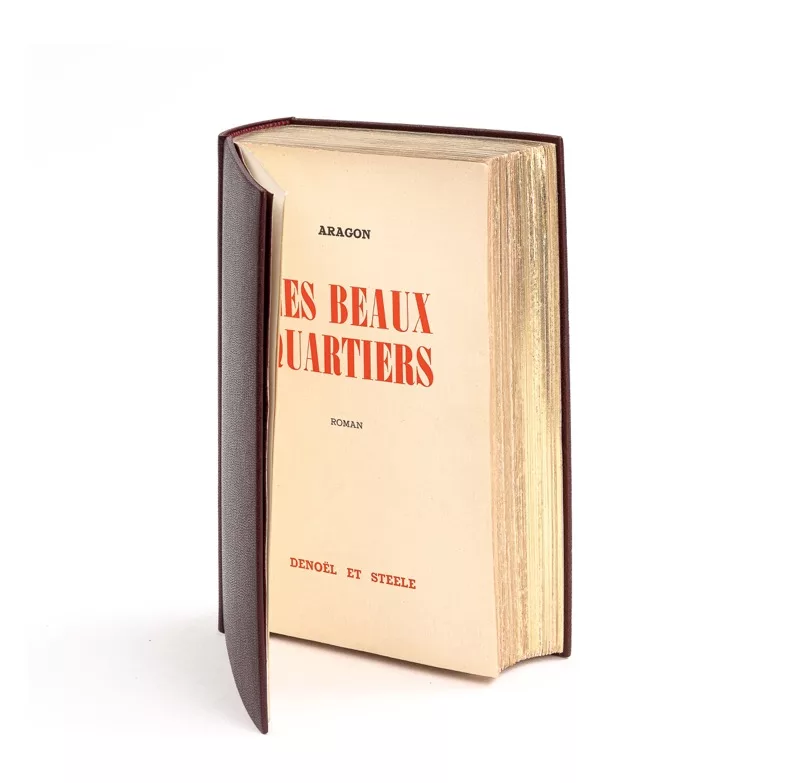
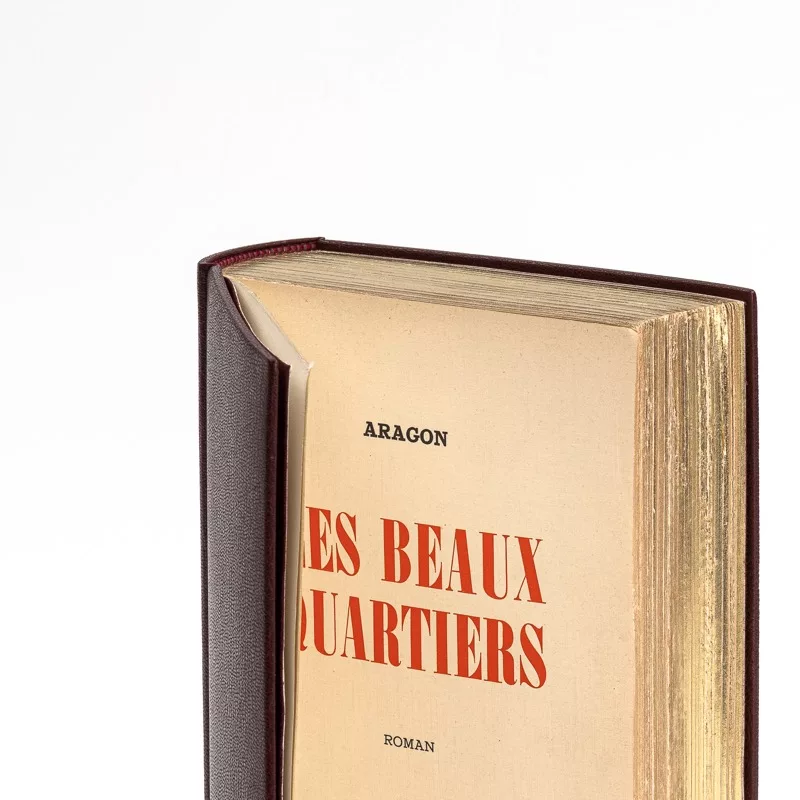
Les Beaux Quartiers
One of 25 copies on pur fil paper (no. 21).
One of the three novels in the Le Monde réel trilogy, and a testament to Aragon’s definitive commitment to the Communist Party.
In March 1932, the date of his final and public break with the Surrealist group, Aragon made the irrevocable decision to devote himself to the revolutionary cause. This marked the beginning of a new period of literary and journalistic production carried out exclusively under the auspices of the Communist Party. The year he spent in the USSR, between spring 1932 and March 1933, the responsibilities entrusted to him — notably for the French edition of the journal Littérature de la révolution mondiale, published by the UIER [International Union of Revolutionary Writers] — and the various commitments he made before returning to France completed his transformation into a fully committed militant. He was also promised a position on the editorial staff of L’Humanité and a major role in launching the future propaganda journal Commune, organ of the AEAR [Association of Revolutionary Writers and Artists], which he would in fact direct from July 1933 to December 1936.
Les Beaux Quartiers was written during this journey to the Soviet Union, continuing the fictional cycle begun with Les Cloches de Bâle, published two years earlier and already praised by Party critics as an example of the application of socialist realism to literature.
In an autobiographical text, Pour un réalisme socialiste, Aragon would later insist on the consequences of his adherence to revolutionary ideas: “This transformation of my whole self and of my work by the USSR and by practical work within revolutionary organizations is not simply a fact of my biography.”
By the time Les Beaux Quartiers appeared, Aragon was no longer merely one intellectual among many committed to the revolutionary struggle: he was secretary general of the Maison de la Culture (formerly the AEAR), became secretary general of Commune, and, at the request of Maurice Thorez, was about to take over the direction of a new daily newspaper, Ce soir. The fame conferred on him by the Prix Renaudot in December 1936 confirmed this slow but steady rise.
Since 1930, and the famous letter he was “compelled” to sign in order to attend the Kharkov Congress (“Our only desire is to work as effectively as possible according to the directives of the Party, to whose discipline and control we undertake to submit our literary activity”), it is clear that Aragon had abandoned the demand for autonomy so dear to his former Surrealist companions — a demand from which André Breton never departed.