

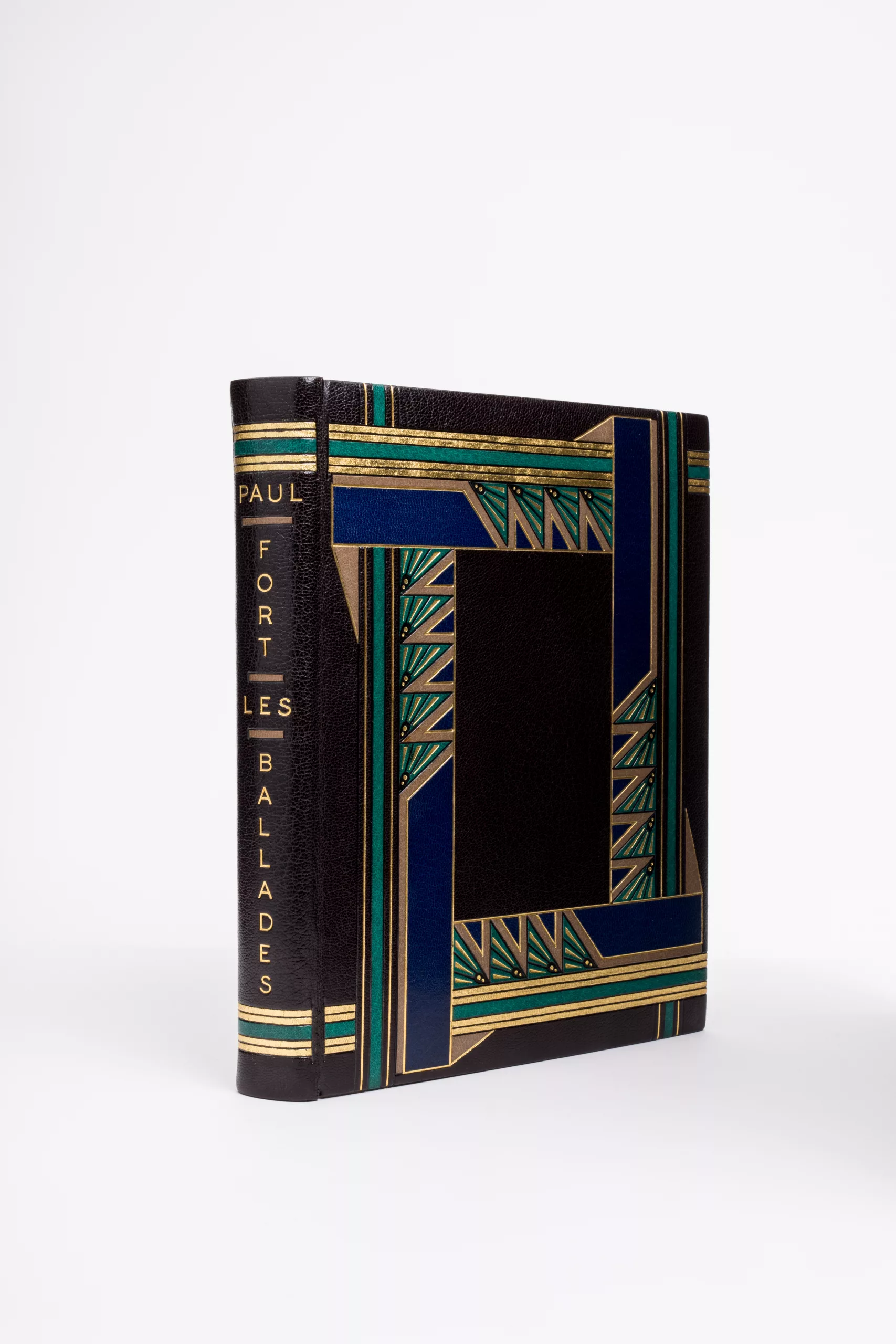
Les Ballades françaises
56 color compositions by F.-L. Schmied, engraved on wood under the direction of his son Théo Schmied, in an innovative layout that broke with the classical conception of the illustrated book: 26 plates, 4 title pages, 20 headpieces and tailpieces, 5 in-text illustrations and cover. “F.-L. Schmied conceived the layout, typography and illustration of this edition, which was printed in his workshops,” states the colophon.
A precious copy enriched with:
- 2 original signed gouaches, mounted at front;
- 2 numbered and signed suites, printed on fine Japanese paper, one of which comprises states of the plates, bound at the end of the text volume;
- 1 suite in black, on Japanese paper, entitled “suite de fumés,” numbered no. 11, bound separately.
The Ballades françaises, a collection of poems spread across several dozen volumes, were published between 1896 and 1958. It was the first series, published in 1897, that gave its name to the whole of Paul Fort’s work; Fort was elected “Prince of Poets” in 1912 and remained so until his death in 1960. The poet moves from one theme to another, depicting nature in its beauty and diversity or staging characters drawn from mythology. This series, “Montagne, forêt, plaine, mer,” forms volume II, published in 1898.
This is the only text by Paul Fort illustrated by Schmied, who found in these calls to travel a subject perfectly suited to his technique. An experienced wood engraver, Schmied employed the long and delicate camaïeu technique to produce color illustrations of extreme refinement, particularly well suited to the text, which delighted the most demanding bibliophiles of the interwar period. From 1922 he was assisted by Gustave Miklos, who supplied him with illustrations and ornaments, designed either from his own imagination or according to Schmied’s instructions. The collaboration long remained anonymous, at Miklos’s request; thanks to the substantial income he derived from it, he bought land on rue Gauguet in Paris around 1930 and built a house-studio there, moving in in 1933. Because of F.-L. Schmied’s financial difficulties in the 1930s, Miklos’s final work for him was never paid, and he subsequently turned to sculpture and the decorative arts.
A copy in the purest Art Deco style by Paul Gruel: finely inlaid with pieces of taupe, blue and green morocco, and delicate double bands of gilt fabric running across the covers and spine.
This exceptional work attests to the perfect mastery of Paul Gruel (or his craftsmen), inherited from his father, Léon Gruel, one of the leading French binders of the period 1890–1914.
This binding was probably executed from indications or designs by Schmied, who supplied the Maison Gruel with several highly detailed design models.