

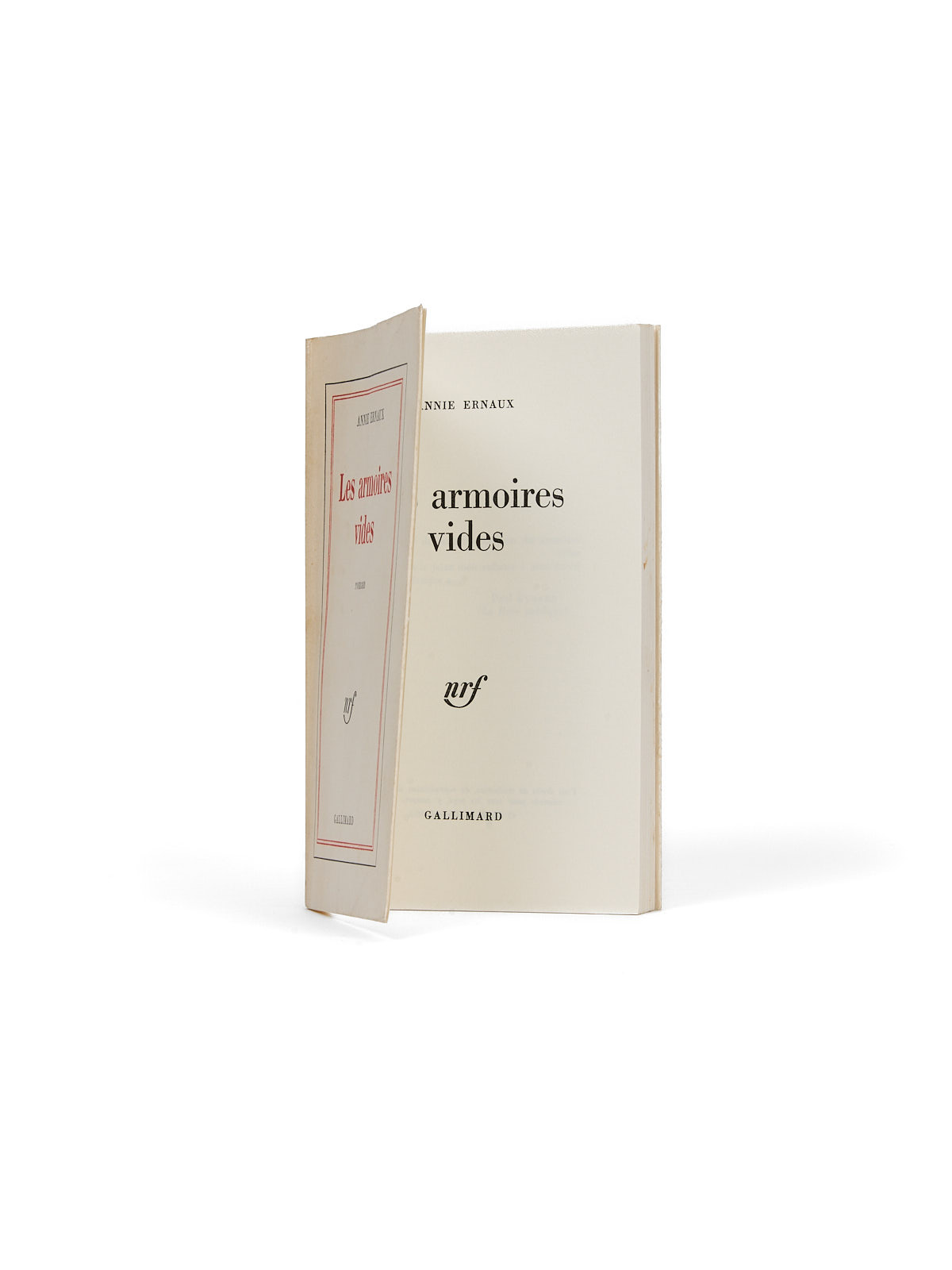
Les Armoires vides
Press copy, stamped as such.
Ernaux’s first foray into autofictional writing, Les Armoires vides lays the groundwork for the themes that would define her work: social memory, upward mobility through education, class shame, and the female body confronted with social norms. The prose is already nervous and charged with narrative momentum, yet already driven by a desire for raw truth. The novel forms the first part of an autobiographical triptych, followed by La Honte (1997) and, above all, La Place (1983), which would return to the figure of the father with a more assured sobriety.
On publication, Jacqueline Piatier sensed its importance: “A devil of a book! From an unknown author. Another teacher, an agrégée in literature, but one who knows how to speak and write, and who puts her finger on a wound. Hers? Ours? That remains to be debated once one has read this account of devastation, which owes nothing to documentary literature. A sharp, raw, vehement interior monologue unspools the poetic and sordid images of a childhood and adolescence leading to uprooting. A novel of formation, then, or rather of deformation, from which one does not emerge unscathed…” (Le Monde, 5 April 1974).