


L’Épervier de Maheux
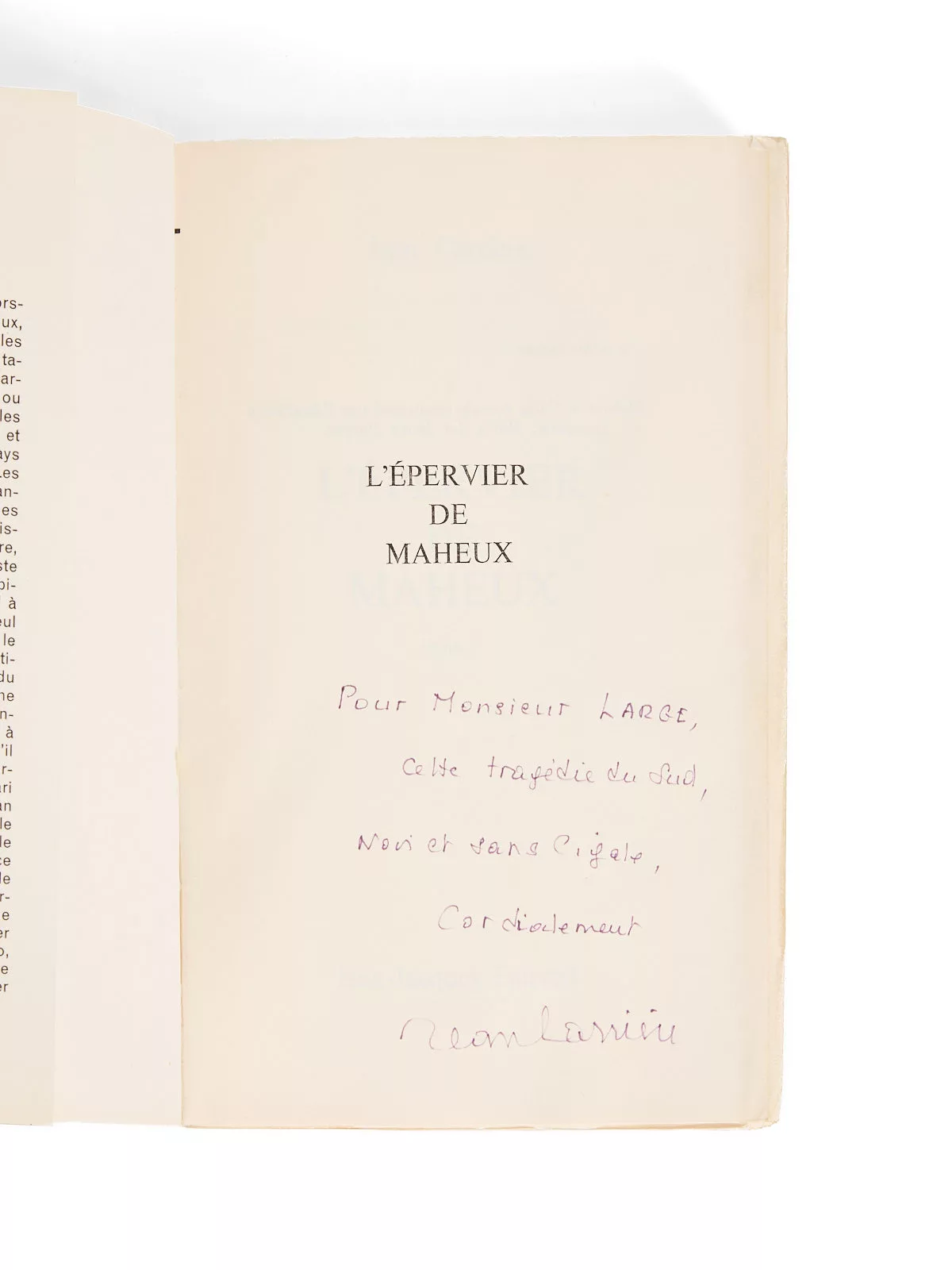
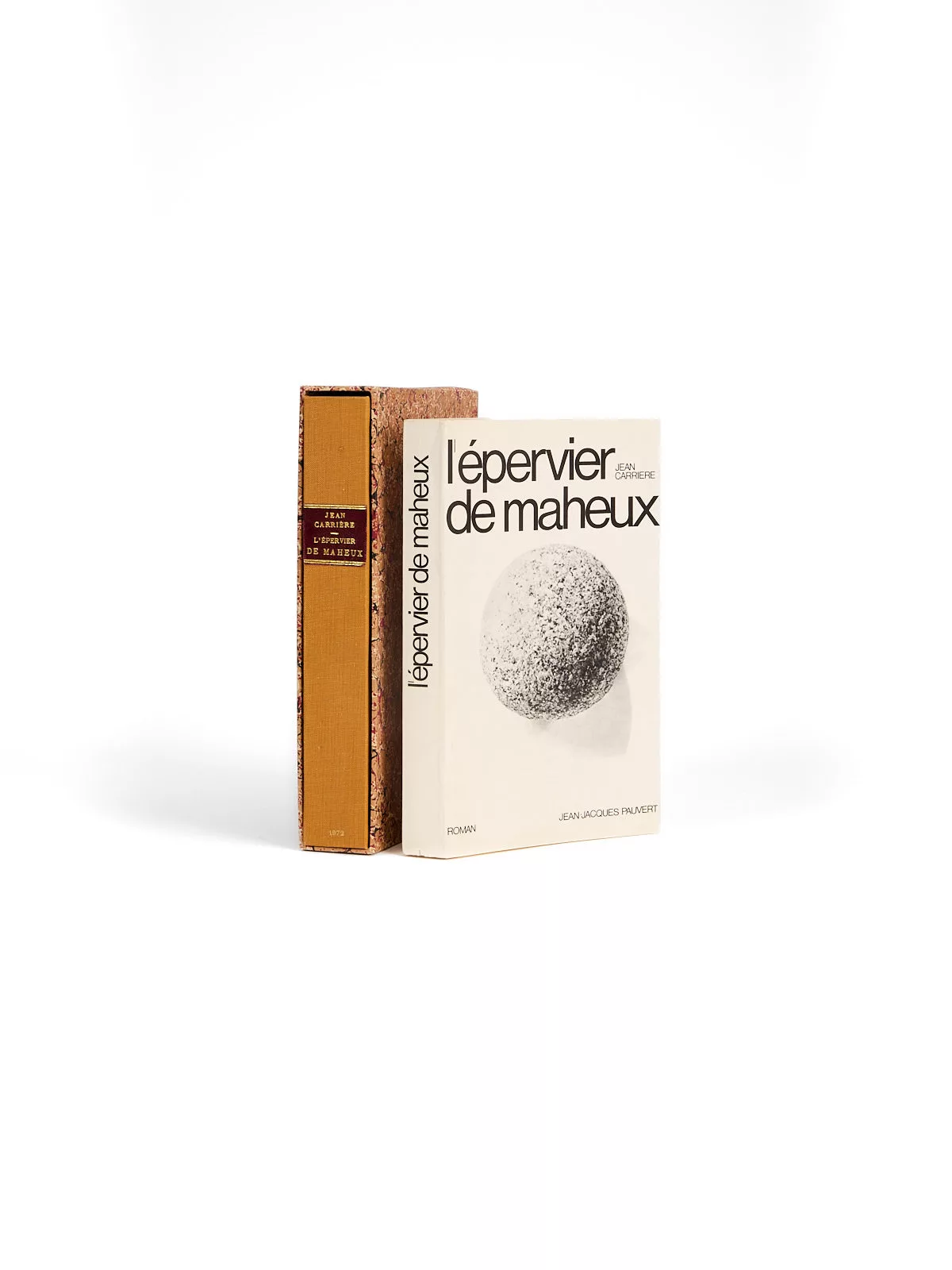
One of 50 copies on vélin pur fil (no. 7).
Signed presentation inscription: “Pour Monsieur Large, cette tragédie sur du Sud, noire et sans Cigale, Jean Carrière.”
When the Goncourt jury awarded its prize, on 20 November 1972, to L’Épervier de Maheux on the fifth ballot, they surely had no idea that this book would become the best-selling Goncourt winner in history: two million copies sold and fourteen translations worldwide. An immense success, both for its author and for its small publisher, Jean-Jacques Pauvert, whose reputation for controversy had until then kept him far from literary prizes.
The novel takes place in an imaginary hamlet, Maheux, precisely situated in the high Cévennes. This seemingly barren land is transfigured from the outset by a sumptuous description of the changing seasons, with their harshness and their beauty, and by the weight of “mineral oppression,” silence and solitude, where man lives a hard existence amid a magnificent and pitiless nature. The old people die, farms are abandoned one after another, children leave the region: this is the tragic atmosphere of an anachronistic France dying not far from us, described by a forty-three-year-old son of the Cévennes, still little known, who had until then published only one earlier novel, Retour à Uzès, which had gone largely unnoticed.
This regional, rural novel moved both the publishing world and the public. In Le Figaro, André Brincourt wrote: “Jean Carrière would rather take pride in his kinships. Far from concealing them, he displays them, takes his place in the sun and measures himself against the great names: Ramuz, Giono, Bosco, Chamson” (22 July 1972). Jean Freustié and Matthieu Galey, on Le Masque et la Plume of 26 November 1972, saw this Goncourt as “a kind of metaphysical adventure,” written in a lyrical and musical style, “emphatic and beautiful,” shaping a novel that went far beyond a simple account of poverty among Cévenol families.
But this success, as colossal as it was unexpected, proved a “catastrophe” for the author, who sank into a deep depression. This child of the mountains could not bear being catapulted into the role of a successful author and having to frequent Paris, an unreal and enchanted adventure that left him only with inner unease. The following summer, the Cévennes became fashionable: hordes of curious visitors sought out the novel’s settings; as early as May 1973, several hikes and a “Sporting and Literary Weekend in the Land of Maheux” were organized.
Local officials openly expressed their displeasure, and criticism rained down on Carrière, who was nonetheless responsible for none of it. Deeply wounded by the harsh criticism he received from his fellow Cévenols, he stopped writing and would return to this painful episode fifteen years later in Le Prix d’un Goncourt, prefacing it with this line from Borges: “Success is a misunderstanding, perhaps the worst of all.”
A very fine copy; rare on deluxe paper and with an inscription.