

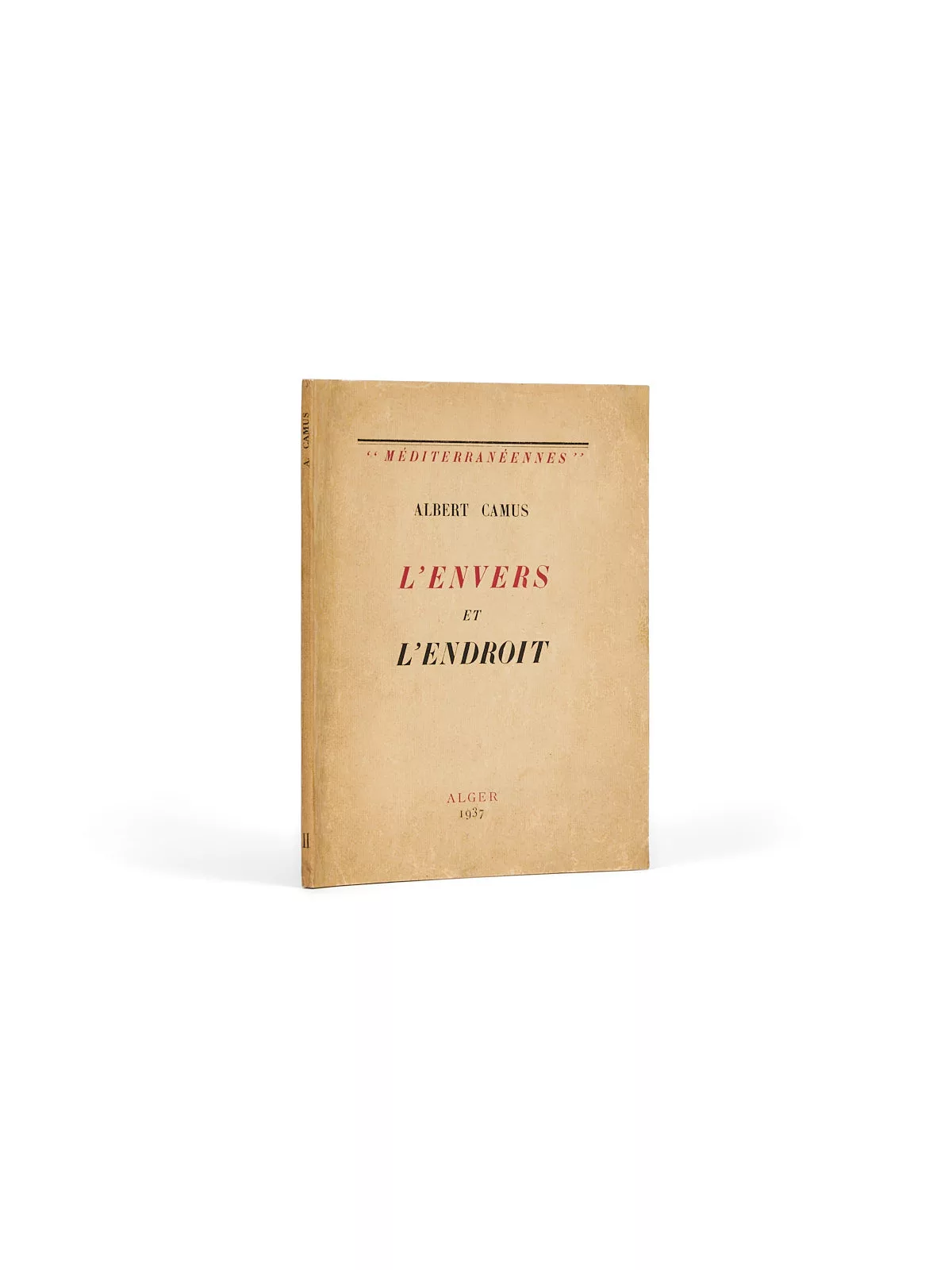
L’Envers et l’Endroit
One of 325 copies on alfa Hélio paper (no. 261).
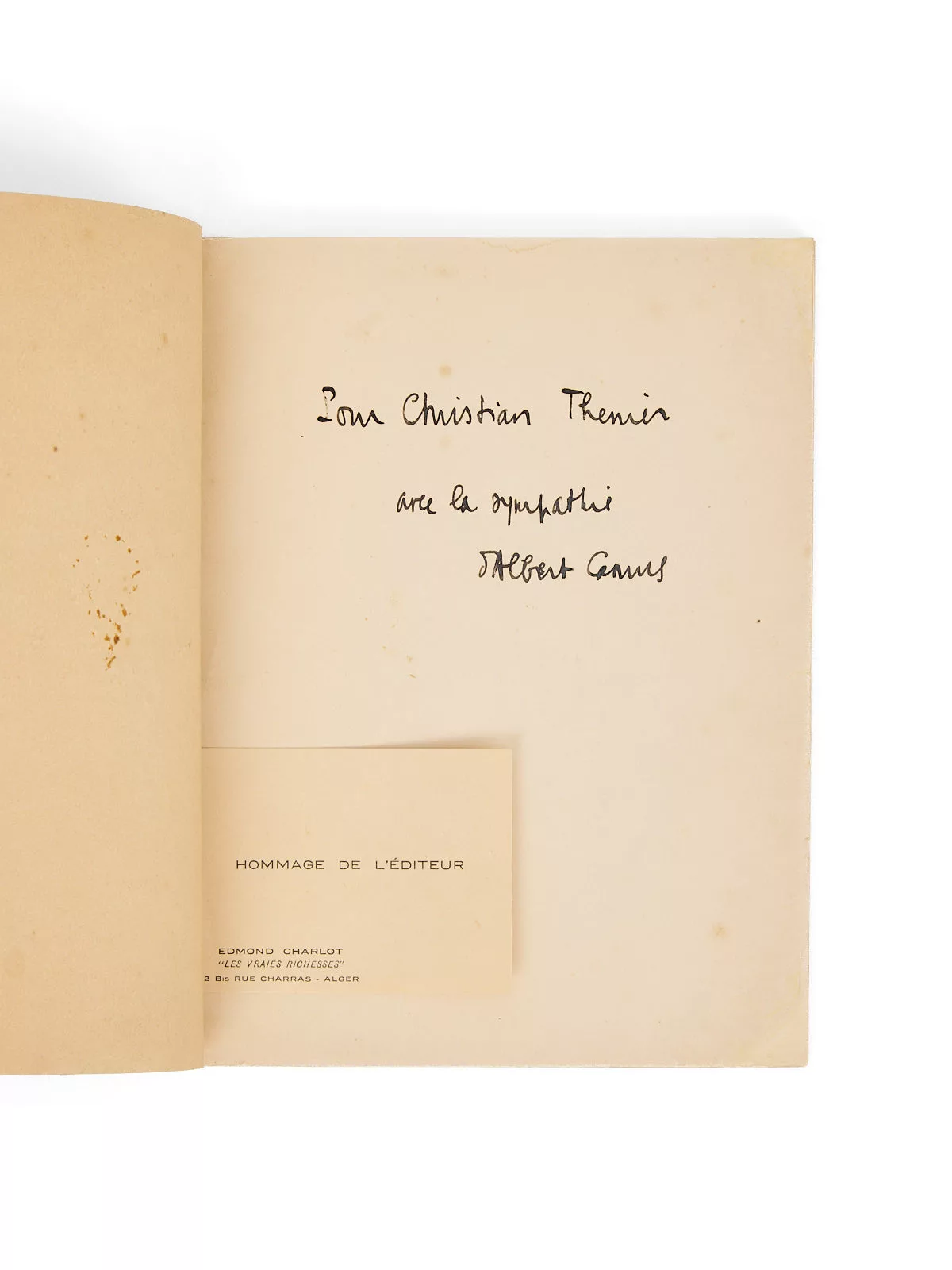
Signed presentation inscription: “à Christian Thenier, avec la sympathie d'Albert Camus.”
Mounted at front, the rare visiting card “hommage de l'éditeur” from Edmond Charlot.
The first book Camus published under his own name, L’Envers et l’Endroit brings together five essays written at the age of twenty-three: L’Ironie, Entre oui et non, La Mort dans l’âme, Amour de vivre and L’Envers et l’Endroit. Dedicated to Jean Grenier, his former philosophy teacher at the lycée in Algiers, the book already contains the whole source of his future work: poverty, the silent mother, the light of Algiers, the temptation of happiness and the awareness of death.
“The testimonial value of this little book is, for me, considerable. I say for me, because it is before myself that it bears witness, and it is from me that it demands a fidelity whose depth of difficulty I alone know”: this admission was made by Camus twenty years later, in the preface to the Gallimard reissue of the text. It indicates the importance of this first book published under his own name — after the “collective” essay Révolte dans les Asturies, a play written and staged in 1936, already printed by Edmond Charlot.
At the time, Charlot was a publisher still establishing himself, who wished to produce fine-paper printings for his “Méditerranéennes” series. The texts in the series were usually adorned with portraits or illustrations, but Camus’s two prewar publications with this publisher, L’Envers et l’Endroit and then Noces in 1939, have none, leaving only the sober text itself. This was no accident.
L’Envers et l’Endroit was offered by subscription in 350 copies on Alfa and 30 copies on vellum; in the end, the printing consisted of 30 copies on pur fil (five of them on green paper), 325 copies on alfa Hélio paper, and 30 press copies, printed S.P., on bouffant paper.
Only a handful of inscribed copies are known — just three have been identified. This copy was presented, almost certainly on publication in May 1937, to a “neighbor” of Camus, Christian Thenier, whose shop was located at 9, rue de Tanger, a few hundred meters from Edmond Charlot’s bookshop on rue de Charras, and between Camus’s home on rue de Lyon and that of his uncle Acault on rue Michelet: streets Camus walked daily, making this a particularly fitting provenance for the son of the Belcourt neighborhood, evoking the summer evenings in Algiers when all the neighbors gathered on their balconies, sharing “a solitude in poverty that restores worth to everything.”
Published in Algiers and little distributed during the “phoney war,” L’Envers et l’Endroit was slow, after the Liberation, to benefit from the success of L’Étranger and Le Mythe de Sisyphe. Camus finally agreed to its reissue in 1958. This gave him the occasion, in a substantial preface, to look back on the course of his career so far. While he judged the essays harshly in terms of form, written as they were at an age when “one barely knows how to write,” he warmly praised in them “the one source every artist carries within.” He now identified more clearly the lesson of the “voices of the poor neighborhoods,” “halfway between poverty and sunlight,” having since discovered in Paris “the double humiliation of poverty and ugliness.”
This copy was long part of the collection of the bookseller Louis Tschann and his daughter Marie-Madeleine Tschann (Paris, Alde, May 2013, no. 208). It was also exhibited at De Tipasa à Lourmarin (2013, no. 10, reproduced in the catalogue).
A good copy, despite a restored wrapper and some old foxing to the preliminary leaves.