

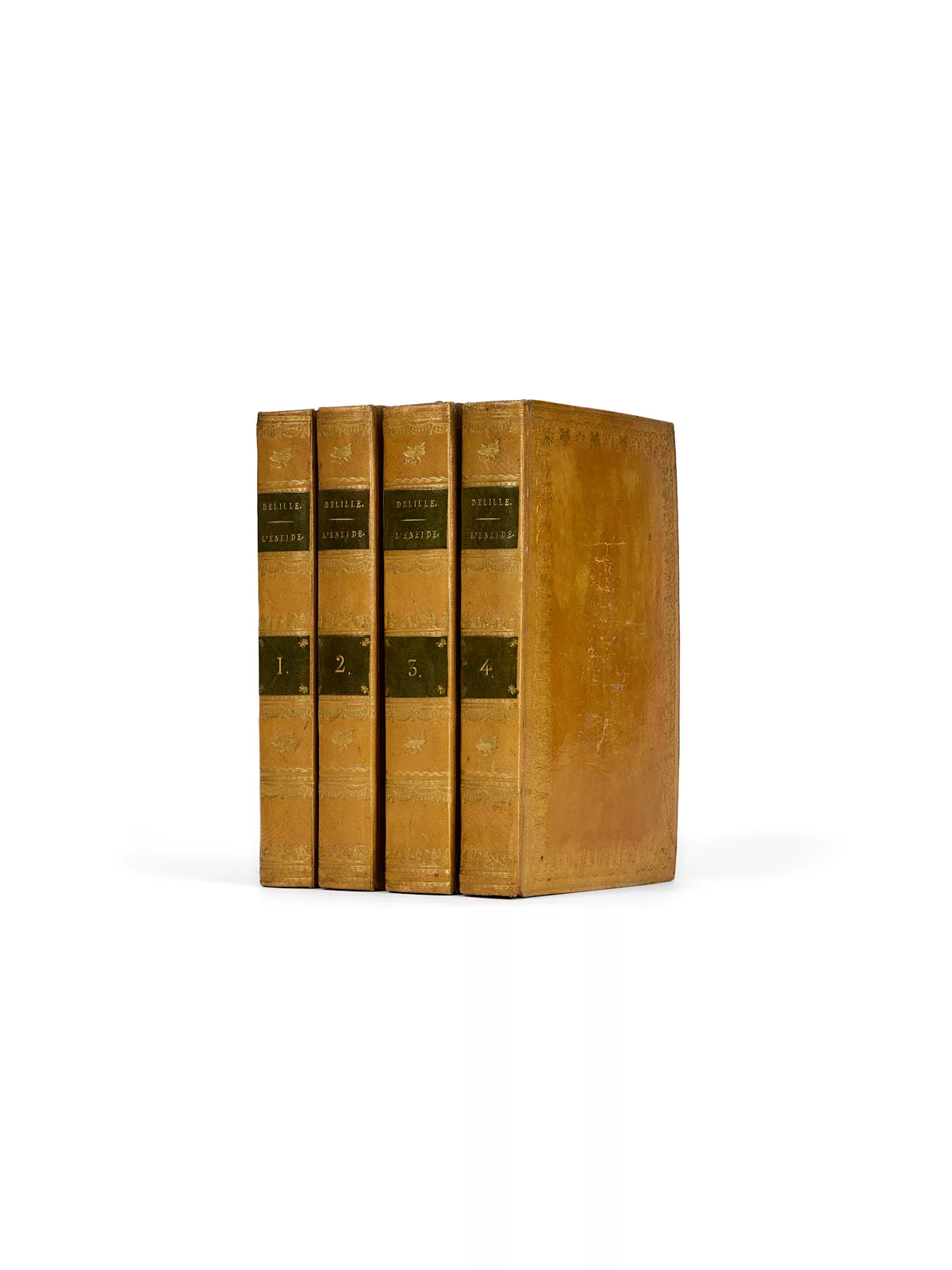
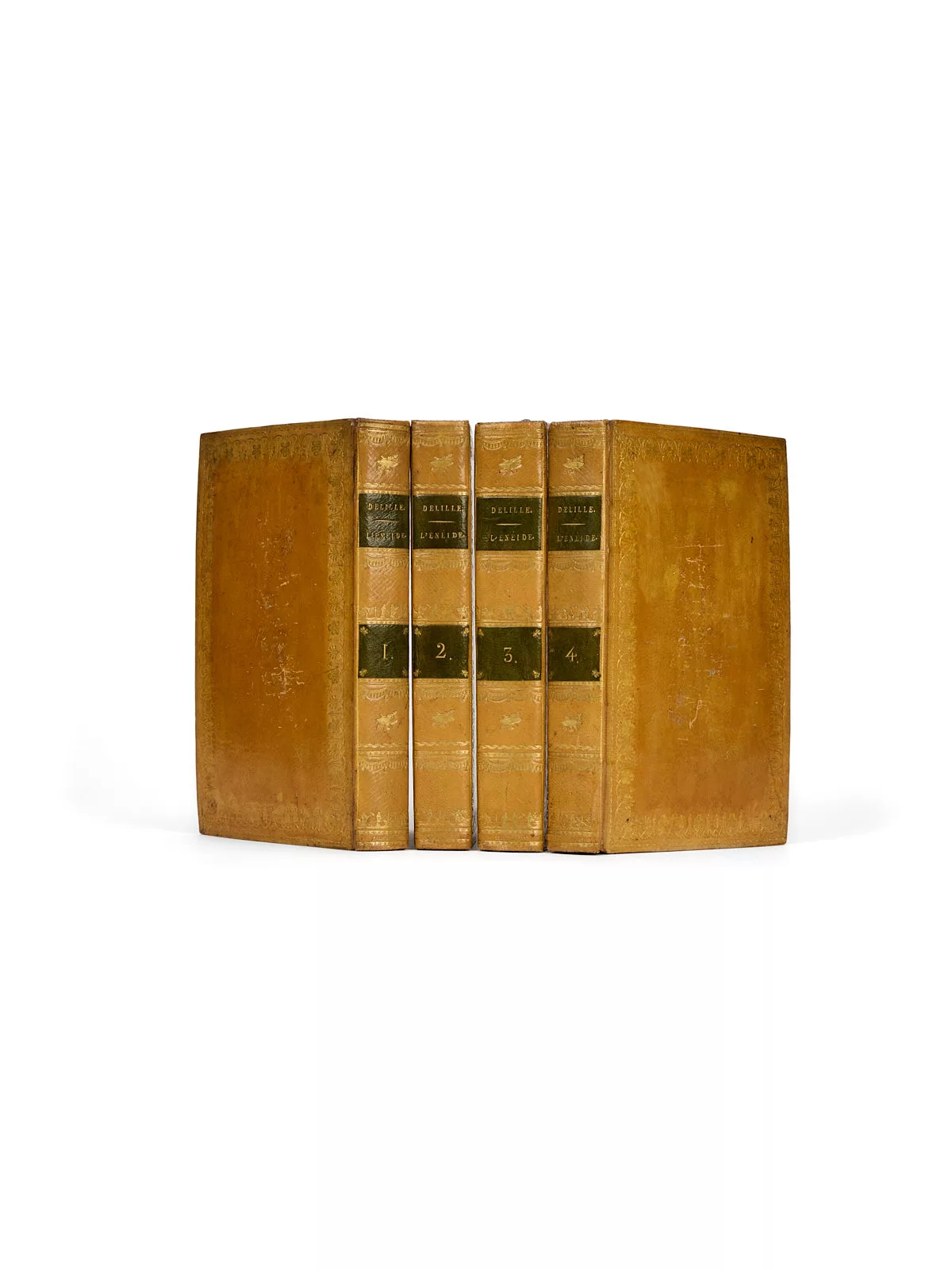
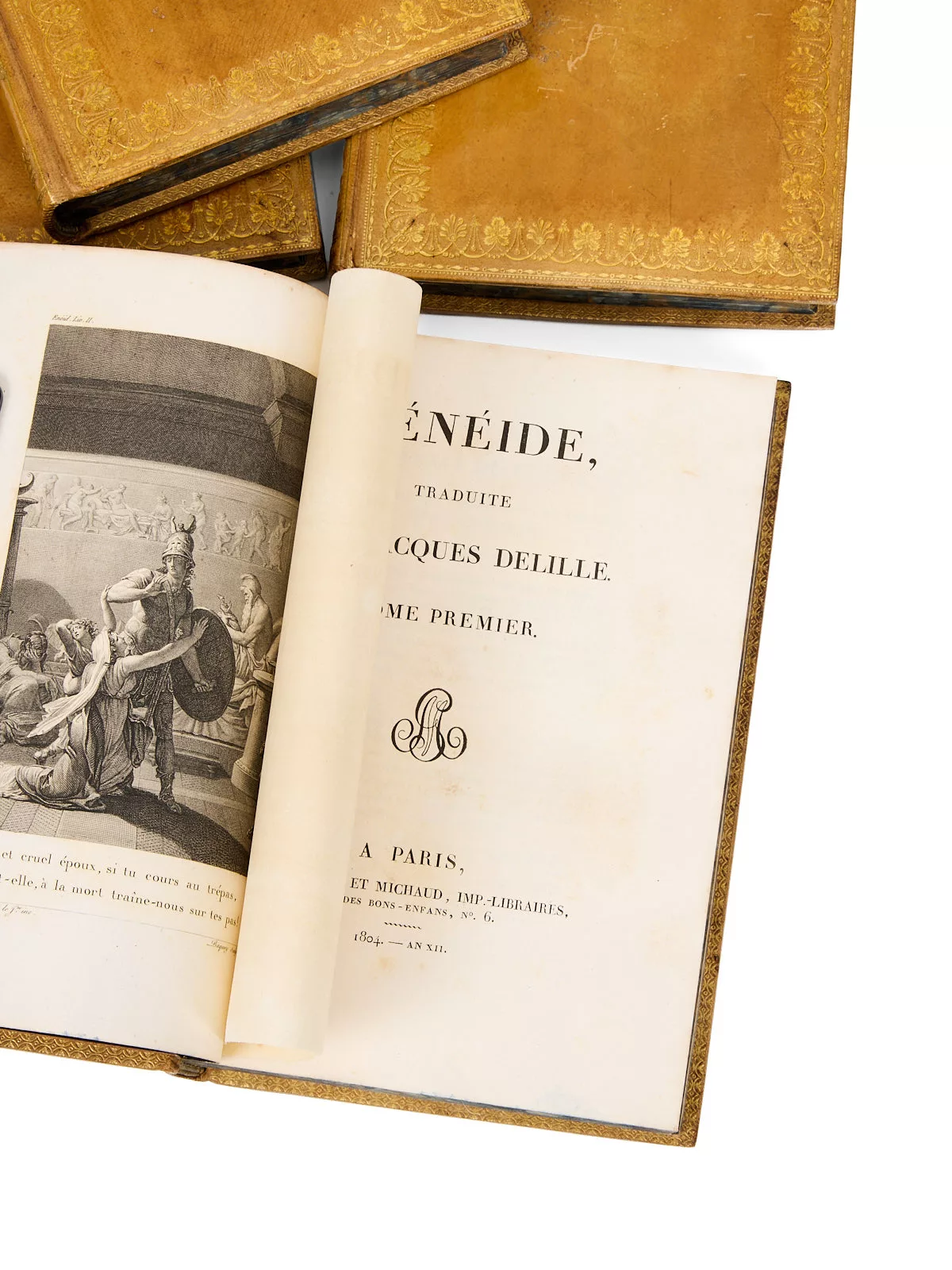
The translation of the Georgics, published in 1770, had established Jacques Delille’s reputation and shaped his career. It had opened the doors of the Collège de France, then of the Académie française, and made him the most celebrated verse translator of his time. More than thirty years after this first Virgilian triumph, Delille returned to the Latin poet with a far more considerable undertaking: rendering all twelve books of the Aeneid into French rhymed alexandrines.
For much of the nineteenth century, Delille’s Aeneid remained one of the most widely read French translations of Virgil, constantly reprinted and long regarded as a model of poetic eloquence. In the history of translation in France, it occupies a place comparable to Chateaubriand’s Paradise Lost and Leconte de Lisle’s Iliad.
The four engraved frontispieces after Moreau le Jeune felicitously accompany this neoclassical rendering of the epic.
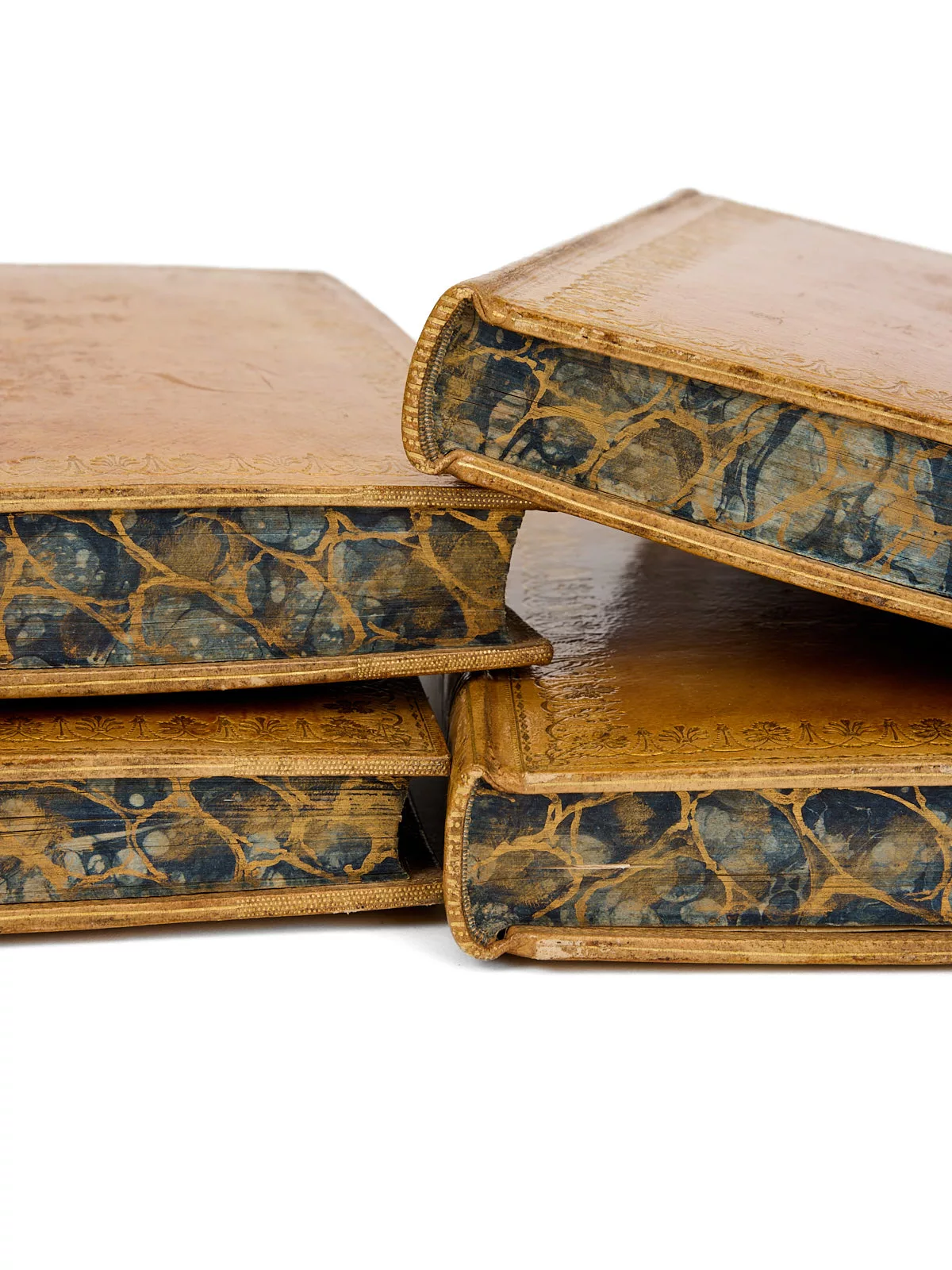
The copy is remarkable for its lemon morocco binding, signed by François-Ambroise Mairet. A binder, gilder and lithographic printer, Mairet was established in Dijon in the early nineteenth century. Contemporary bibliophiles held his work in high esteem: he was described as a rival to the finest Parisian craftsmen, and Gabriel Peignot ranked him among the distinguished binders of his day. Mairet also played an important role in the early development of lithography in Burgundy. In 1818 he published a Notice sur la lithographie, whose second edition, in 1824, was expanded with an Essai sur la reliure et le blanchiment des livres et gravures. This treatise, drawn from his own practice, was frequently reprinted and cited in nineteenth-century technical manuals.
The copy bears the bookplate of the library of the Château de Montmoyen, in the Côte-d’Or, some sixty kilometers from Dijon. The combination of this bookplate and the binder’s signature allows this elegant binding to be linked to a commission for the château’s library.
A fine copy.