

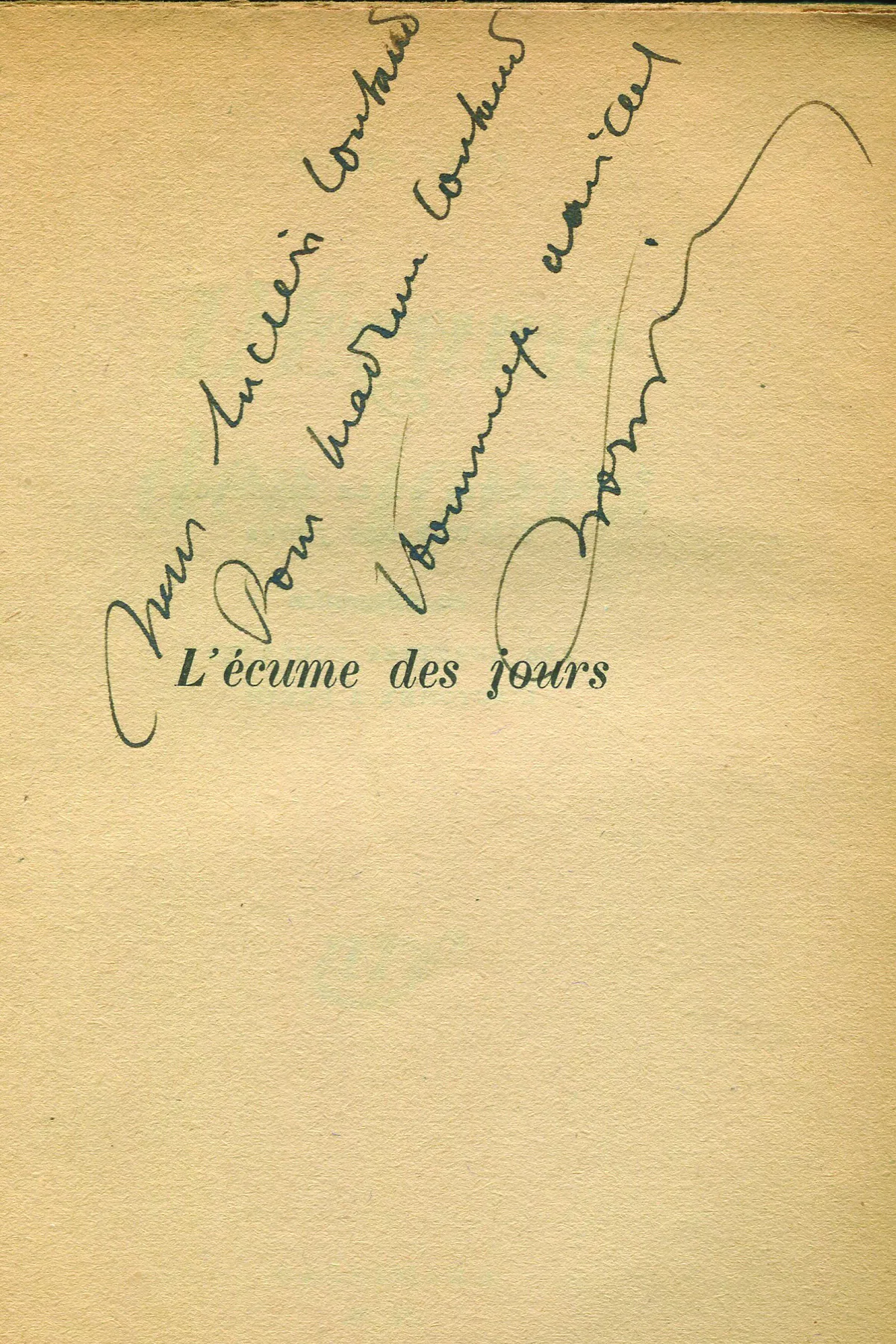
L’Ecume des jours
Review copy (no deluxe-paper copies were issued).
Presentation copy inscribed to Lucien Coutaud. A graduate of the École des Arts Décoratifs in Paris, Coutaud had frequented the Parisian galleries since 1920. Close to André Fraigneau, Jacques Prévert and Rose Adler, he illustrated several titles published by Guy Lévis Mano and in Surrealist journals. After the war, he became part of the Saint-Germain-des-Prés circle, alongside Hugnet, Sartre, Picasso, Paulhan, Labisse and Vian, whom he met in 1947. A close relationship developed between the two men, and Vian wrote a long presentation text on the artist for the Maeght supplement of Derrière le Miroir in November 1948: “Coutaud, a man of the South, builds his own world and mocks the other.” The following year, when Cantilènes en gelée appeared, Vian dedicated one of its poems, the striking “Les Îles” (“Il ne faut pas aller dans les îles de la mer Noire / Il vaut mieux acheter du jambon”), to Coutaud.
“There are only two things: love, in every way, with pretty girls, and the music of New Orleans or Duke Ellington — it’s all the same. Everything else should disappear, for everything else is ugly.”
When this novel appeared, Boris Vian was the jazzman of the Abadie orchestra, which he had formed in complete secrecy during the Occupation. Thanks to his friend Claude Léon, the group’s drummer, he obtained a position at the Office du papier — a dream job requiring nothing more than his physical presence. L’Écume des jours was written in nine weeks in the large room he shared with Léon, which served as their “office,” and was completed on 13 June 1946, just in time to enter for the Prix de la Pléiade on Paulhan’s advice.
The novel earned the young author a place contributing to Les Temps modernes — fitting enough, since one of the book’s heroes is a devoted reader and collector of the works of Jean-Sol Partre. True fame came fifteen years later, thanks to Jean-Jacques Pauvert, publisher of Vian’s complete works, who bought back the rights in 1960: “Gallimard even asked me, as a favor, to take the unsold stock off their hands. They sold it to me at the price of the paper! Which gives some idea of how little had sold between 1947 and 1963…”