

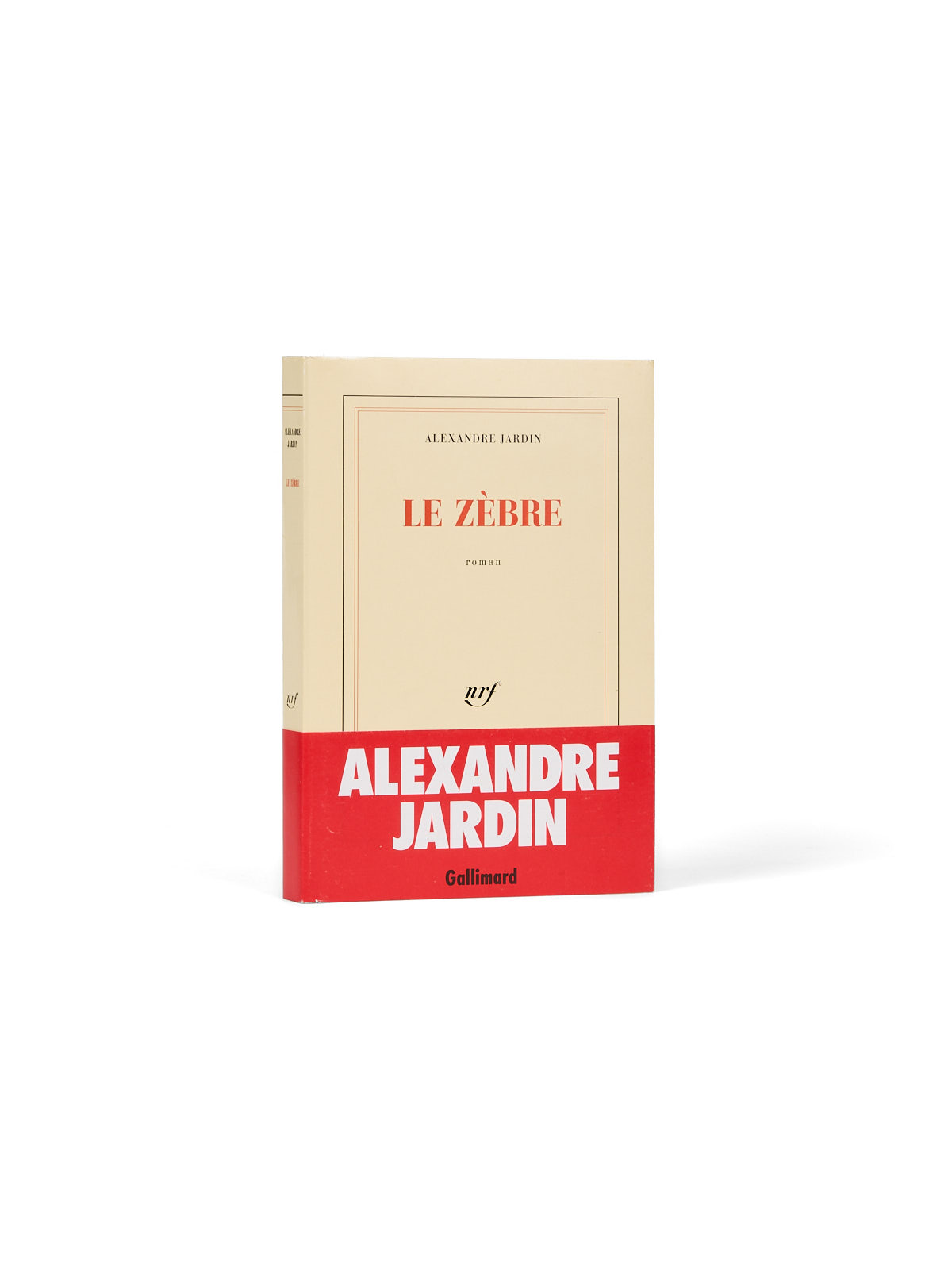
Le Zèbre
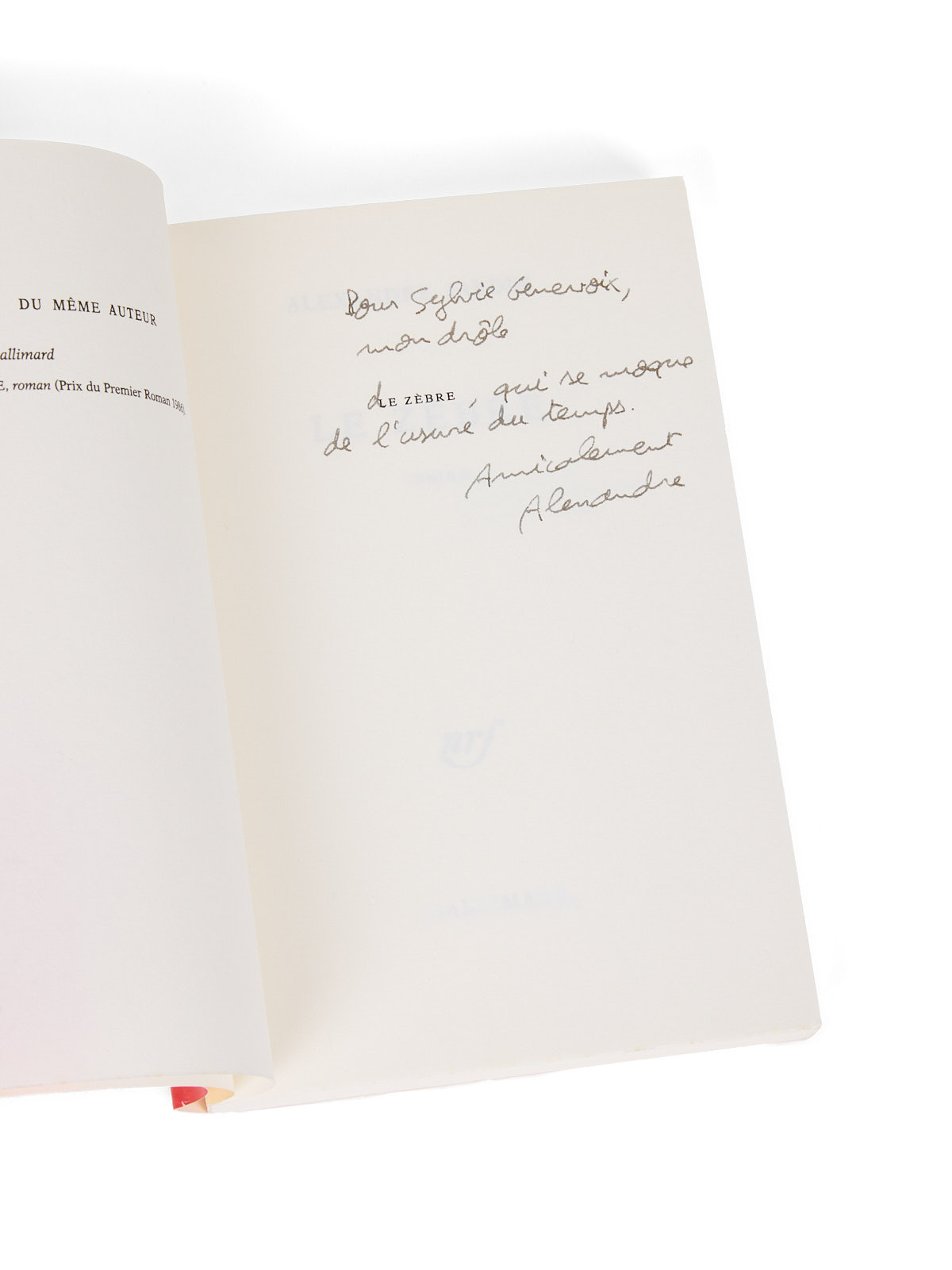
Signed presentation inscription: “Pour Sylvie Genevoix, mon drôle de [le zèbre], qui se moque de l'usure du temps. Amicalement, Alexandre.”
“Gaspard Sauvage, known as the Zebra, refuses to believe in the decline of passion. Though a provincial notary — hardly a profession prone to eccentricity — the Zebra is one of those irregular souls who live at the mercy of their own fantastical moods. Fifteen years after marrying Camille, he decides to revive the ardor of their early days together. Imperceptibly, the fervor of their embraces has turned into the quiet complicity of an old married couple. This decline distresses Gaspard: to him, domestic peace is synonymous with shipwreck. Far from resigning himself, he sets out to reconquer his wife. Through comic devices and outlandish stratagems, he will become again what he should never have ceased to be: Camille’s Lover, the man of her dreams.”
Alexandre Jardin has recounted how this second novel came about: “In the spring of 1988, I had already written a first novel [Bille en tête], and I had a deadline for my second one. I arrive at the countryside and tell my mother that I’ve just finished a book, but that I’m ashamed of it, because it doesn’t feel like me. ‘It really doesn’t feel like you?’ I said no. So she took the manuscript and threw it into the fire. She burned it. She told me, ‘You can’t publish something that isn’t you.’ She put me in a terrible bind, because I had a deadline. So I wrote Le Zèbre in six weeks. It’s a replacement book. The starting point was the certainty that my father should have experienced this. Even if in my novel, the zebra is more effective than dad! For my part, I wrote the man I dreamed of, and repaired in advance the mediocrity of life. Tens of thousands of people, maybe more, have played at being the zebra. If fiction inspires our reality, it’s worth publishing.”
Winner of the Prix Femina in 1988 and an immense popular success, the novel was adapted for the screen three years later by Jean Poiret, in what would be his final film.
A good copy with a distinguished provenance: Sylvie Genevoix.
A discreet but influential literary figure, Sylvie Genevoix studied classical literature at the Sorbonne before embarking on a career in publishing. She began at Plon as a press attaché for the 10/18 imprint, then coordinated the literary departments of Plon-Perrin-Julliard, becoming literary director at Julliard. From 1992 to 2005, she served as literary director at Albin Michel, before being appointed to the Conseil supérieur de l’audiovisuel (CSA), where she worked on the development of local television and on making programming accessible to people with disabilities. She also chaired the Mission langue française et francophonie. She grew up at Les Vernelles, the family home acquired by her father, Maurice Genevoix, in 1927, where she developed a deep attachment to the Loire and to family memory, which she would evoke in La maison de mon père (2001):
“It was in this nest of Les Vernelles that I was born, that I took my first steps, my hand in my father’s hand, that he taught me to speak, to look, and to marvel. There he gave me the most precious, the most wonderful of teachings: the love of life. There I return, as often as possible and for a long time to come, to find memories which, twenty years after his death, have taken on an ever-renewed intensity and color. … I feel, toward my father and toward this house made in his image, indebted for so many unspeakable treasures, so many of those small nothings that enchant or soothe, that I can only be a modest spokesperson, a faithful and attentive witness who tries to pass on and share a little of what he received.” (Sylvie Genevoix, La maison de mon père, introduction).
Publisher’s wraparound band preserved.