

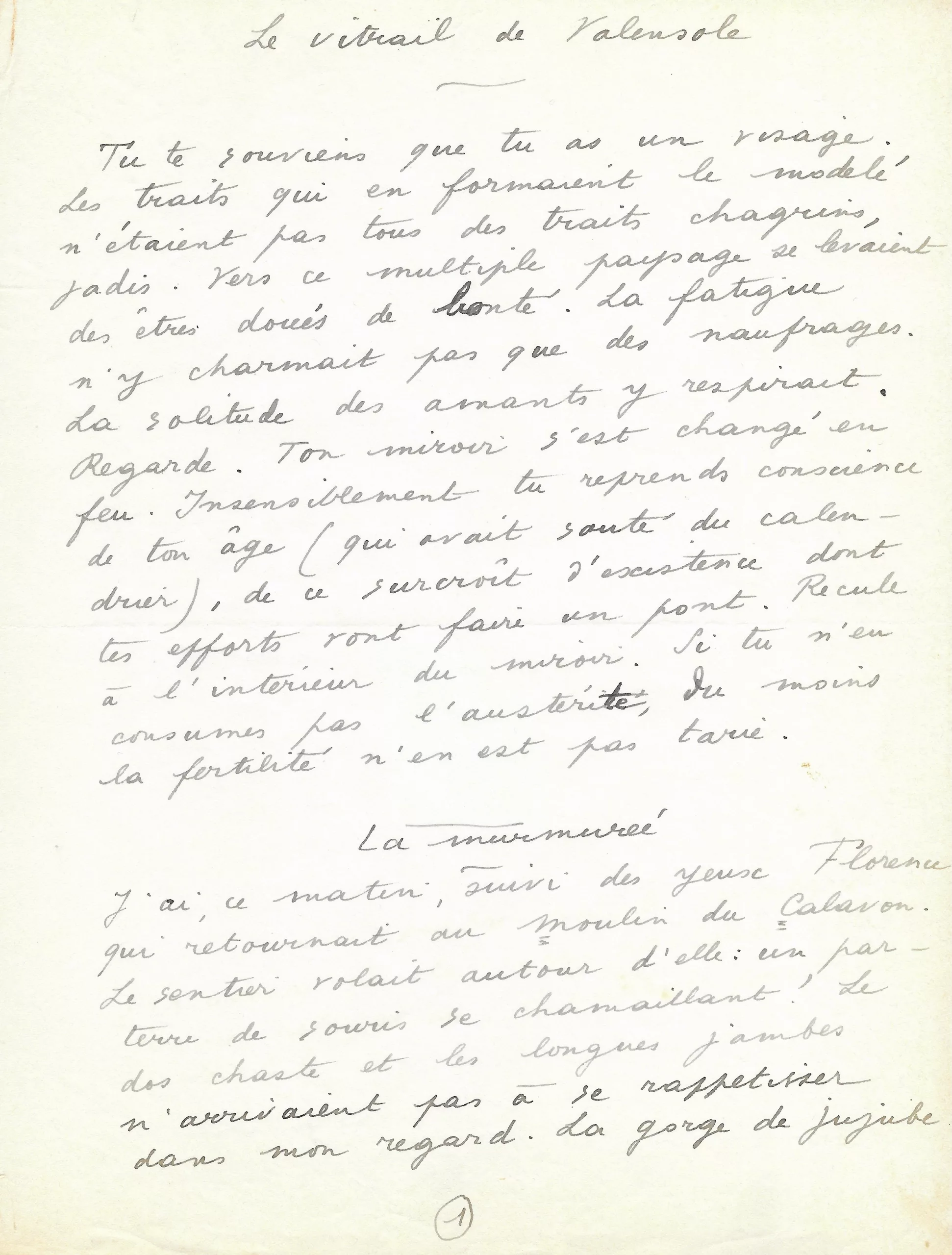
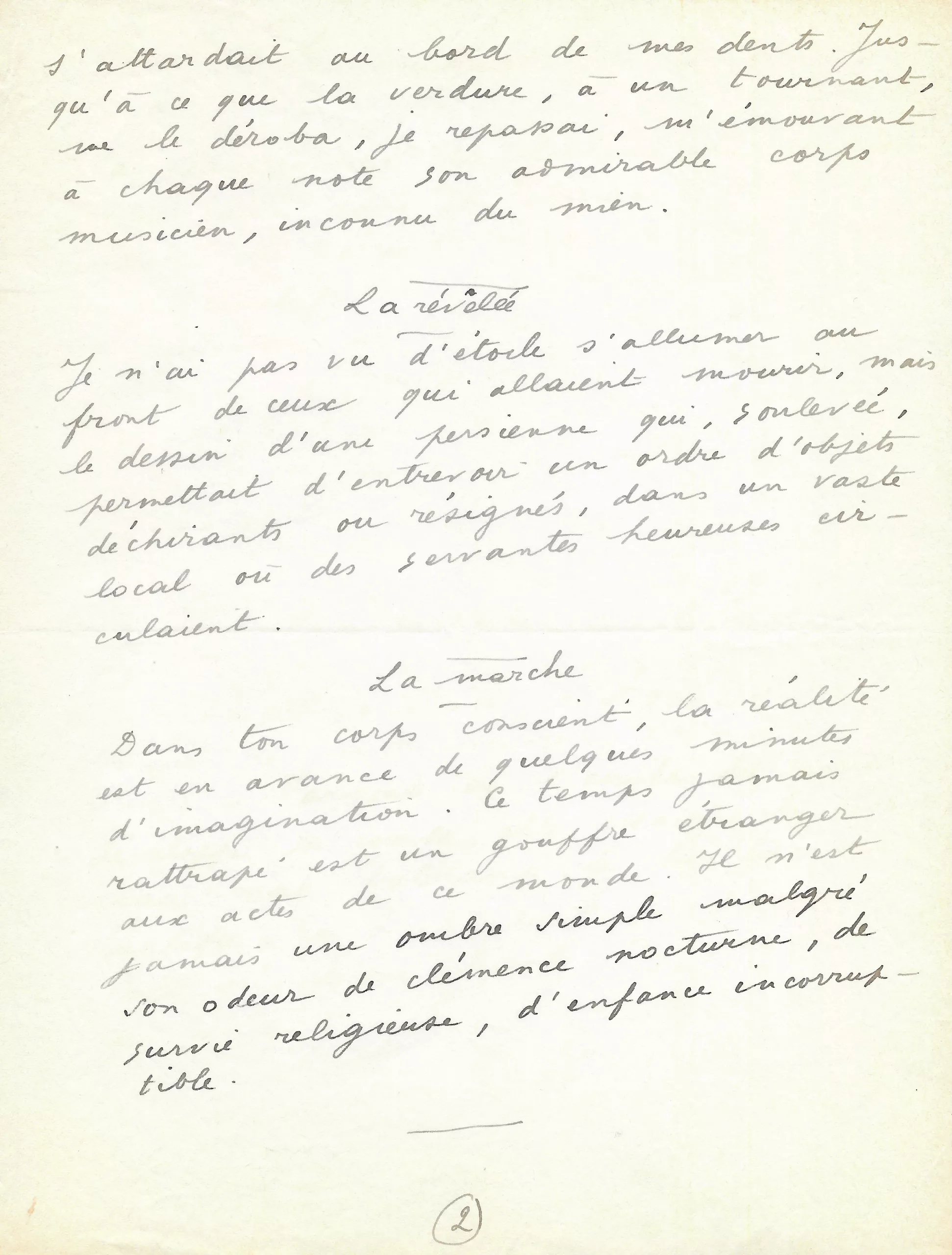
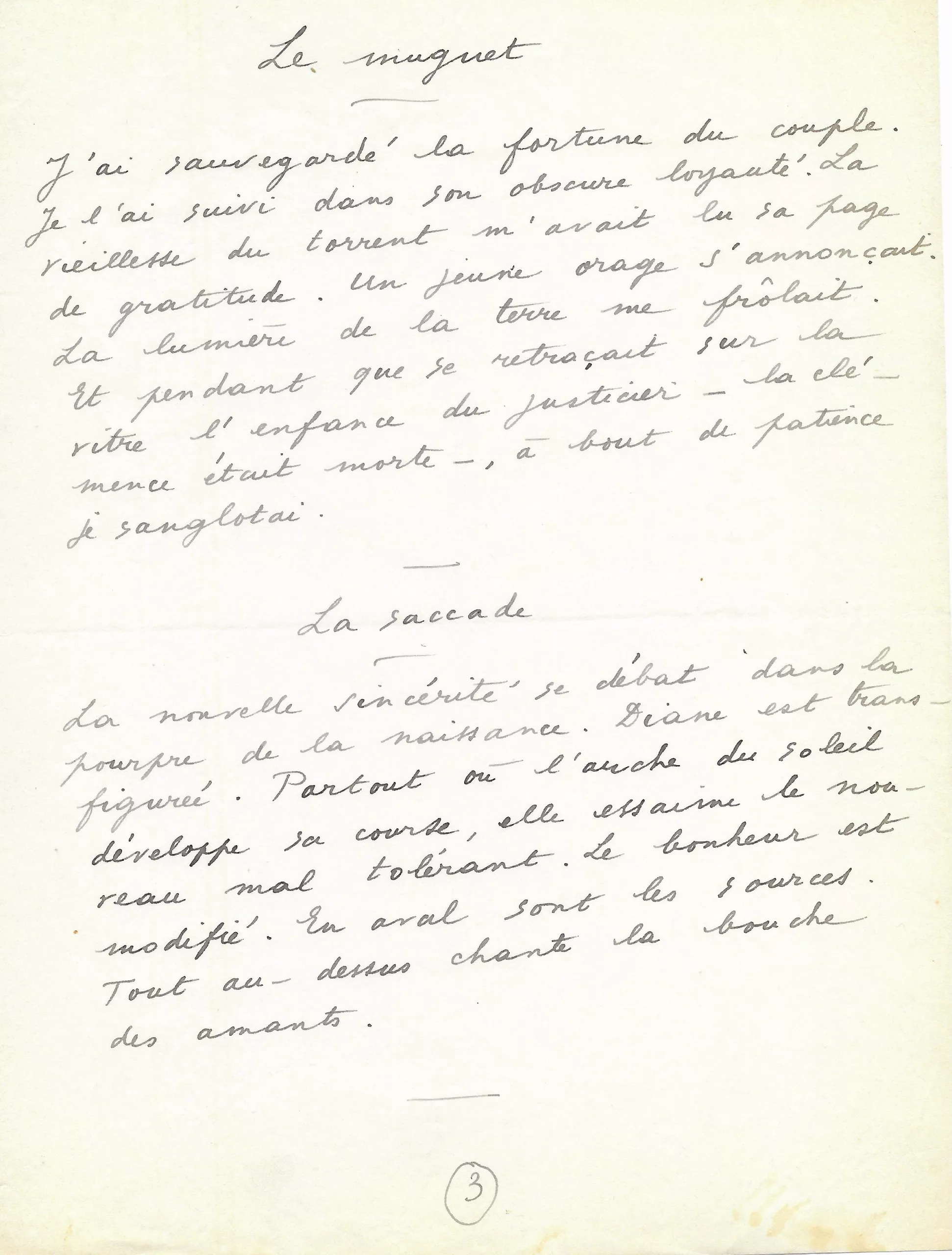
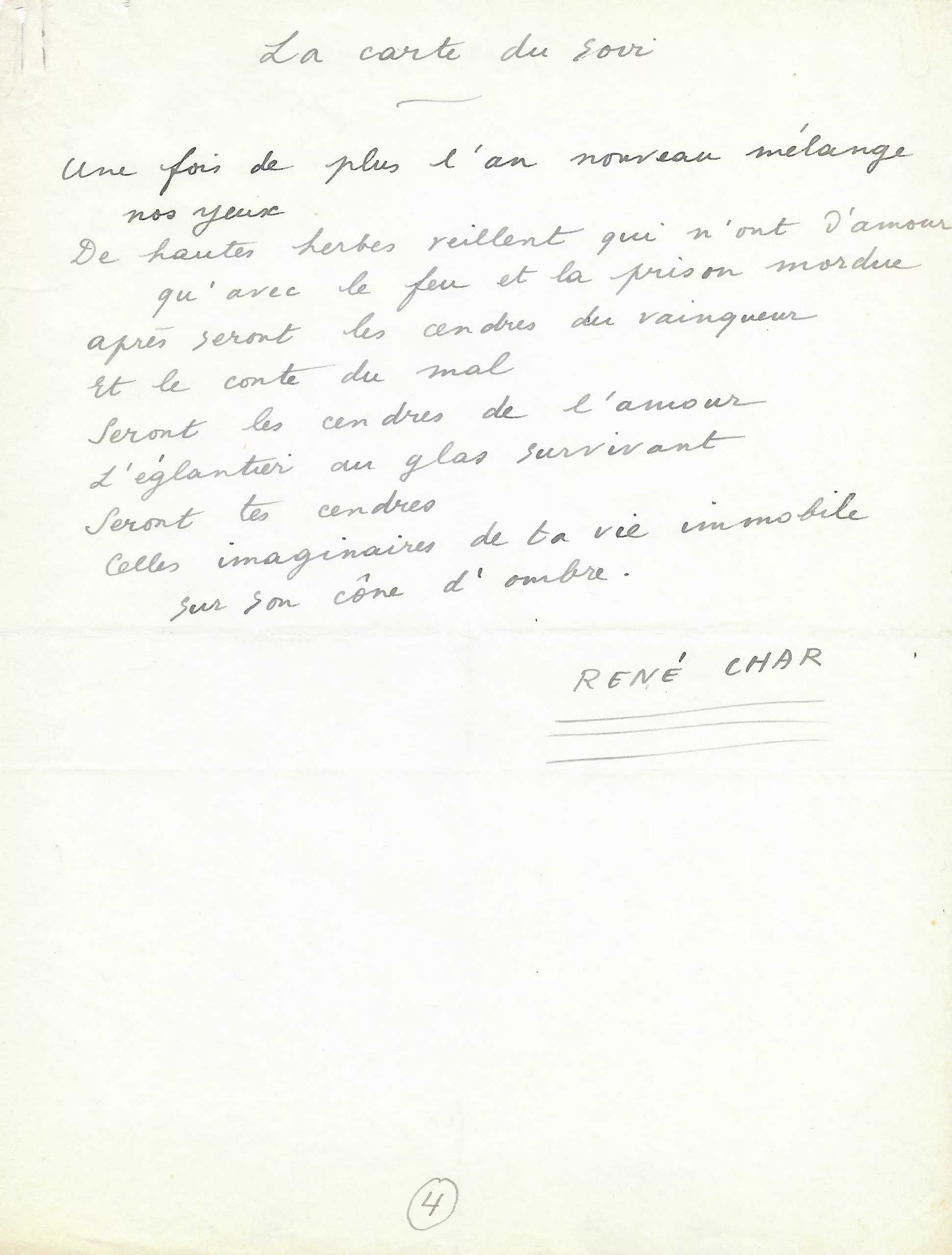
« Le Vitrail de Valensole », « La murmurée », « La révélée », « La marche » et « La carte du soir »
The Feuillets d’Hypnos were written between 1943 and 1944, while the poet, known as “Capitaine Alexandre,” commanded the parachute and landing section of the Durance zone of the Resistance. He took the name “Hypnos,” the man who watches over his people through the night, alert like the Resistance itself, ready to awaken at any moment.
Char rarely spoke of his actions in the Resistance, but he liked to tell one story: he had been asked to find, on the Valensole plateau, an open field where Allied planes in difficulty could land. He found a suitable field, but a magnificent three-hundred-year-old walnut tree stood in the middle. The owner agreed to lease the field but refused to cut down the tree, until Char explained why it was needed. As they cleared the base of the tree, they followed its long, thick main root for some ten meters and found, at its end, the bones of a warrior buried in his armor, apparently from the Middle Ages, with a walnut in his pocket at the moment he was killed — the root having grown to exactly the height of his femur, the walnut having taken root in the grave. This extraordinary meeting of two warriors separated by centuries clearly struck the imagination of the poet-soldier who was then Captain Alexandre, and its fragments, phrases and words would, years later, form the pages of the Feuillets d’Hypnos. As Char later wrote, the pages were written “in tension, anger, fear, emulation, disgust, cunning, furtive meditation, illusions of the future, friendship, love,” marking “the resistance of a humanism conscious of its duties, discreet about its virtues.”
This fragmentary writing, dictated by the demands of clandestine engagement, was first assembled two years later into a typescript of 72 fragments, which Char revised the following year. As he wrote to Gilbert Lely on 17 July 1945: “I have thrown myself violently into the work. It is called Carnet d’Hypnos (Hypnos is a man’s name), 1943–1944. I was fortunate enough to recently recover the notebook I kept at Céreste, buried in a wall before I left for Algiers. It is this notebook that I am going to publish […]. I am putting it in order, abridging or expanding as needed.” He added, among other things, fragments 204 and 221, written in Algiers in the summer of 1944. This work resulted, in August 1945, in a second typescript intended for the printer, now preserved at the Bibliothèque littéraire Jacques Doucet, with the note: “There is no other manuscript of the Feuillets d’Hypnos. For reasons easy to understand, I destroyed the notebook of originals […] except for one leaf kept as a witness.”
As Char told Lély, he destroyed all the wartime manuscripts of Hypnos, and few or none of the original fragments survive. However, the Gallimard publication was preceded by a magazine appearance, in Fontaine, for which the poet sent manuscripts to his editor, Max-Pol Fouchet. The poems were intended to appear in the collection Char was preparing for the following year, Le Poème pulvérisé, for which he asked Henri Matisse to design the frontispiece.
The first texts from Hypnos appeared in the magazine in March 1946: fragments 213, 214, 218, 219, 221 and 222, each then bearing an independent title (“Bora,” “Le vitrail de Valensole,” “La murmurée,” “La révélée,” “La marche” and “La carte du soir”).
A precious manuscript of five of the six published texts, presenting for the first time the poet’s “Resistance writings.” Almost certainly copied from the only typescript preserved by René Char, they constitute in fact the only known contemporary manuscripts of the Feuillets d’Hypnos.