





Le Veuf
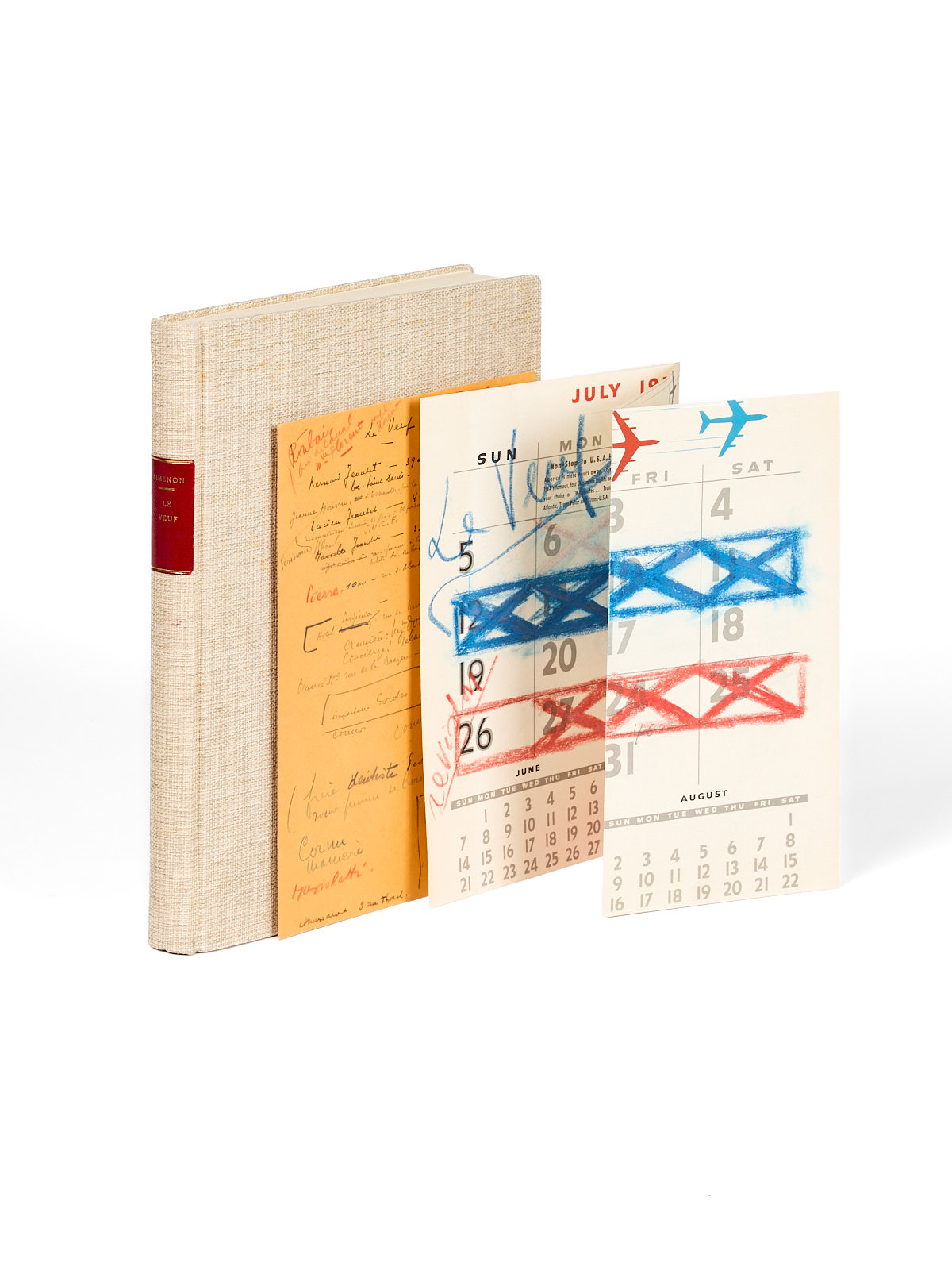
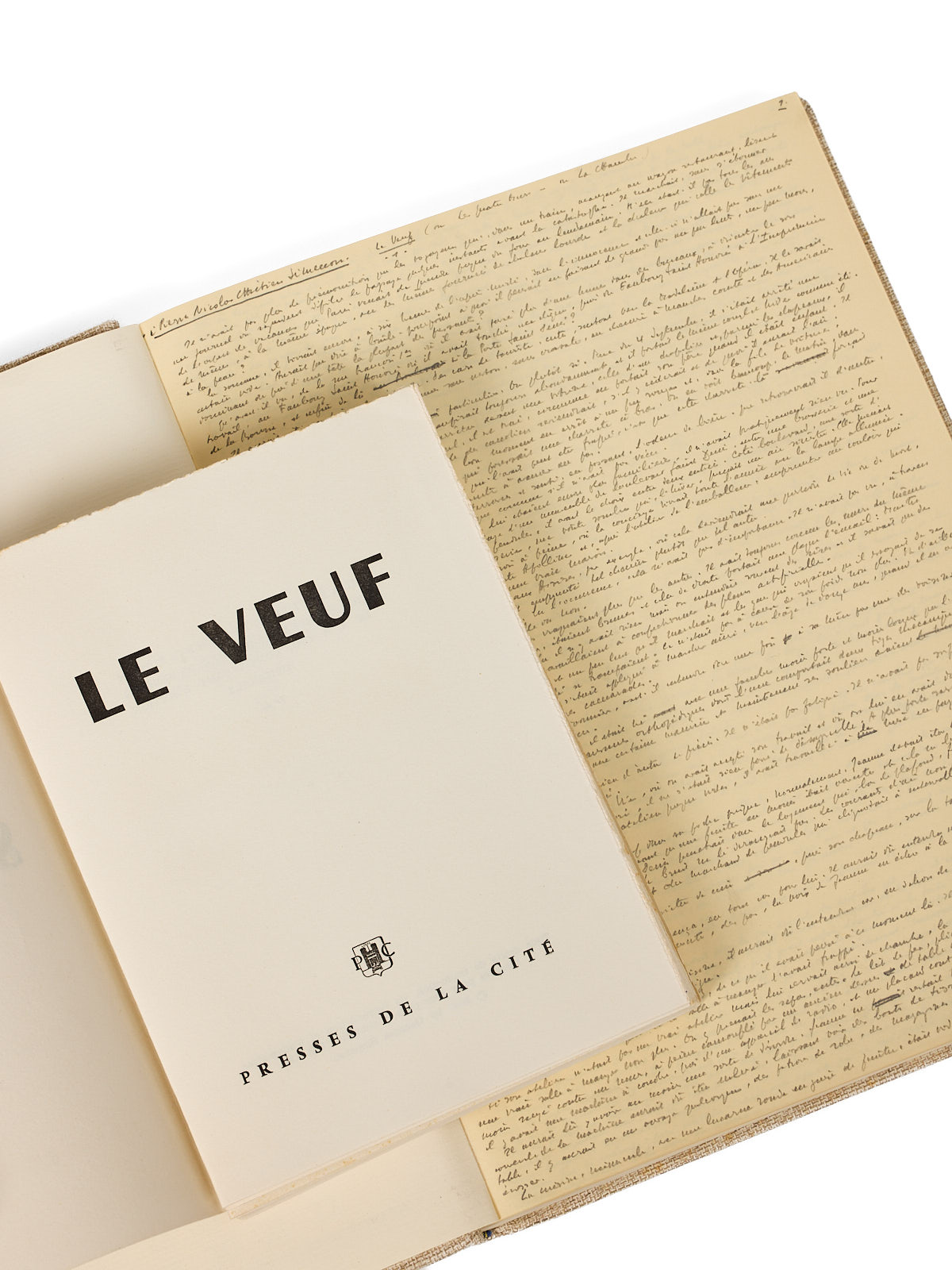
It brings together the preparatory plan on the yellow envelope, the first-draft manuscript, the corrected typescript and the working calendar. The whole is bound in full cloth, commissioned by Simenon, identical to the other manuscripts he had bound during this period. Manuscripts preserved in this way are held either at the Fonds Simenon of the University of Liège or in the Fonds des Archives Simenon in Lausanne. Manuscripts circulating in private hands are generally older, dating from the 1930s or 1940s: Simenon gave away a few, and most of the others were those sold at auction in 1943 for the benefit of prisoners of war. Thereafter, Simenon very rarely parted with his manuscripts.
A set assembled in this way and complete with all its elements (envelope, calendar, manuscript and typescript) is extremely rare. This set is all the more exceptional in that it is one of only four manuscripts that Simenon gave to his children, who were also the dedicatees of the published books.
The first element is the yellow envelope, part of the ritual of Simenon’s working method: it is the first written trace of his work, “the place where he records the concrete elements that help him grasp his character, and the reservoir or aide-mémoire from which he will draw (or to which he will return) at the moment of writing, for the details described — figures, proper names he needs. It is, in short, a rather disconcerting thing: it is the novel minus its two essential components — the personality of the hero and the plot… The peripherals without the essential” (C. Gothiot-Mersch, “Simenon et la gestion de l’écriture romanesque,” Traces, no. 2, 1990, p. 110).
Simenon created his principal and secondary characters using “the residue of revealed details,” as he put it: all of them appear in the first chapter. He invented the other characters as the action unfolded. It was only then that he chose civil identities for them. For this he kept a complete collection of directories from every country. He would search out some three hundred names and copy them down. For an hour, walking about his study, he would read them aloud, checking them against his mental image of the character — until he was satisfied and one of them fit perfectly. The envelope bears these manuscript annotations, recto and verso, in black or red ink and pencil: names, ages, occupations and locations of characters, addresses of important places (police station, hospitals) and elements of the plot: the foundations of the novel are laid out here. It is kept in a flap at the front of the binding, together with the working calendar.
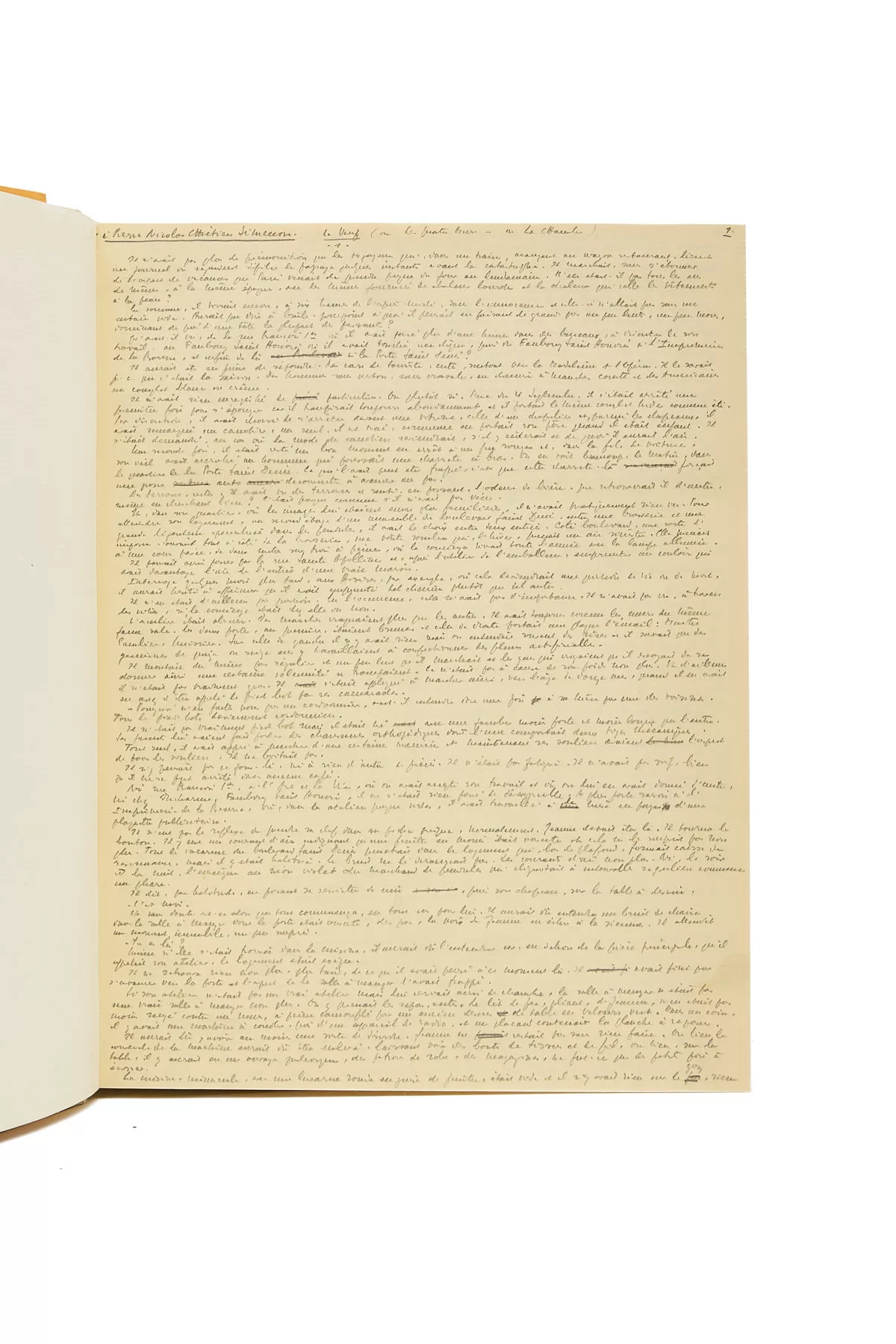
Next comes the autograph manuscript. Complete, it has multiple paginations totaling 38 leaves:
Part One: 5 chapters of 5 leaves each, i.e. 25 leaves.
Part Two: 3 chapters of 4 leaves, 5 leaves for the last, i.e. 13 leaves.
At the head, a short dedication intended for print: “à Pierre Nicolas Chrétien Simenon,” followed by the title “Le veuf” and two other possible titles, “ou Les quatre murs” and “ou La chambre.”
The manuscript is written entirely in pencil, in a fine, tight hand: corrections are few, mostly deletions made in the course of writing. It was written chapter by chapter, according to the ritual of five pages, then four, per day, over eight days. It is signed and dated at the end “Echandens, le 14 juillet 1959.” This is followed by a long address to the dedicatee of the novel: Simenon’s own son. In these affectionate and touching words from a father to his son, Simenon refers to another novel he had long planned to write, but which he ultimately never undertook, choosing Le Veuf instead:
“Mon petit Pierre,
» J’ai pris l’habitude de destiner à mes enfants le premier roman que j’écris après leur naissance. Pour toi, ce devait être un roman auquel je pense depuis longtemps. Ceci doit être plein de joie de vivre et que je remets chaque fois à plus tard parce que j’ai peur de le rater. Il s’intitule ‘Le rouquin’ et j’aurais d’autant plus aimé te donner celui-ci que depuis que ta mère est enceinte, nous avons décidé que tu serais roux. Tu l’es, en tout cas à présent, ce qui nous enchante. Faute du Rouquin, que je te dois en quelle sorte, et que je compte réussir un jour, accepte ce nouveau roman, qui ne s’harmonise pas avec ta robustesse, ton équilibre et ton heureux caractère. J’y ai quand même mis un petit Pierre qui n’a rien de commun avec toi. J’ai l’impression que je te connais déjà si bien, que nous nous comprenons depuis le premier jour où tu sortais si vaillamment du ventre de ta mère et que je t’aime tendrement. Ton père, GS.”
[Editor’s note: this planned novel would eventually be published under the title Le Petit Saint in 1965.]
It should be recalled that Simenon had decided to give each of his children the manuscript of the novel he was writing at the time of their birth: for Marc, it was Pedigree (begun in 1939); for John, Un nouveau dans la ville (1949); for Marie-Jo, Feux rouges (1953); and for Pierre, Le Veuf (1959).
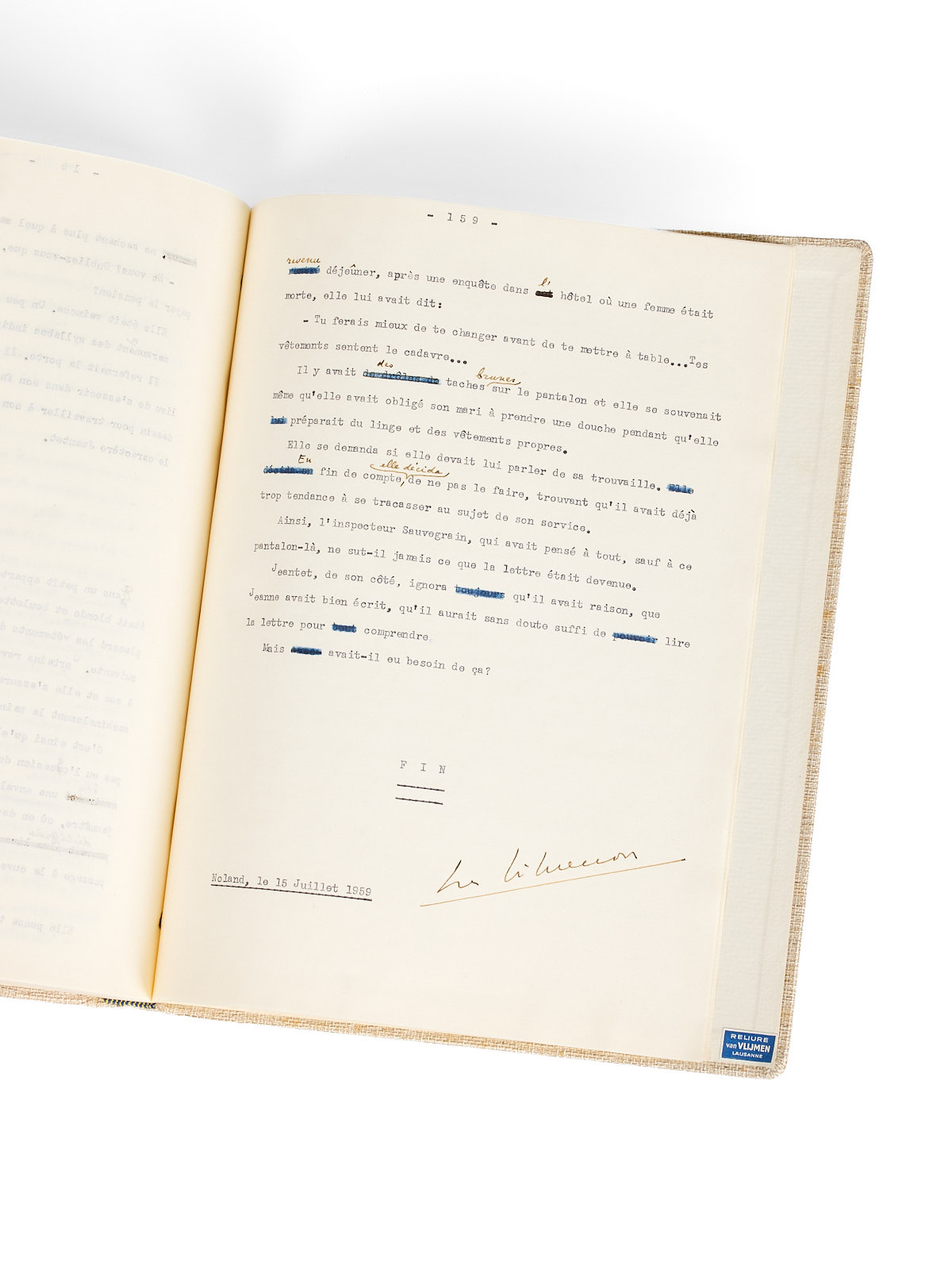
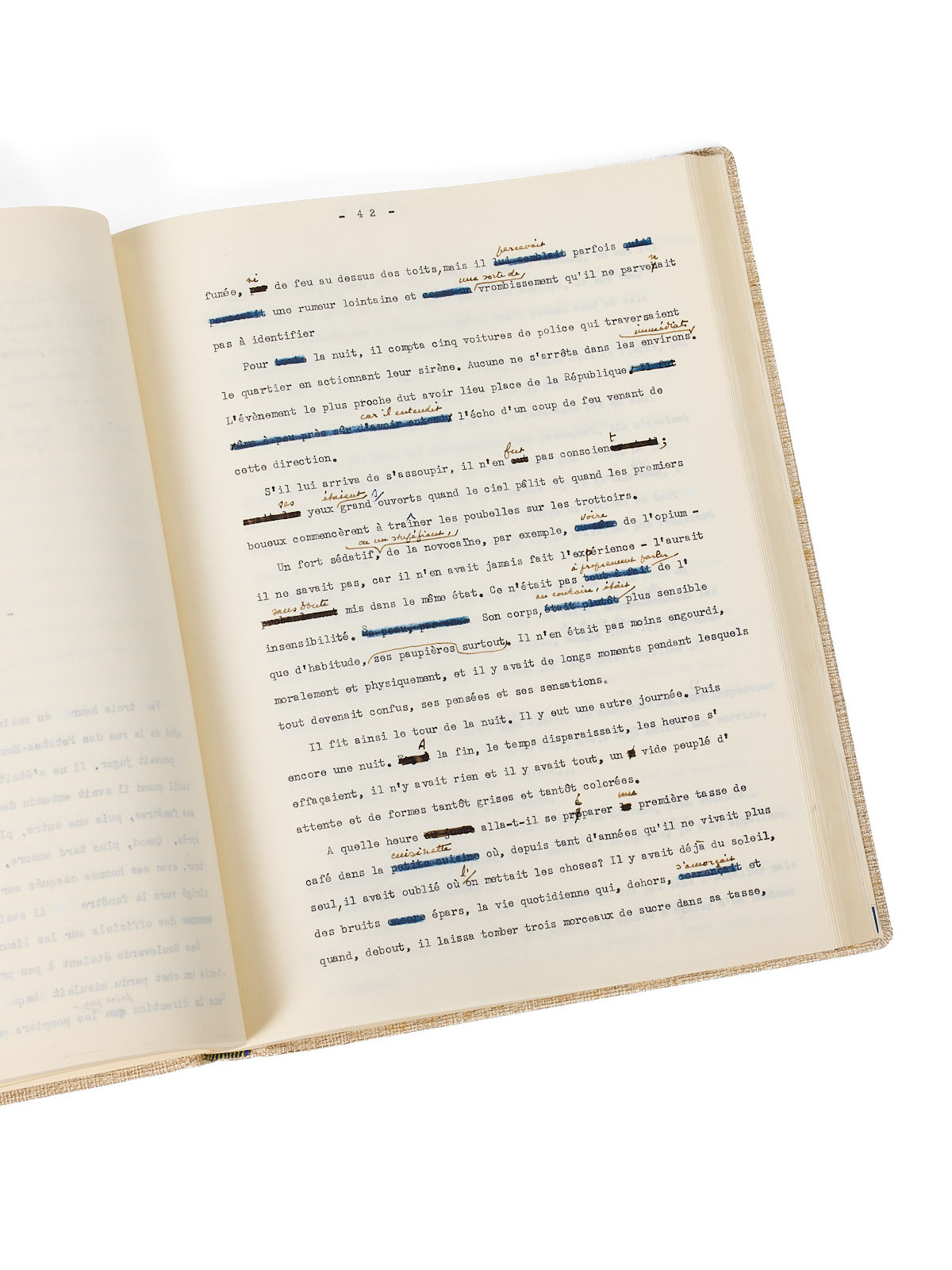
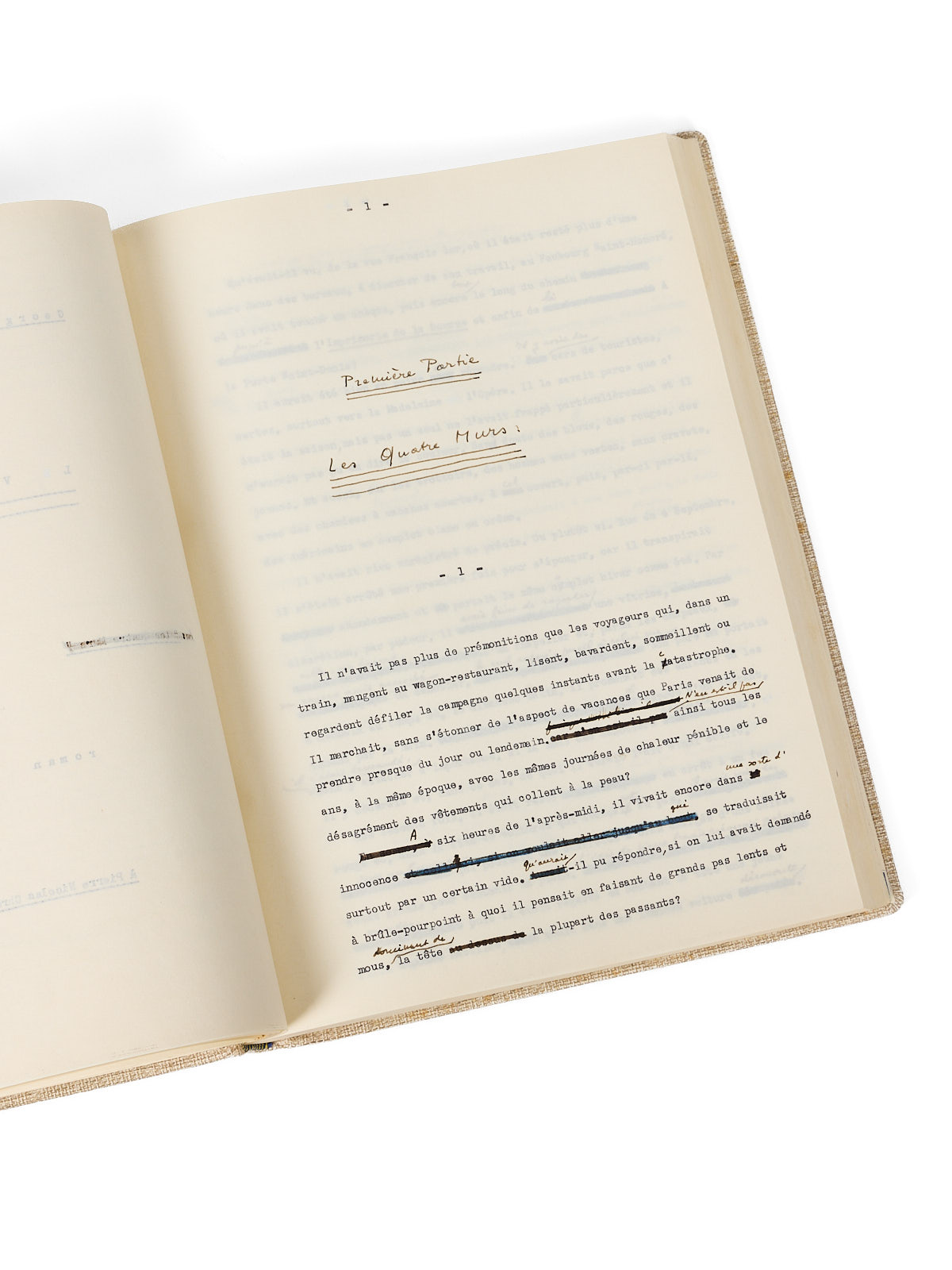
Next comes the typescript. Complete, this original typing comprises 159 leaves, with numerous corrections by the author. It is signed and dated at the end “Noland, le 15 juillet 1959.” The typescript is dated the day after the manuscript was finished. After writing a chapter of a novel, Simenon would type it himself the following morning “with many changes,” as he himself put it, before letting it rest for a few days and then making final corrections.
All this work is confirmed by the presence of the working calendar, also kept at the front: meticulousness, always. It is illustrated, for example, by these large diary pages covered with brief notes, with certain days, in blocks, crossed through. These were Georges Simenon’s writing calendars. For a Maigret novel: a few days of preparation, the writing days — blue crosses, twelve to fifteen days — a brief pause, then the periods of rereading and correction — red hatching — three days. He spoke of this in interviews and in his autobiographical writings: in the moment, in Quand j’étais vieux, and later, in retrospect, in the Dictées and in Mémoires intimes. In the 1968 interview “Simenon sur le gril,” he explains that he had to concentrate the writing of a novel into a limited number of days: “I can stay inside a novel for four or five days, but I cannot hold it for more than fifteen. This work must be constant, and I cannot skip a day in writing it, or the thread is broken. […] While writing the book, I must write as quickly as possible, thinking about it as little as possible, so as to let the unconscious work as much as possible.” This “psychological” explanation was often paired with a “physiological” one: Simenon recounted that the tension under which he wrote had physical effects — he lost weight and finished the writing exhausted. That, he said, was why, as he grew older, he found it increasingly difficult to sustain this tension, and so tended more and more to shorten the writing period. In his Mémoires intimes, he adds another reason, more directly linked to his method: “When I started out […] a novel took me twelve days, Maigret or not. As I strove to condense further, to strip my style of all flourish or ornament, I gradually went from twelve days to eleven, to ten, to nine. And then […] I arrived at the figure seven […], which would become the definitive mold into which my novels would thenceforth be cast.”
Simenon donated much of his writing material to the Fonds Simenon: yellow envelopes, preparatory files, and some sixty writing calendars, of which very few copies remain in private hands. The oldest date from the mid-1950s, and it was in America that the novelist took up the habit of annotating these calendars, all issued by Pan American World Airways. With the help of these calendars and other documents, one can observe a gradual shift, from the mid-1950s to the early 1970s, from an average writing period of ten or eleven days to one of seven days.
The calendar for Le Veuf corresponds perfectly to this meticulous writing ritual: 7 July, marked in red, is devoted to the preparatory day — characters, reflections, notes on the yellow envelope. Writing begins the next day, 8 July, and continues until the 15th, the date on which the typescript was completed (that is, the day after the last pages of the manuscript). An eight-day blank period follows, during which Simenon let the novel rest, then, from the 24th to the 28th, revisions to the text, made on the typescript. These corrections correspond to the version that would be printed.
“Examination of his typescripts reveals his consistency: few deletions, barely a few per leaf. In most cases these consist of removing adverbs, qualifiers, redundancies — everything he judged superfluous […]. The story and its unfolding undergo no alteration. The characters, like the dialogue, remain intact. They must remain as they are, because that is how he experienced them. Sometimes his second thoughts concern surnames or places […]. To correct is not only to purify but to make precise […]. In the revision process, Simenon attaches particular importance to the ending, whether he corrects it or extends it.” (Pierre Assouline, Simenon, Gallimard, Folio, 2002, pp. 841–843).
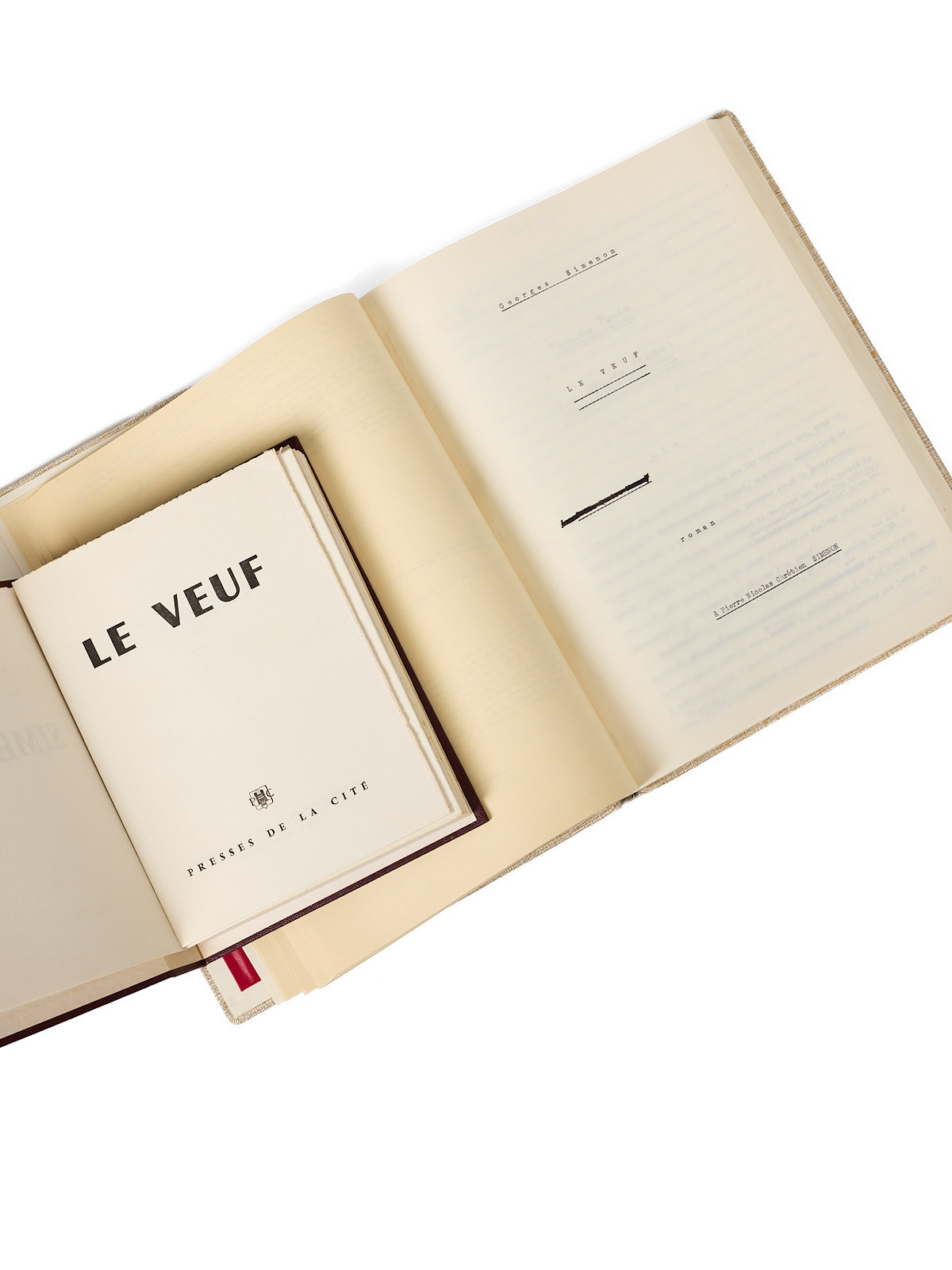
Le Veuf was first serialized in 14 installments in the weekly Les Nouvelles littéraires (from no. 1680 to no. 1693, 12 November 1959 – 18 February 1960), with illustrations by Claude Forest. It was published by Presses de la Cité shortly after the first installments, in a dust jacket illustrated by J. Jacquelin. A deluxe printing was produced, in a double wine-colored box (no wrapper was made for this printing), limited to 100 deluxe copies numbered 1 to 100.
We add to the set the first edition on deluxe paper, as well as a copy in mint condition of the trade edition’s dust jacket.
A certificate in Pierre Simenon’s hand authenticates the set and again specifies the particular circumstances of these “family” copies.
Finally, a pipe from the Simenon collection, one of those he used during this period, is included, illustrated by a photograph captioned: “La collection de pipes de Georges Simenon […]. Le célèbre auteur français (sic) de romans policiers vit actuellement en Suisse au Château d’Echandens près de Lausanne avec sa femme et ses trois enfants Jean (sic, pour John), 13 ans, Marie-Georges, 10 ans et Pierre, 4 ans. Il marche ‘au chrono’ si l’on peut dire… en effet, il se lève tous les matins à 6h20, fait sa toilette et son café dont il boit trois tasses. Il écrit au roman en cours pendant trois heures en tapant à la machine, puis il déjeune avec sa femme et ses enfants, puis fait une courte sieste avant de retravailler pendant trois heures. Il dîne ensuite à 19 heures, et toute la famille se met au lit à 19h30… Et le créateur du célèbre commissaire Maigret qui fume continuellement est fier de montrer sa sensationnelle collection de pipes…” (Château d’Echandens, 8 February 1963. One period gelatin silver print, with typed note on verso).