

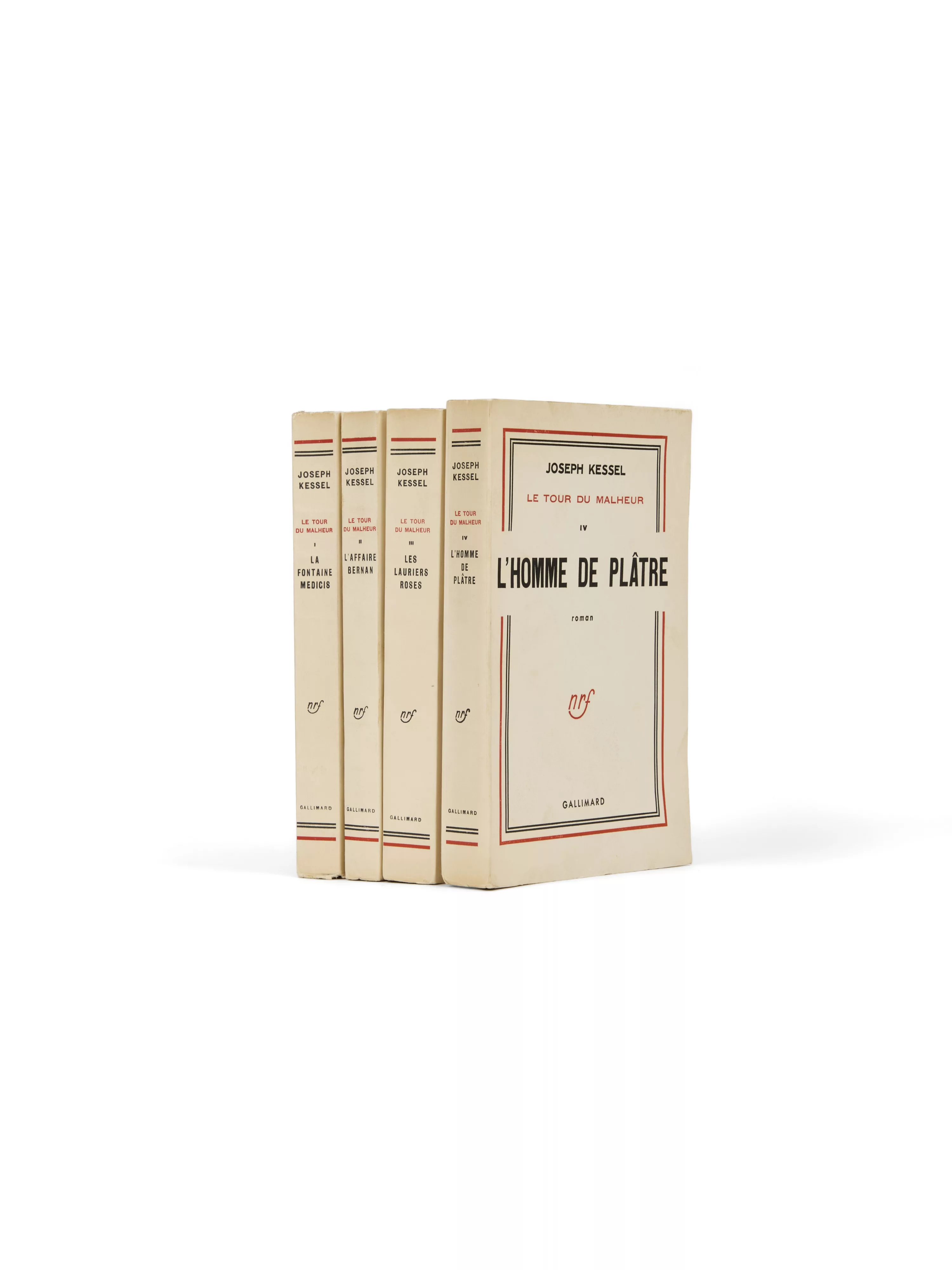
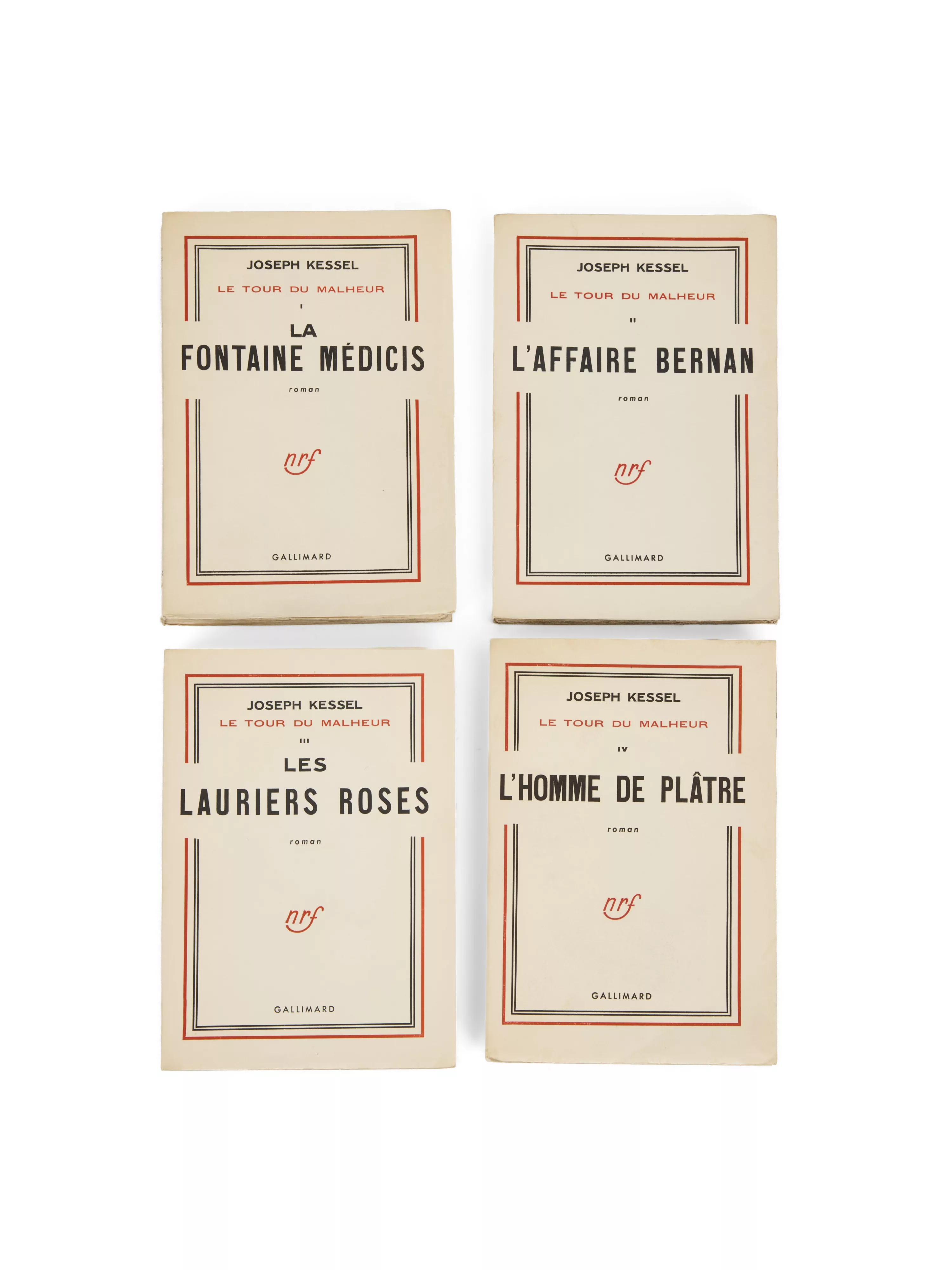
Le Tour du malheur
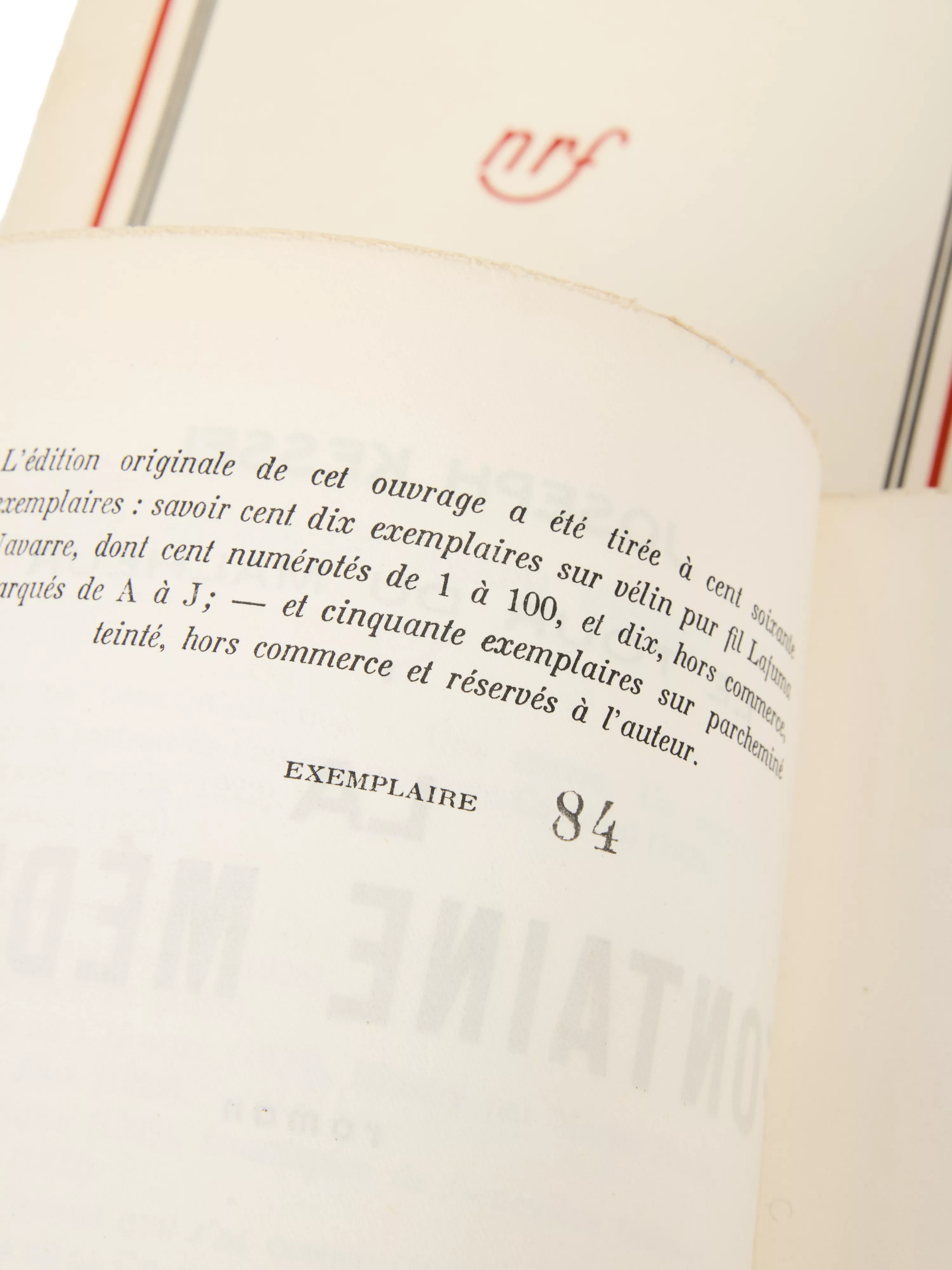
One of 110 copies on vélin pur fil (no. 84), after the 50 copies on tinted parchment-style paper.
Kessel’s magnum opus. It covers the period from 1915 to 1930, during which Kessel, gradually leaving behind his early years as an unknown young refugee, became first a journalist and then a successful writer. Through the character of Richard Dalleau, he retraces his own path: from the boy too young to go to the front, discovering the horrors of war in a luxury hotel in Nice converted into a hospital, to the accomplished man pursuing parallel careers in journalism and literature.
“The title came to me around the age of thirty: there, I seem to have gone all the way round happiness, and I have gone all the way round my unhappiness, because I know that I will never, ever be at peace with myself,” Kessel declared in 1974. He went on to confirm the chronology of the work’s composition: “When Munich happened, one did not need to be a prophet — war was coming, and I felt it was truly essential for me to write this book. I was afraid I would not be able to write it; one never knows what may happen during a war. I rented a small house in the Eure. I had written about a book and a half when the war broke out […] When I came back, I made film scripts, further reportages. I had only one idea, to take up this book again. As soon as I could, I set off again on another campaign, and there, in a small hotel on the Marne, I looked back over the first two volumes, and carried on. It took me about a year and a half. By 1948–49, the book was finished. Le Tour du malheur is, by far, the book I care about most.” (Le Monde, 14 June 1974).
Kessel had already expressed this sentiment eight years earlier, in a letter to a journalist, in March 1966: “Since you are kind enough to ask me for the titles of the books I consider most significant among those I have written, here they are: L’Équipage, Les Captifs, Belle de Jour, Fortune Carrée, Le Tour du Malheur and Le Lion. But it is Le Tour du Malheur that I prefer, only the flaw of this novel is that it has four volumes…”
This letter is now found in Kessel’s own nominative copy (Alde, June 2023, no. 204). A narrative that Kessel took twenty years to mature, and ten to write.
“Before setting off with Druon for London, Kessel buried, in a garden on the Côte d’Azur next to the house where he had lived during the preceding months, the manuscript of the first two volumes of Le Tour du malheur. They lay at the bottom of a disused well, at Agay, a seaside resort at the foot of the Estérel. The third volume, still being written, he carried with him, in his precious leather case. He had found its title, one recent sunny and joyful day: Les Lauriers roses.” (Bona, Les Partisans).
Kessel did not return to the spot until 1946. A miracle occurred: the manuscripts were still there, intact. He took up his texts again, determined this time to bring the saga to a close. He returned to Paris, where he led a bohemian life from which he tried to withdraw by settling in the Paris region. He spent a year at Mary-sur-Marne: in the small hotel overlooking the village square, in the shadow of the imposing Château Marysien, a vast eighteenth-century residence, Kessel occupied room no. 3. Once volume IV was finished, he could return to Paris and the rue Quentin-Bauchart. Corrections took more than a year, interrupted once again by further reportages. Finally, at the end of 1948, he was able to hand Gaston Gallimard the book he cared for most, “the secret, beating heart of his life” (Bona, op. cit.).
A very fine copy.
Extremely rare in such condition, in wrappers.