





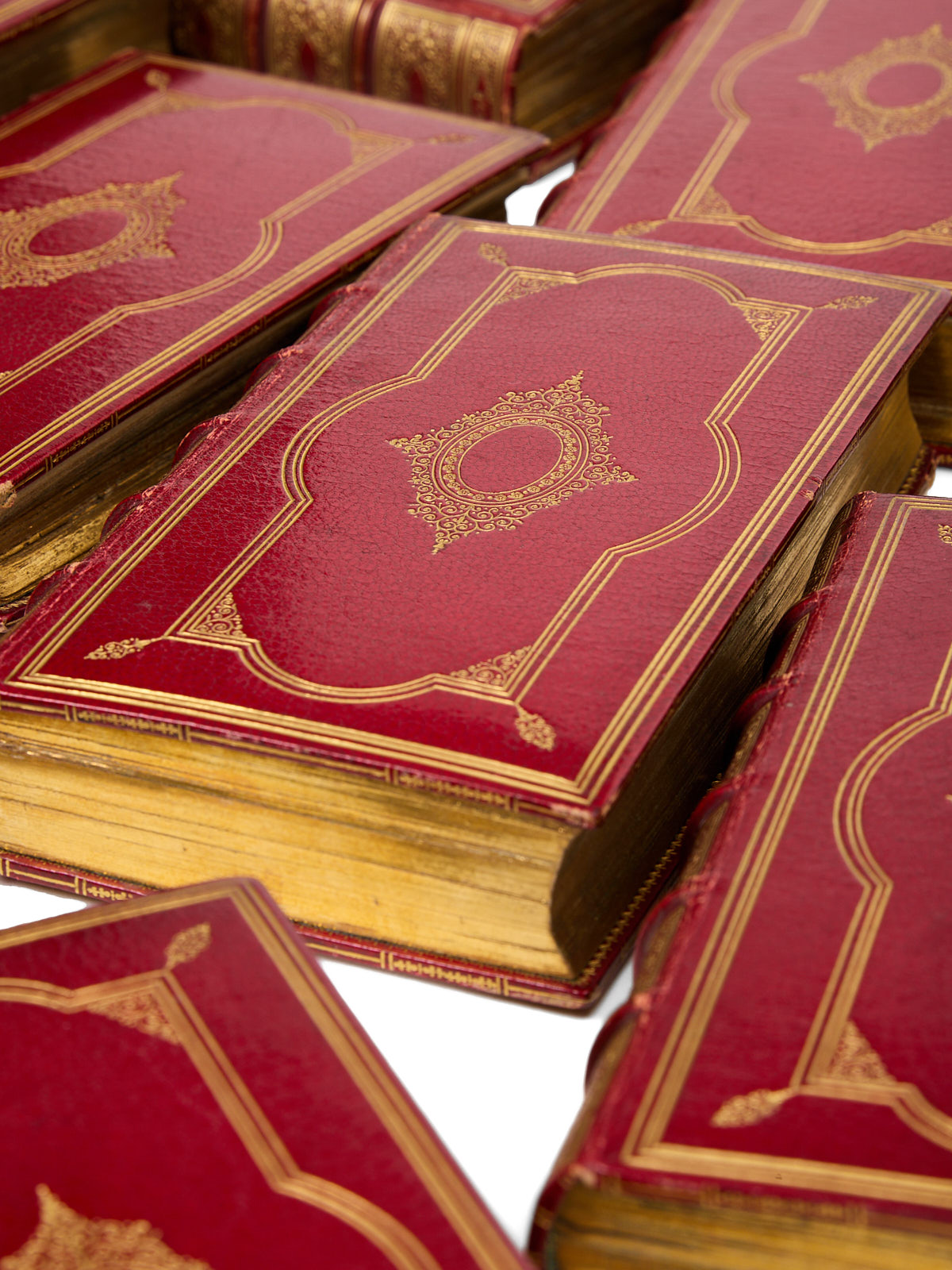


A choice copy, with all dates correct, without exception (from 1664 to 1678), and with an impeccable provenance: Pierre-Marcellin Lortic, Henri Bordes and Jules Lemaître.
This edition is precisely described by Picot in his Bibliographie cornélienne, no. 381. It is celebrated and contains admirable engravings, illustrating the entire dramatic output of the two brothers.
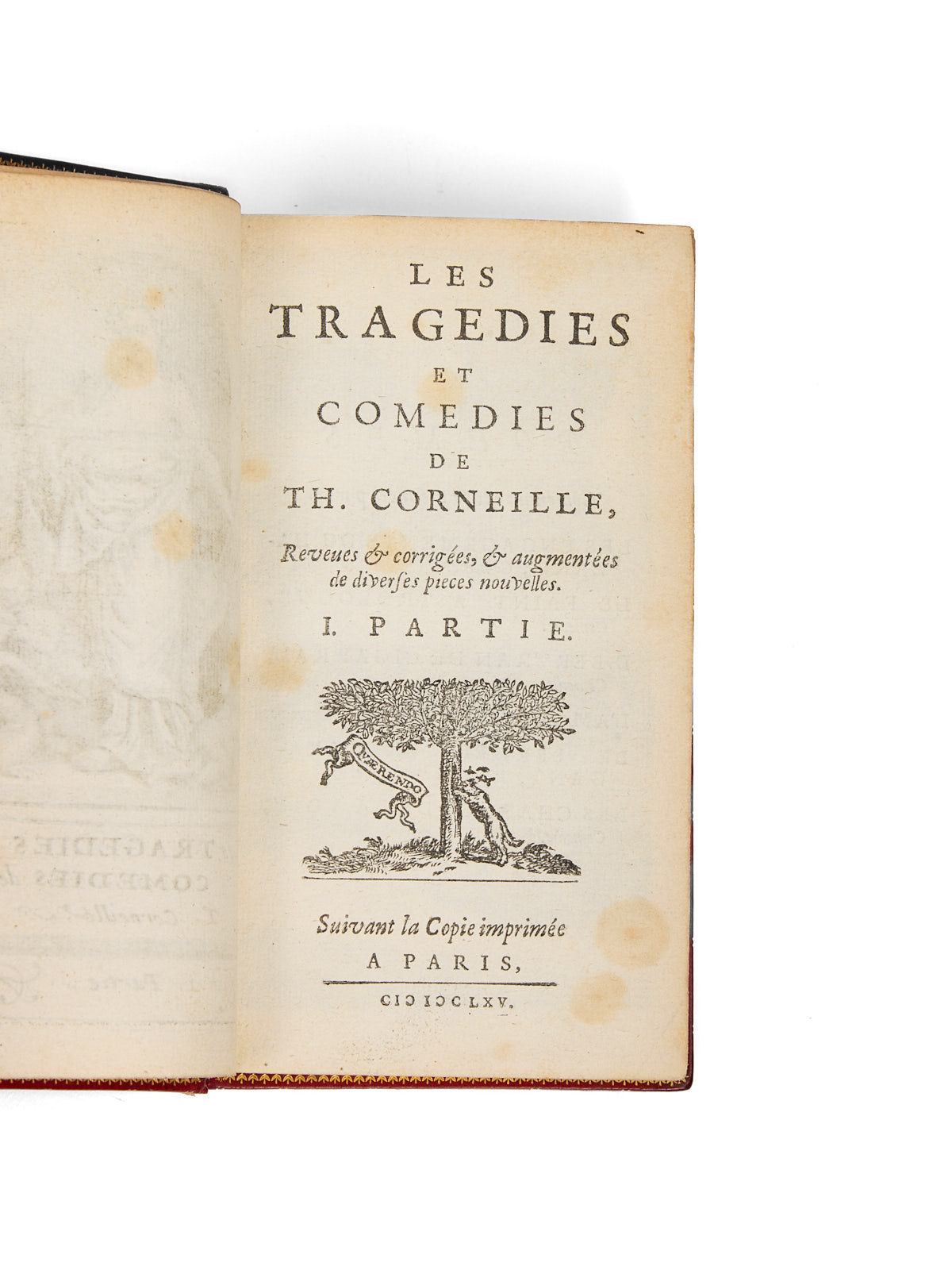
After the first five volumes devoted to Pierre Corneille, the publisher continued through 1678 with the Tragédies et Comédies of his brother Thomas.
One of the finest known copies of this “charming edition executed in Amsterdam by Abraham Wolfgang, and rightly sought after, if not for the text itself, then at least for the beauty of the printing and paper and for the elegance of the plates. This edition has the advantage of offering not a selection, but the complete run of Corneille’s plays. It has become, in recent years, says M. Brunet, an object of very great importance among French bibliomaniacs, and complete copies are very difficult to find” (Picot, 381). This assertion is confirmed by Willems: “This collection is difficult to assemble. Copies that leave nothing to be desired as to the dates of the plays and the size of the margins fetch very high prices.”
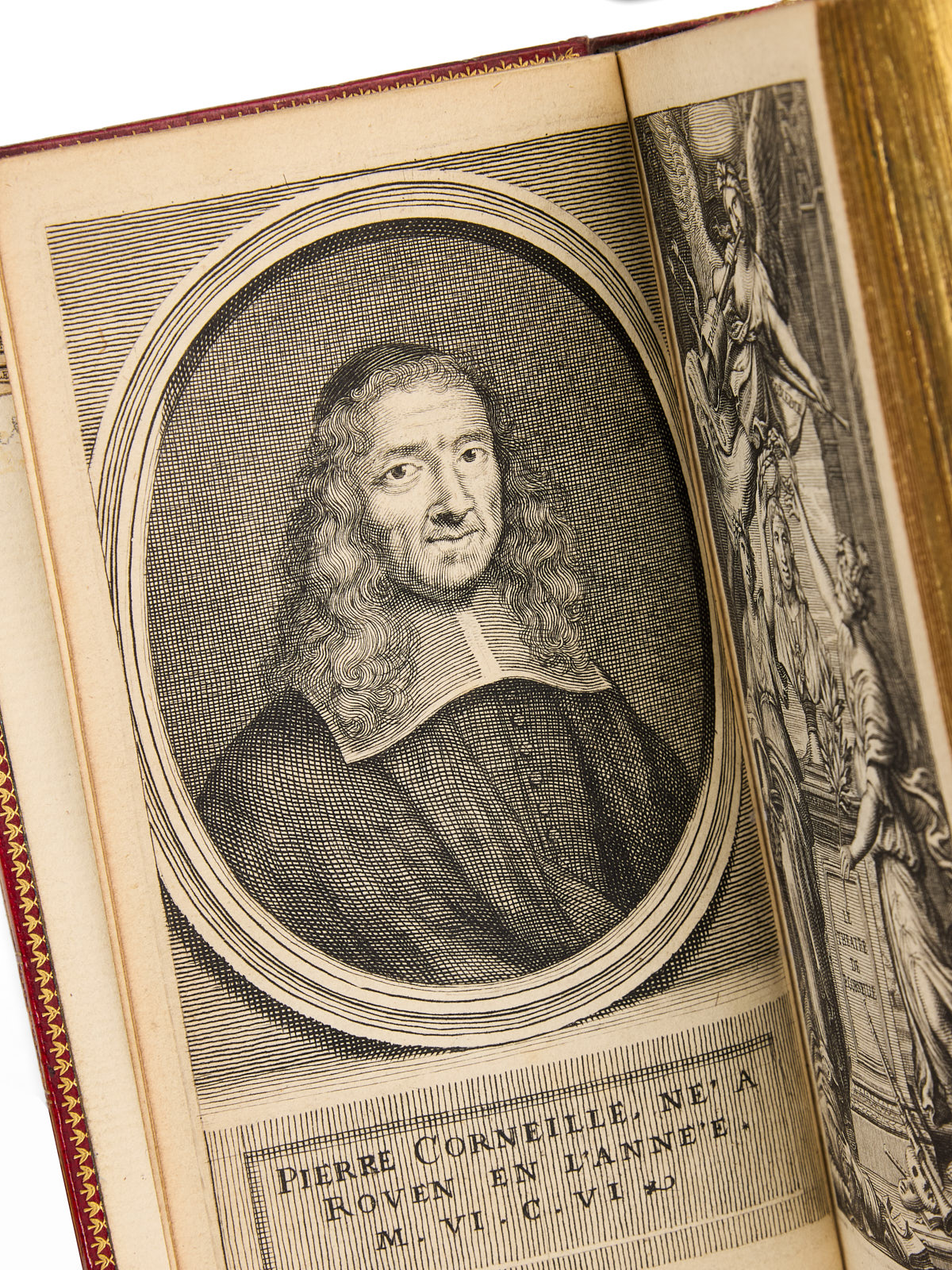
Such is the case with this copy, in exceptional condition and with remarkably large margins (134 mm). All the plays, plates, general titles and frontispieces are present, along with a large proportion of the blank leaves that sometimes separate the plays. It is complete with the printer’s notice to the reader and the portrait in volume 1, both often missing.
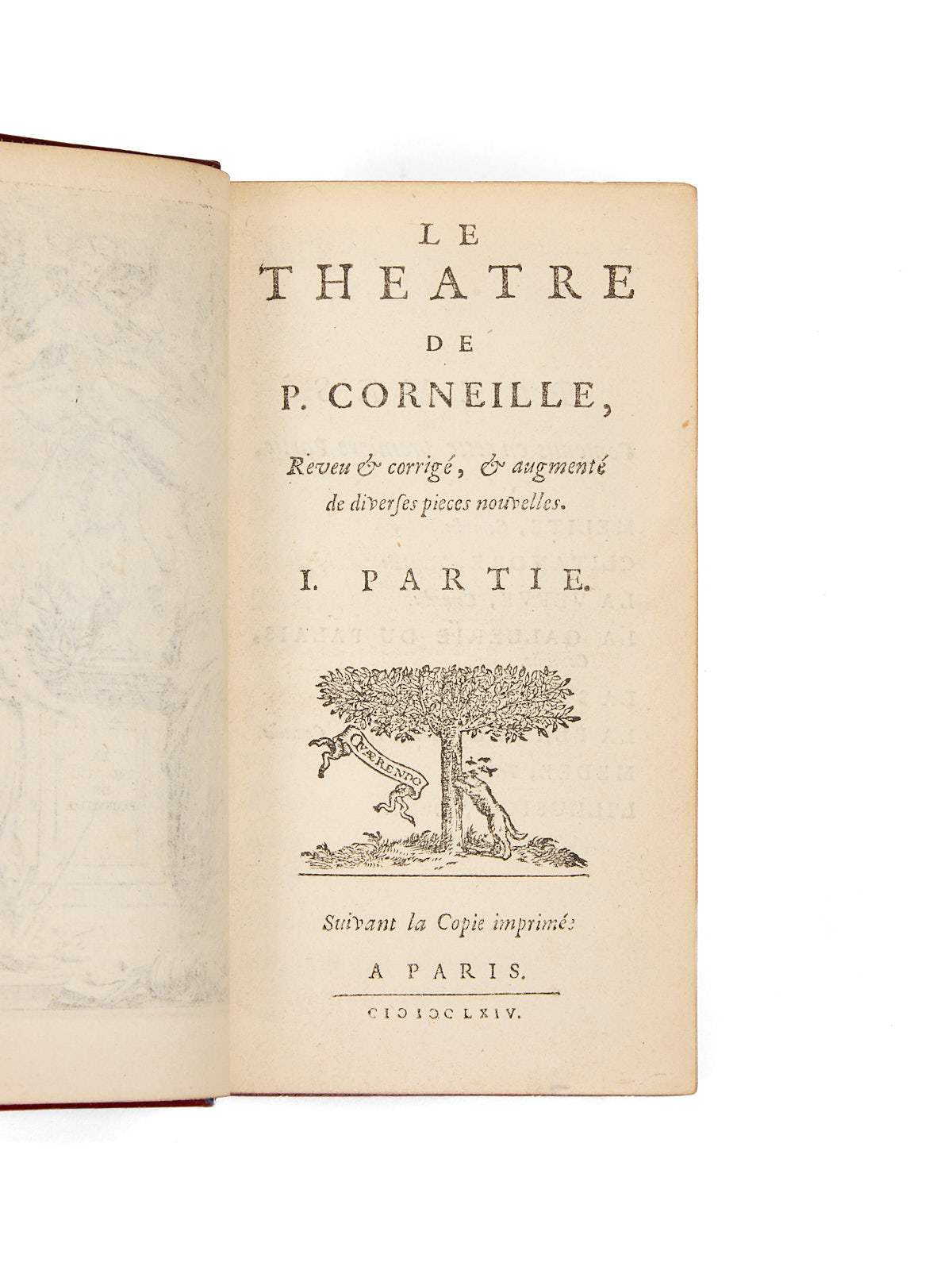
The 5 volumes of the Théâtre de Pierre Corneille all bear Abraham Wolfgang’s device, signed “Quarendo” and known as the “Fox Watching Its Prey”:
Part I: portrait of Corneille, engraver unnamed; engraved frontispiece depicting the bust of Corneille crowned by two ‘Renommées’, with the title: “Le Théâtre de P. Corneille”; 5 leaves for the “Avis de l’Imprimeur au Lecteur” (notice signed A. W.) and the table of plays by Pierre Corneille and Thomas Corneille; 74 pp. for the “Discours du Poëme dramatique” and the “Examens”. Followed by the eight plays (from Mélite to L’Illusion comique), each preceded by a plate and a title, with separate pagination.
Part II: engraved frontispiece depicting two ‘Amours’, one unfurling a veil on which is read: “Le Théâtre de P. Corneille”, the other engraving arms on a stone; 1 leaf for the title, 92 pp. containing the “Discours de la Tragédie” and the “Examens”. Followed by the 7 plays (from Le Cid to La Suite du Menteur), each preceded by a plate and a title, with separate pagination.
Part III: engraved frontispiece, depicting ‘Vérité’ standing on a sphere surrounded by Oriental kings holding a sash on which is read: “Le Théâtre de P. Corneille”; 1 leaf for the title; 68 pp. for the “Discours des trois Unitez” and the three “Examens”. Followed by the 7 plays (from Rodogune to Œdipe), each preceded by a plate and a title, with separate pagination.
Part IV: engraved frontispiece; 1 leaf for the title; 4 leaves for the “Avertissement” for Sertorius. Followed by the 4 plays (from Sertorius to Othon), each preceded by a plate and a title, with separate pagination.
Part V: engraved frontispiece. Followed by 5 plays (from Agésilas to Suréna), each preceded by a plate, a notice “Au lecteur” and a title, with separate pagination.
These 5 volumes are completed by the works of his brother, Thomas Corneille:
Part I: 2 leaves for the engraved frontispiece and title. Followed by 6 plays (from Les Engagemens du hazard to Le Berger extravagant). Each play has a plate, a title and separate pagination, some with an “Epistre”.
Part II: 2 leaves for the engraved frontispiece and title. Followed by 6 plays (from Le Geolier de soy mesme to Darius). Each play has a plate, a title and separate pagination.
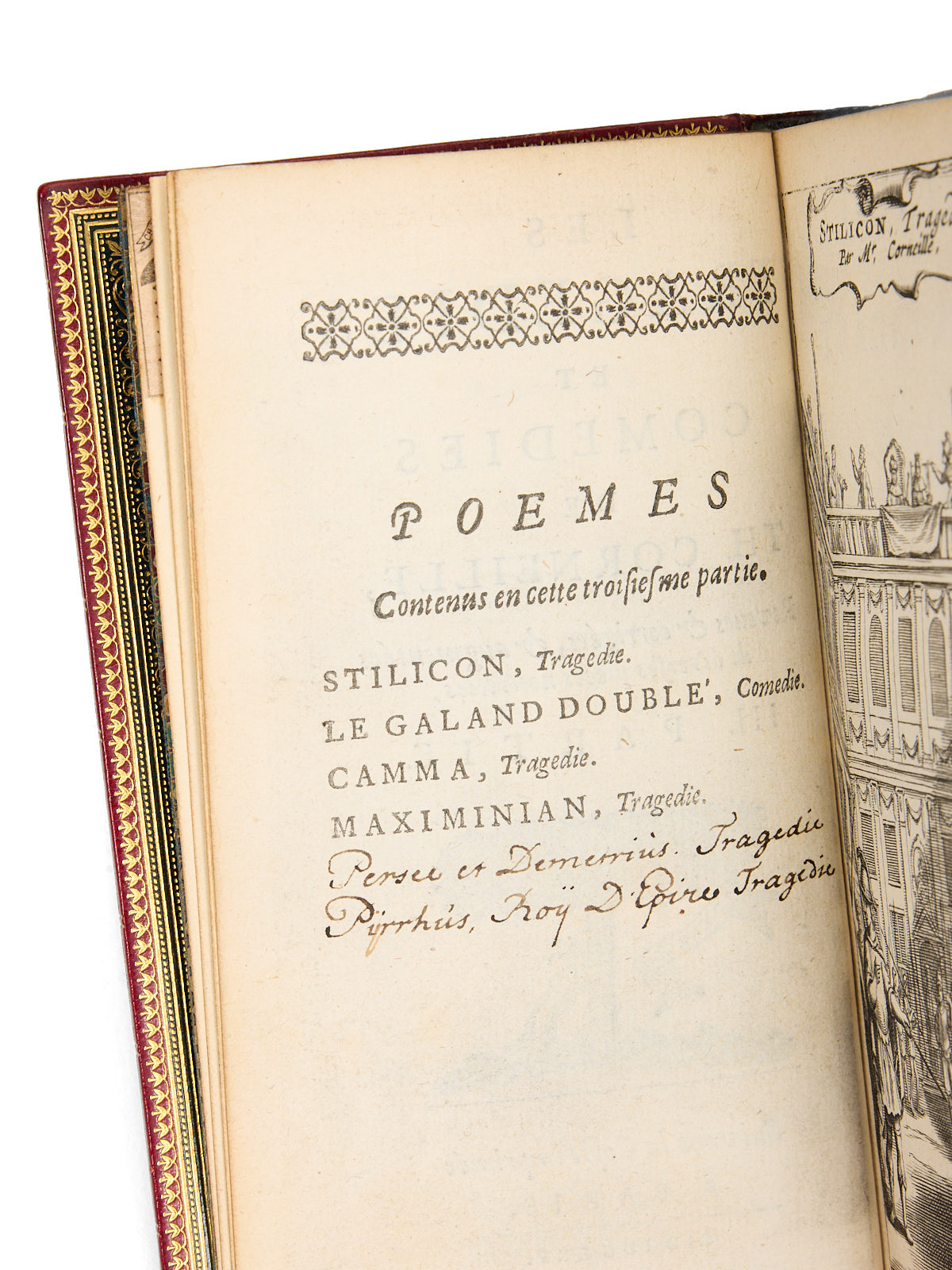
Part III: 2 leaves for the engraved frontispiece and title. Followed by 6 plays (from Stilicon to Pyrrhus, roy d’Epire), of which only the first four are listed; the last two, Pyrrhus, roy d’Epire and Persée, are indeed present here, their titles having been added long ago in ink to the list. Each play has a plate, a title and separate pagination.
Part IV: 2 leaves for the engraved frontispiece and title. Followed by 6 plays (from Antiochus to La Mort d’Annibal). Each play has a plate, a title and separate pagination, some with an “Epistre”.
Part V: 2 leaves for the engraved frontispiece and title. Followed by 6 plays (from Ariane to Le Comte d’Essex), each with a plate, a title and separate pagination, some with an “Argument”, a note on the “Décoration du prologue” and a notice “Au lecteur”.
Elected to seat 14 at the Académie française in 1647, Pierre Corneille was its senior member when he died in October 1684. All the Academy’s members were moved by his death and proposed that his grieving brother fill the vacant seat. Thomas was elected unanimously on 2 January 1685; since he could not decently deliver the eulogy for the brother he was replacing, Racine did so while also receiving Thomas — the only instance in the Academy’s history of a single academician delivering both the eulogy and reception addresses.
Voltaire said of the younger brother that, Racine excepted, he was the only man of his time worthy of ranking just below his own brother: “He was a man who would have enjoyed a great reputation had he not had a brother.” A skilled grammarian, Thomas Corneille wrote a Dictionnaire des arts et des sciences and a Dictionnaire universel géographique et historique. At the Academy, he received Fontenelle on 5 May 1691.
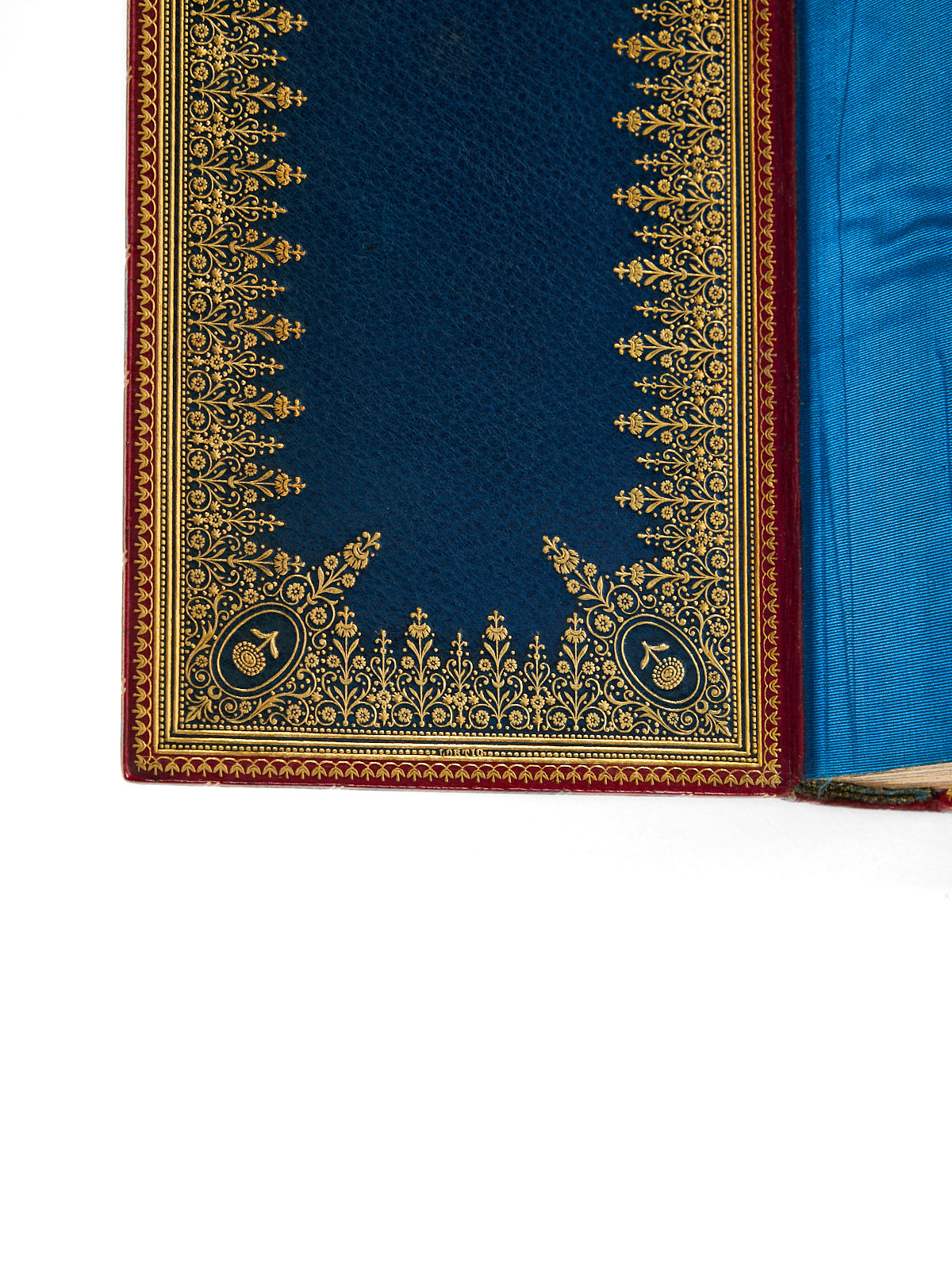
An exceptional gathering of the works of both brothers, in perfect condition. The copy was bound with delicate and attentive care by Pierre-Marcellin Lortic, then sold to Henri Bordes.
Born in Saint-Gaudens on 4 April 1822, the Gascon Pierre-Marcellin Lortic, known as “le Frondeur”, arrived in Paris in the late 1830s and joined the workshop of Pierre-Paul Gruel as a workman. The young man stood out for his strong character and his firmly held personal ideas and, at only twenty-two, set up on his own in 1844 at 199 rue Saint-Honoré, an address he kept until his move to 1 rue de la Monnaie, around 1860.
“Pierre-Marcellin Lortic’s bindings are distinguished by the polish of their morocco, their firmness, their lightness, the fineness of their boards and their tightly pinched raised bands, and the subtlety of their gilding — even though ‘Le Frondeur’ was not himself a gilder and entrusted this work to the finest specialists of the day, notably Wampflug and Maillard […] Beyond his perfectionism and the undeniable mastery he displayed, he revolutionized the industrial art of bookbinding, whether in his relationship with the bibliophile or in his commercial approach, developing a highly personal conception of his craft and having little patience for the criticism or advice of collectors. From this may have sprung his chief commercial innovation: no longer waiting for a customer, he acquired books himself, bound them to his own taste and offered them directly for sale in a workshop that thereby also became a bookshop. The concept was revolutionary at a time when fine binding proceeded from a private commission, the customer bringing his book to the binder with his instructions. It earned Lortic criticism from booksellers and collectors alike, but demonstrated that the binder had an excellent understanding of books and the tastes of his time, if not always a bibliographical one” (Hugues Ouvrard, in Portrait de Pierre-Marcellin Lortic, online).
His sure taste led him toward exceptional works or bibliographical rarities, which he bound with great care and parted with only to sell to the great bibliophiles of his day, who were his clients: Ambroise Firmin-Didot (who owned 504 bindings signed by him), the architect Joseph Lesoufaché, the Duc d’Aumale, the architect Hippolyte Destailleurs, the Bordeaux shipowner Henri Bordes, the Duke of Parma, the Duke of Rivoli, Edmond de Goncourt, Auguste Poulet-Malassis, Charles Asselineau, Théodore de Banville and, of course, Charles Baudelaire, who entrusted Lortic with the binding of eight copies of the first edition of Les Fleurs du mal.
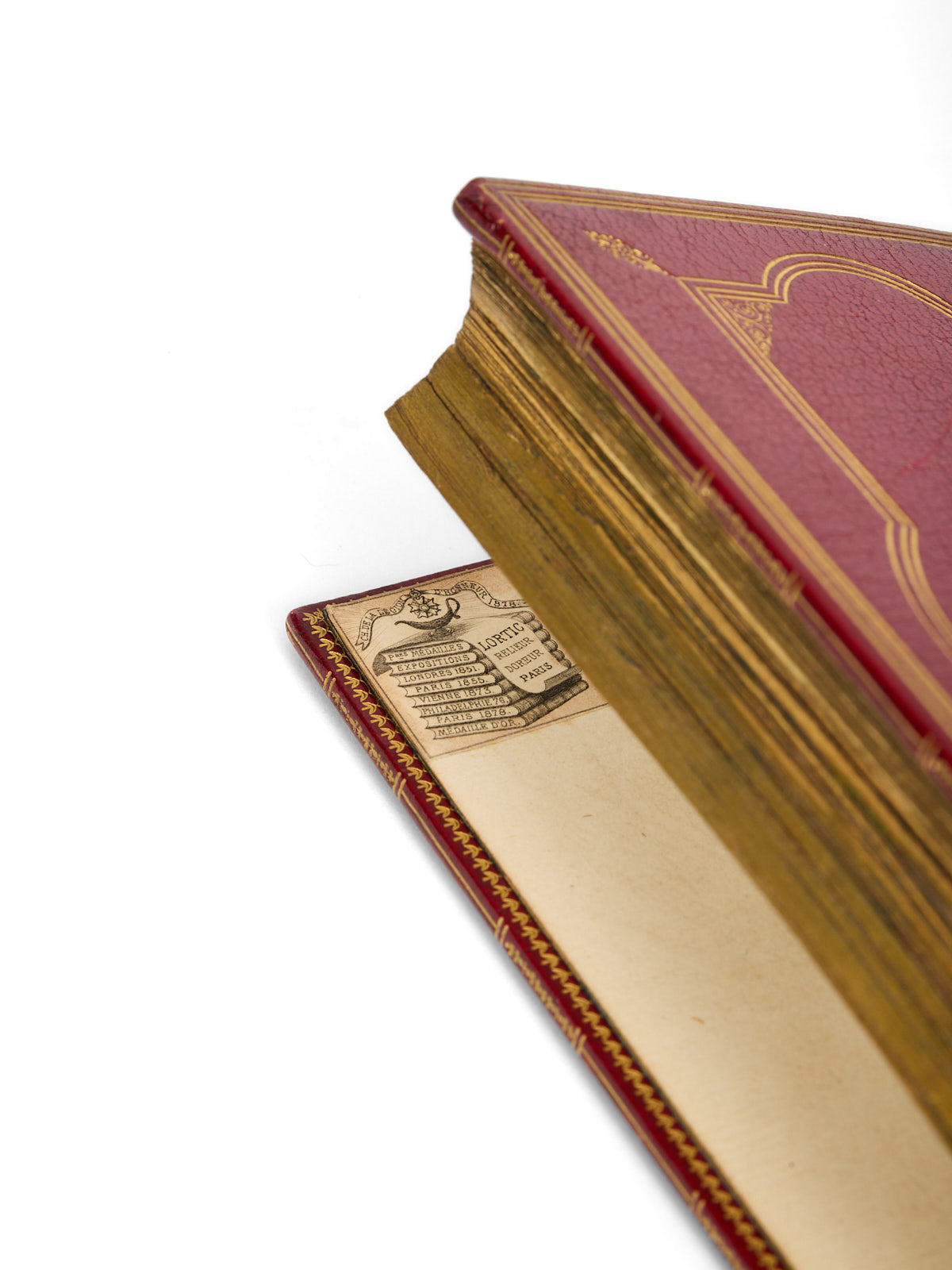
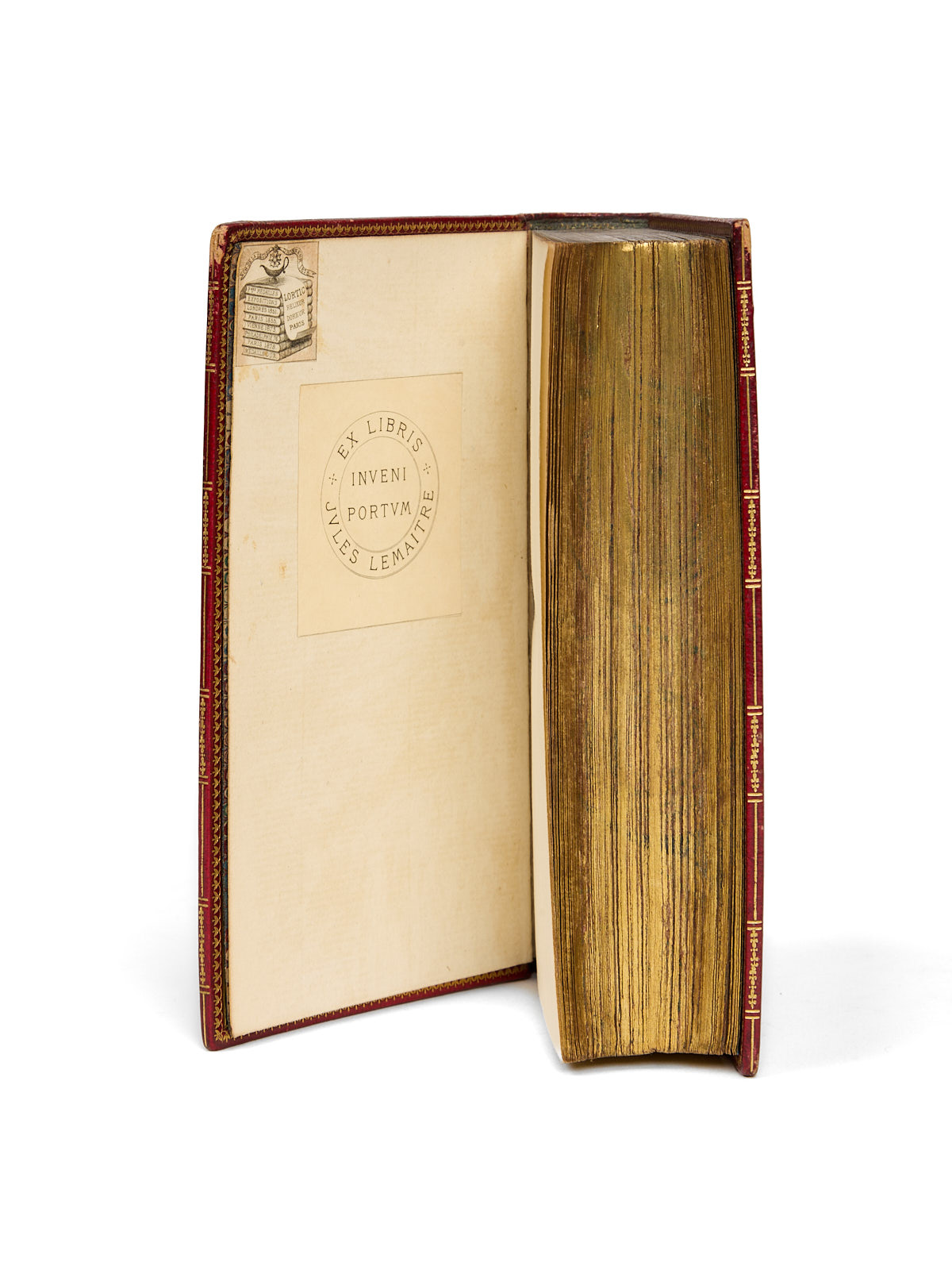
From 1876, Lortic pasted into the left corner of the front doublure of his bindings a label depicting eight stacked books, listing the various prizes he had won in London (in 1851, when he was only twenty-nine), Paris (1855 and 1878), Vienna (1873) and Philadelphia (1876). In 1878 he became the first binder made a Chevalier of the Legion of Honor, and thereafter modified his bookplate to include this decoration. This Corneille bears that mark, allowing the binding to be dated to those years. He ceased his professional activities in 1884; his sons carried on the business.
Our copy contains this bookplate in every volume, in addition to his stamp, at the center of the front doublure, which serves as his signature.
From the libraries of Pierre-Marcellin Lortic (bookplate, third version of 1878), Henri Bordes (bookplate and sale, 1911); Jules Lemaître (bookplate and sale, 1917).
Picot, Bibliographie cornélienne, 381 (citing a copy in red morocco doublé with blue morocco, from the Benzon collection, but probably a different copy); Willems, p. 466.