

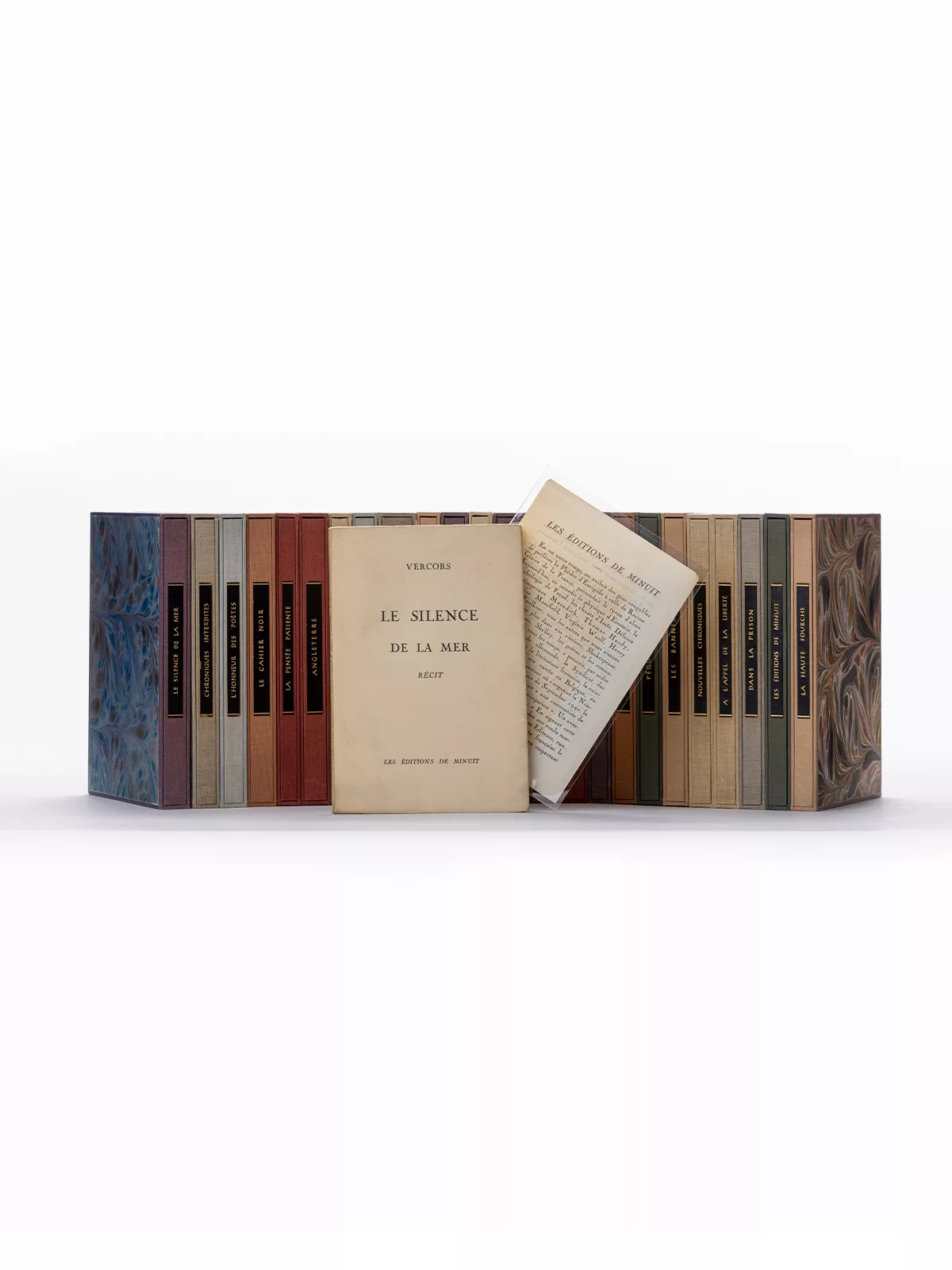
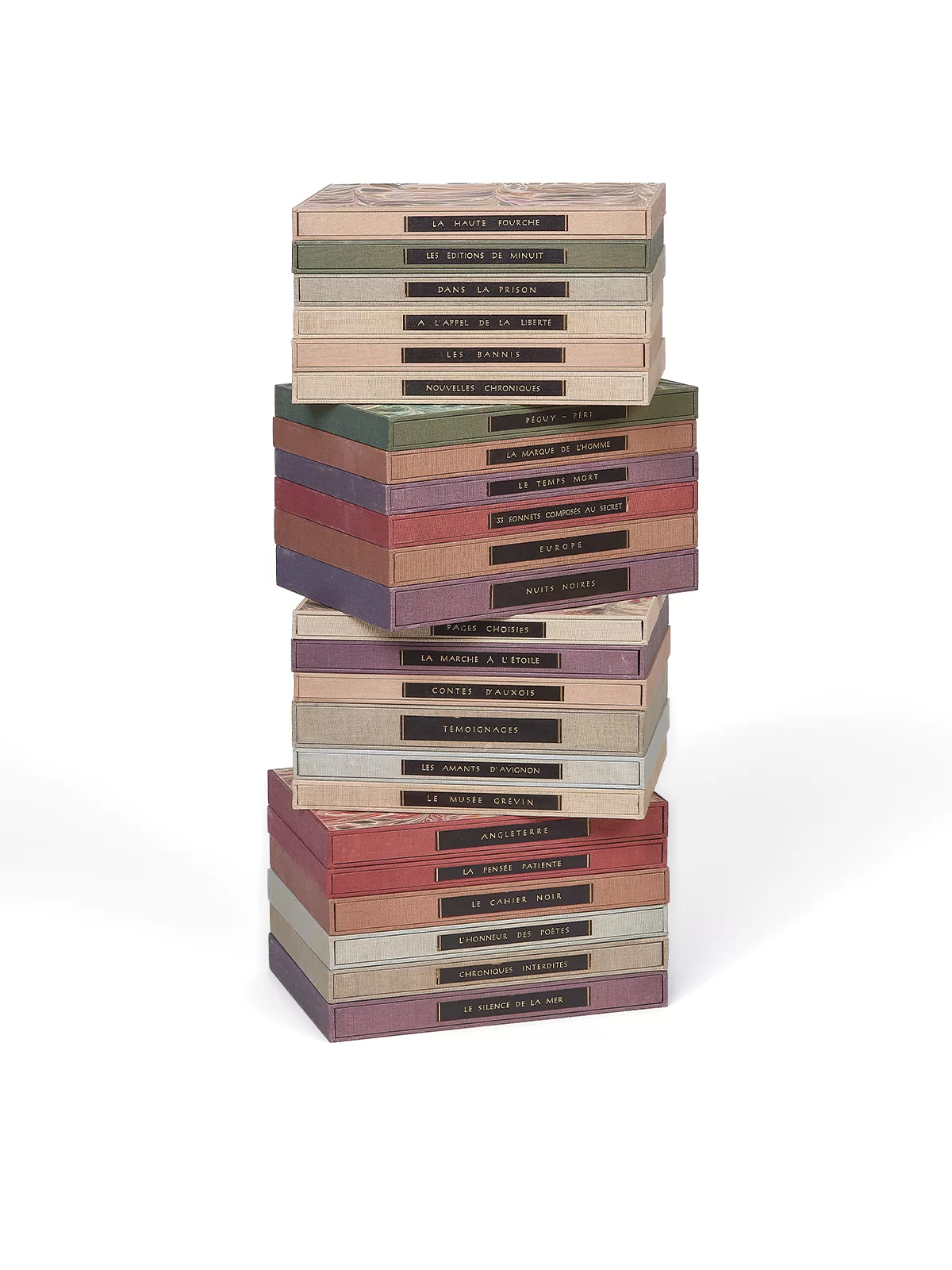
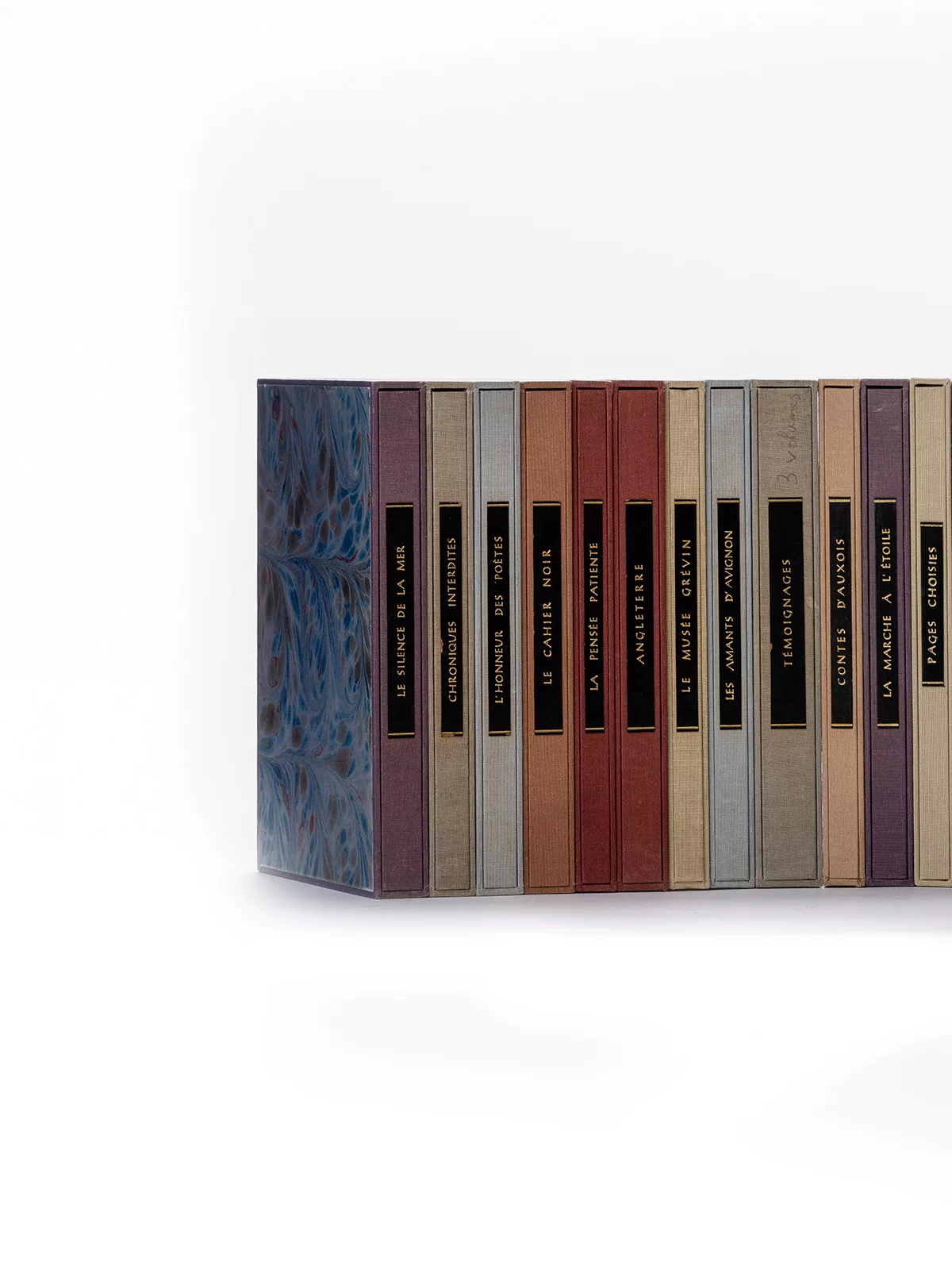
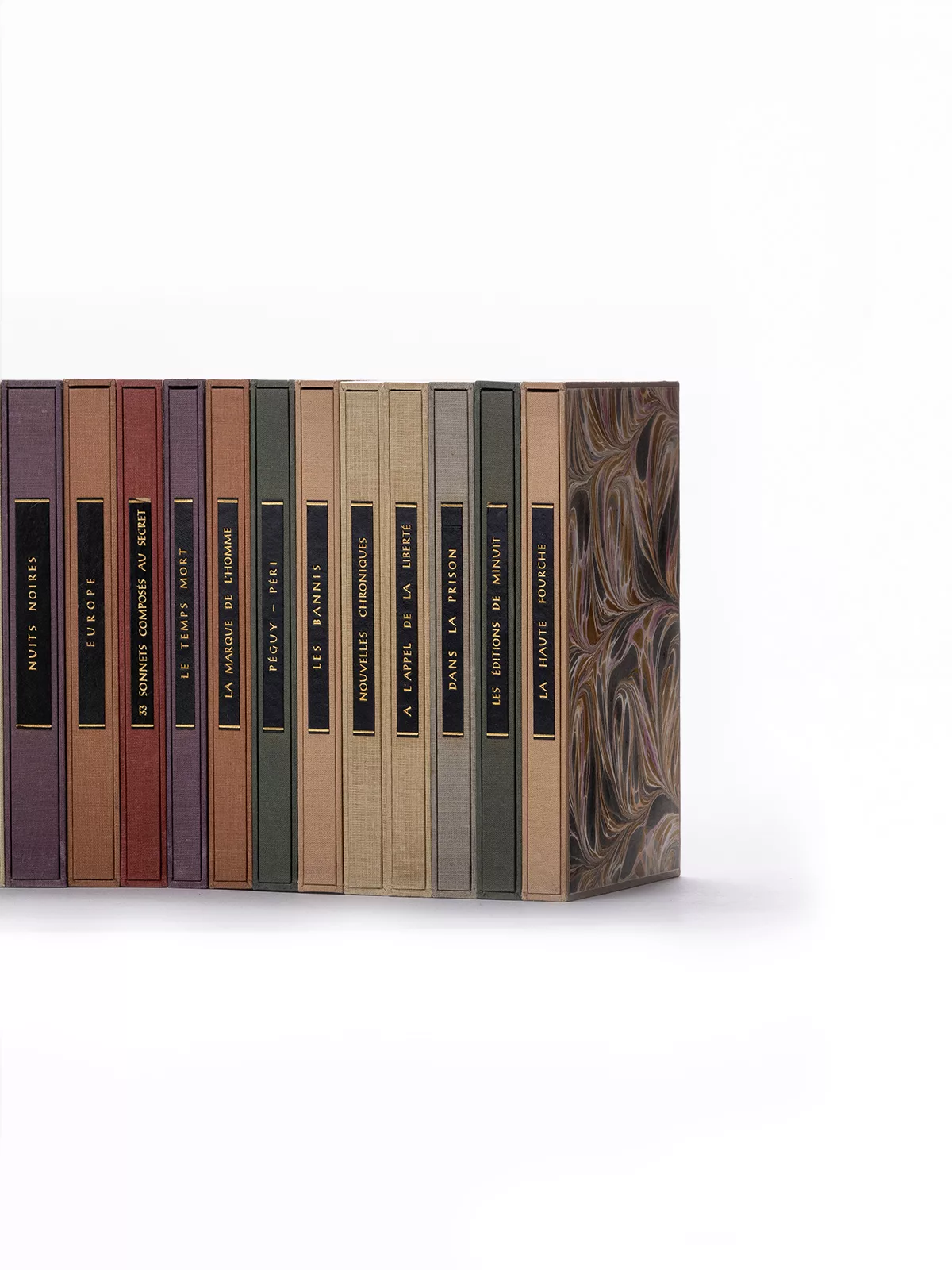
Le Silence de la mer et 25 autres titres dont 23 clandestins
First edition of the landmark work of the literary Resistance, published under the pseudonym Vercors, completed in print on 20 February 1942, complete with the Éditions de Minuit manifesto on a loose leaf, and first edition of 25 other titles, 23 of which were published clandestinely.
On 21 June 1943, Paul Éluard took over the literary direction of Éditions de Minuit from Pierre de Lescure, its co-founder (with Vercors), who was forced into complete clandestinity: “An hour before my departure, I had a conversation of a few minutes with [Éluard]. We were sitting on mountain packs. He simply said to me: ‘Agreed, count on me!’” (quoted by Anne Simonin, p. 107). For nearly a year already—having himself found refuge in autumn 1942 with the bookseller Lucien Scheler, and with “Courage,” his first clandestine poem, published in February 1943 in Les Lettres françaises—Éluard had been working to assemble the poems that Éditions de Minuit, now under his direction, would publish on 14 July 1943: L’Honneur des poètes.
Only three titles had been published by then, the last, Chroniques interdites, in April 1943, more than a year after Le Silence de la mer, and the bold clandestine enterprise still had to prove itself. For the production of Le Silence de la mer in the winter of 1942, the printer Ernest Aulard, known to Jean Bruller/Vercors, had found a typographer from the boulevard de l’Hôpital who specialized in announcements and visiting cards, Georges Oudeville. Vercors wanted a small-format book of about a hundred pages, carefully finished. Aulard supplied the paper and the type. The press, a Minerva platen press, could only print eight pages at a time, so the printing work took nearly three months: each week Bruller brought eight pages of the manuscript, destroying them as composition progressed, and left with the printed pages, which were stored in offices on the boulevard Raspail where a friend of Pierre de Lescure worked, and later, after a German search, in a café on the boulevard de la Gare. By the end of January 1942 the printing was finished. Yvonne Paraf, a friend of Vercors, took charge of the binding, and Vercors himself glued the covers. The result was a beautifully made book, with flawless typography — “fine work,” as Vercors himself would later say with satisfaction. This achievement demonstrated, as Jean Lescure (editor of the review Messages) put it, “that it was possible to publish real books clandestinely. […] One could escape the poverty of mimeographed sheets, remove the unconvincing character of our publications and restore to them the dignity of print, the authority of the book” (quoted by Simonin, p. 92). No one — not even Aulard, nor Oudeville, nor even his own wife — suspected until 1944 that Vercors was the author of the book, and the few who knew kept the secret.
In February 1942, 350 copies were made up: 100 for the Northern zone, quickly distributed underground; 250 for the Southern zone, of which no fewer than 200 were seized by the Germans while in transit to Lyon. A chain was formed to distribute the book, and the first copy reached Jean Paulhan through Jacques Debû-Bridel, a young official at the Ministry of the Navy, but this initial success at first had no immediate sequel.
Things changed rapidly under Éluard’s impetus, and new titles — eight by the end of 1943 alone — followed in quick succession: Le Cahier noir by François Mauriac (under the pseudonym Forez) in August; Angleterre by Jacques Debû-Bridel (Argonne) and La Pensée patiente by Léon Motchane (Thimerais) in September; Le Musée Grévin by Louis Aragon (François La Colère) and Les Amants d’Avignon by Elsa Triolet (Laurent Daniel) in October; Contes by Édith Thomas (Auxois) and La Marche à l’étoile by Vercors in December. The publication of the book by Aragon’s wife was not without controversy, imposed by Éluard, to the point that some saw in it evidence of the Communist Party’s growing influence over the publishing house — a party which Éluard himself had very recently rejoined. Indeed, while the poet went into hiding in Lozère in October 1943, continuing to oversee publications, militant texts multiplied within the Party’s orbit, from the “Témoignages” series, which included Le Crime contre l’esprit by Aragon, to titles printed specially for the Comité national des écrivains, notably Pages choisies by Jacques Decour, the young Communist martyr who had founded Les Lettres françaises. This activity was not limited to such tracts, and literary standards were maintained in 1944 with Nuits noires by John Steinbeck (a technical feat given the double number of pages to print) at the end of February, a second volume of L’Honneur des poètes, and 33 sonnets composés au secret by Jean Cassou (Jean Noir), which he had kept in memory until his release from prison, in May; Le Temps mort by Claude Aveline (Minervois) in June; and Dans la prison by Jean Guéhenno (Cévennes) in early August.
A remarkable set of the volumes published under the Occupation by Éditions de Minuit, with the exception of À travers le désastre by Jacques Maritain, the only one in octavo format, and the extremely rare Éléments de doctrine by Léon Motchane (Thimerais). The series is completed with two titles published at the Liberation (see list below).
List of volumes as follows:
[Jean BRULLER] VERCORS, Le Silence de la mer. 1942
[Jean BRULLER, ed.], Chroniques interdites. 1943
[Paul ÉLUARD, ed.], L’Honneur des poètes.
[François MAURIAC] FOREZ, Le Cahier noir.
[Léon MOTCHANE] THIMERAIS, La Pensée patiente.
[Jacques DEBÛ-BRIDEL] ARGONNE, Angleterre.
[Louis ARAGON] François LA COLÈRE, Le Musée Grévin.
[Elsa TRIOLET] Laurent DANIEL, Les Amants d’Avignon.
[Yves FARGE], Toulon. “Témoignages” series *.
[Louis ARAGON] LE TÉMOIN, Le Crime contre l’esprit. “Témoignages” series **. 1944
[Roger GIRON] VEXIN, L’Armistice. “Témoignages” series ***.
These 3 volumes, from the “Témoignages” series, in a single slipcase.
[Edith THOMAS] AUXOIS, Contes. 1943
[Jean BRULLER] VERCORS, La Marche à l’étoile.
[Jean PAULHAN, ed.], Pages choisies by Jacques Decour. 1944. Printed for the CNE.
John STEINBECK, Nuits noires.
[Paul ÉLUARD, ed.], L’Honneur des poètes**. Europe.
[Jean CASSOU] Jean NOIR, 33 sonnets composés au secret.
[Claude AVELINE] MINERVOIS, Le Temps mort.
[Claude MORGAN] MORTAGNE, La Marque de l’homme.
Péguy-Péri. Deux voix françaises.
[Jean PAULHAN, ed.], Chroniques interdites**.
[Jean PAULHAN, ed.], Les Bannis. Printed for the CNE.
[Georges ADAM] HAINAUT, À l’appel de la liberté.
[Jean GUÉHENNO] CÉVENNES, Dans la prison.
+ Jacques DEBÛ-BRIDEL, Les Éditions de Minuit. Historique et bibliographie.
+ Pierre BOST, La Haute Fourche.