

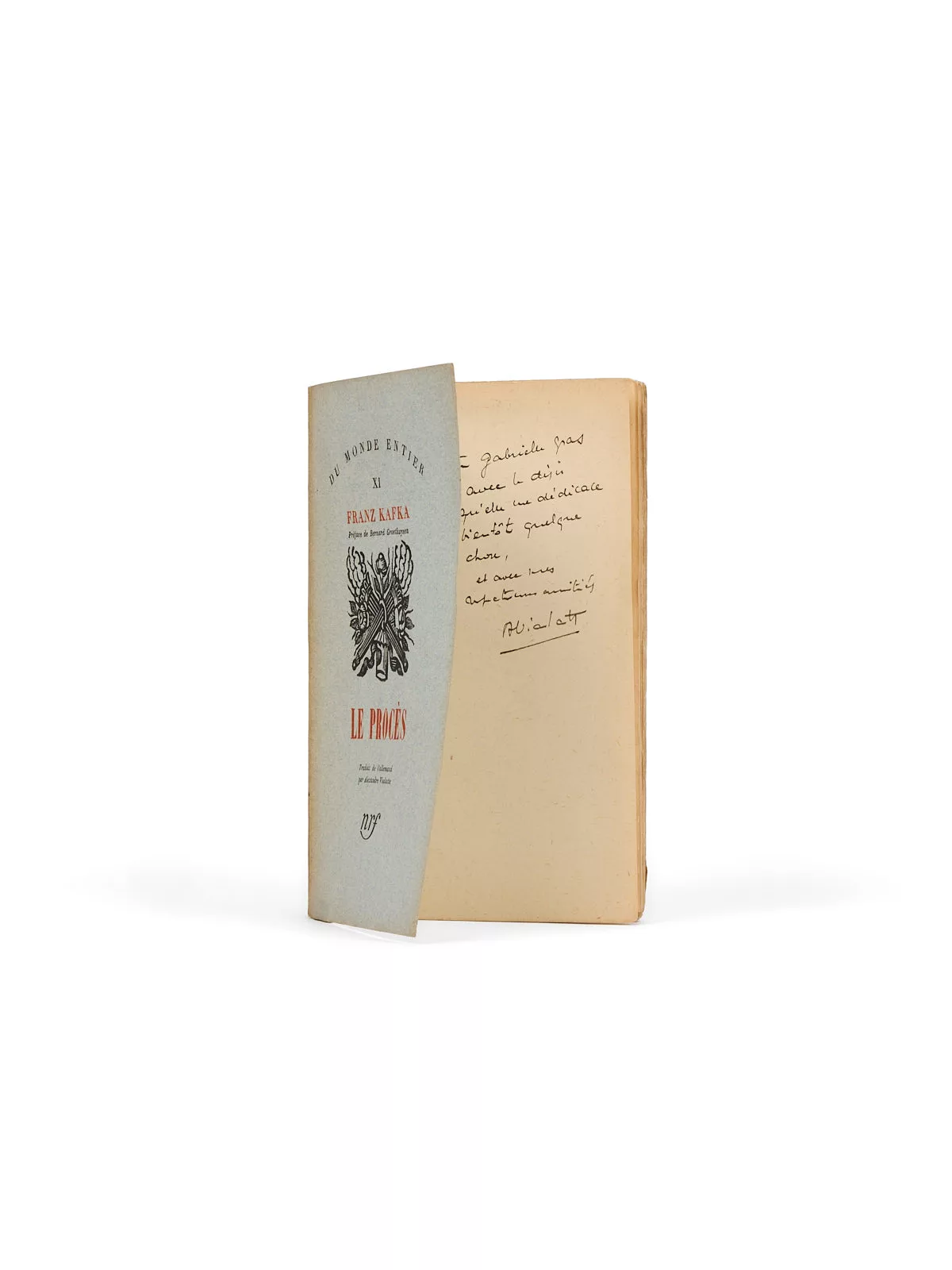
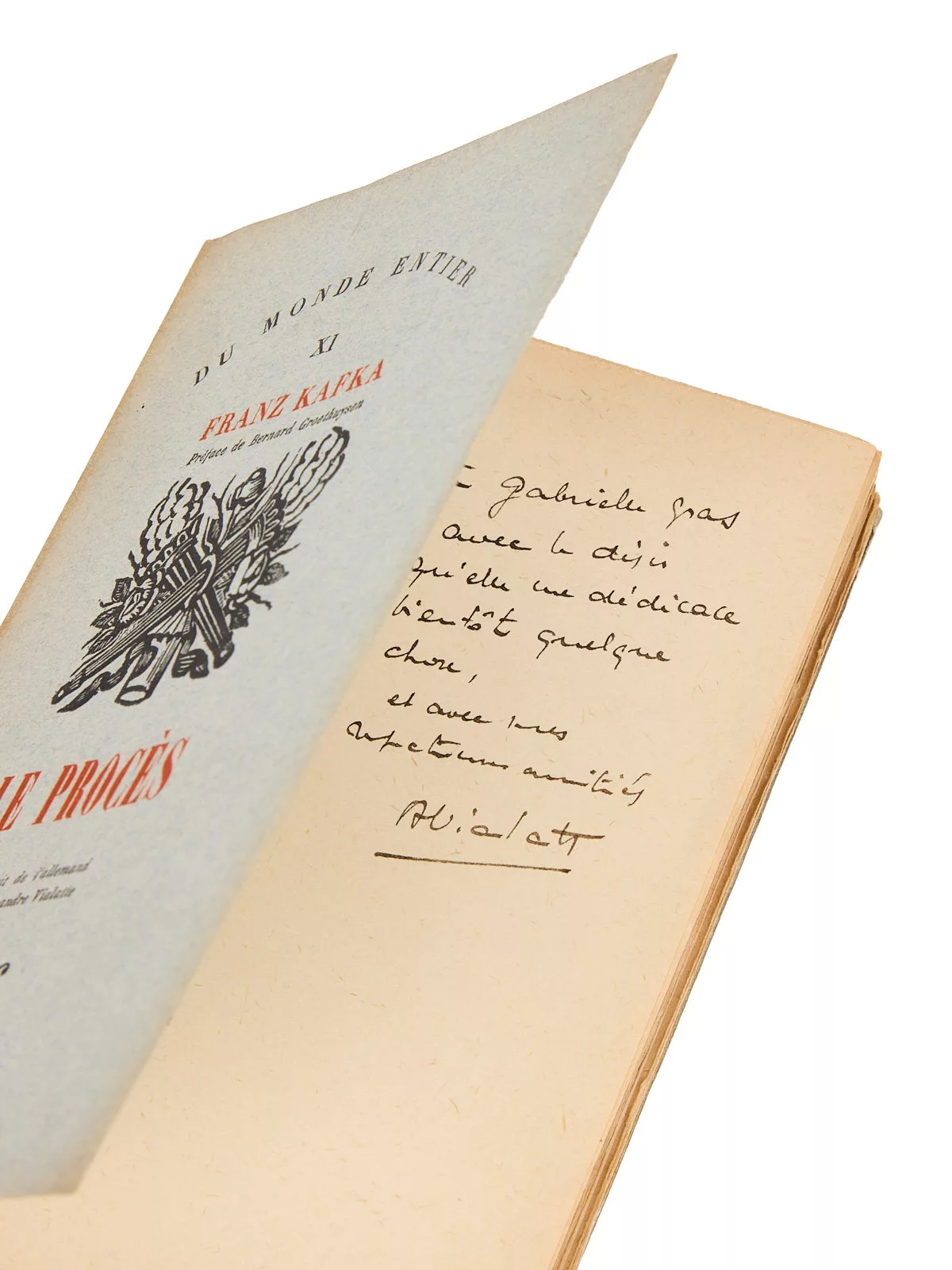
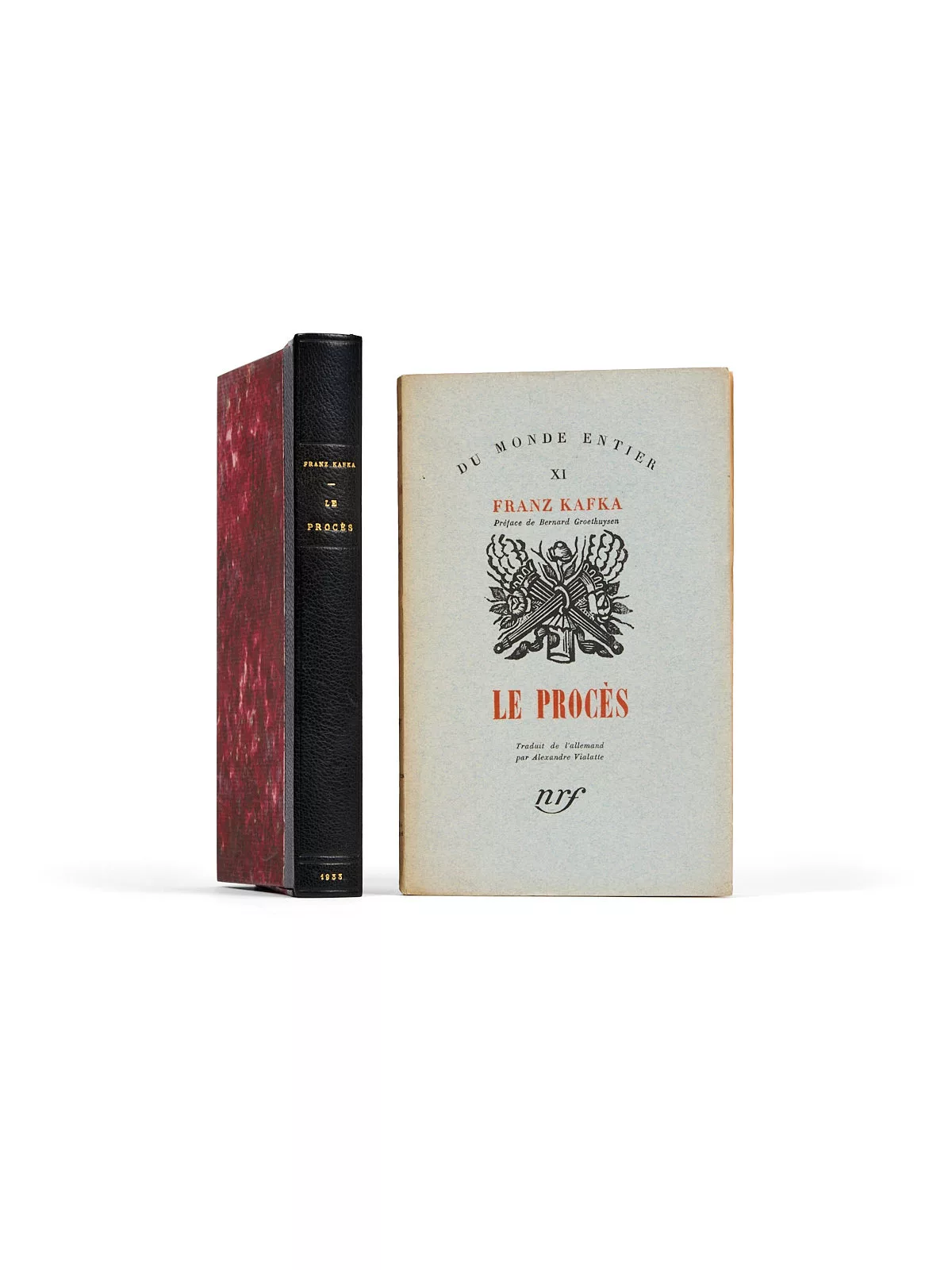
One of 148 copies from the deluxe issue on alfa paper, this one of 18 hors commerce copies (copy n).
Signed presentation inscription by the translator: “à Gabrielle Gras, avec le désir qu’elle me dédicace bientôt quelque chose, et avec mes respectueuses amitiés. A. Vialatte.”
“Dearest Max, my last request: everything I leave behind is to be burned unread.” Franz Kafka died on 11 June 1924 at the Kierling sanatorium, in what is now Klosterneuburg, near Vienna. Less than a year later, Max Brod published Der Prozess, against his friend’s explicit last wishes. The sacrilege is now largely forgotten or forgiven, and every admirer of Kafka’s work secretly thanks him for his betrayal. The French translation appeared seven months after Hitler came to power.
A fine provenance: this copy belonged to Gabrielle Gras, the celebrated Nice bookseller who ran the famous Librairie Paradis at 12 rue de France. She was the companion, and later (in 1957) the wife, of Pierre Abraham, brother of the writer Jean-Richard Bloch. Abraham published an essay on Balzac with Éditions Rieder in 1929 and one on Proust in 1930, and also translated Brecht into French.
A member of the Resistance and a leading literary figure in wartime Nice, he ran an intelligence service there in contact with London and Algiers. He was promoted to commandant by General de Gaulle in September 1943, and to lieutenant-colonel in the air force in March 1945. Elsa Triolet wrote of them: “In Nice itself, Pierre Abraham and Gabrielle Gras had come to run, on rue de France, a bookshop as alive as an underground newspaper, with passers-by bringing news from Paris and elsewhere. The Abragras, as I called them, lived over by the Paillon, in a real apartment; we sometimes went there for dinner.”
Deluxe copies of Le Procès with an inscription are rare. Only five others are known: those given to Gaston Gallimard, Jean Paulhan, Bernard Groethuysen, Henri Pourrat, and his wife Hélène Vialatte.
Spine faded, otherwise a good copy, in a slipcase from the Ateliers Laurenchet.