


Le Printemps de la vie
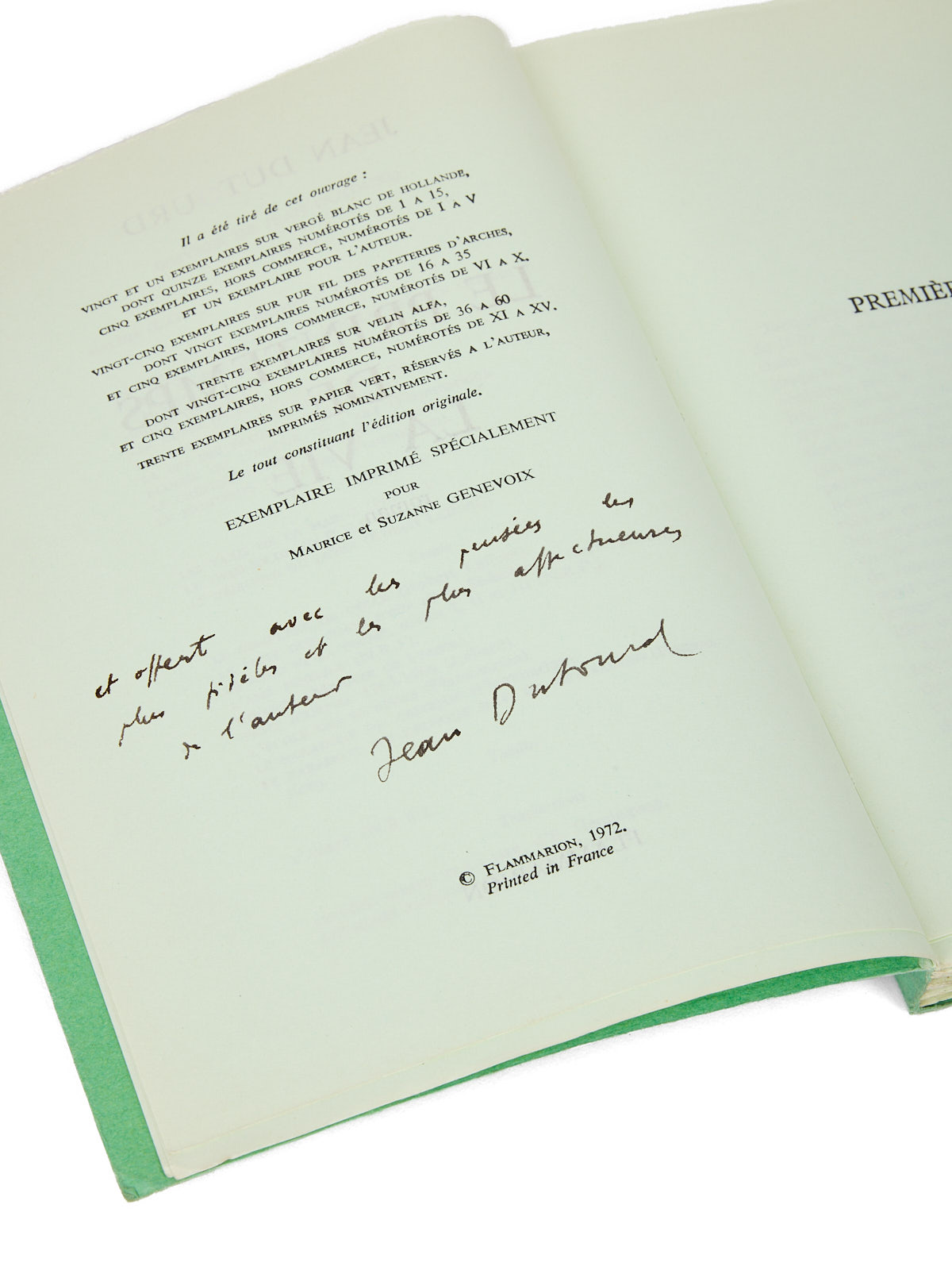
One of 30 copies on green paper, this one a nominative copy for Maurice and Suzanne Genevoix.
Signed presentation inscription: “... et offert avec les pensées les plus fidèles et les plus affectueuses de l'auteur. Jean Dutourd.”
Le Printemps de la vie is set in the 1930s. Jacques de Boissy, a young man with a considerable advantage in the person of his wealthy businessman father, decides overnight to abandon his studies (he holds a degree in literature) in order to begin writing novels. “Do you feel you have a calling?” his father asks him. “If you feel you have a calling, I will say no more. A calling is sacred.” The young man does not really know what a calling is (he has never felt anything of the sort), but he is sure of one thing: he has no desire to be a lawyer, a businessman, an ambassador or a stockbroker. His father, so concerned for his son’s happiness, decides to pay him a monthly allowance to help him in his ambitions: money cannot buy everything, but it remains a valuable aid. Jean Pousselet, Jacques’s childhood friend (and likewise a literature graduate), wants the same fate. An only child, fatherless and without means, will his lot be any different?
“Moralizing sermons are not Dutourd’s style — he carefully avoids handing out ready-made answers. His characters, moreover, bear little resemblance to the crude puppets favored by dispensers of (bad) lessons: they are creatures of flesh and blood, endowed with passions, sometimes good, sometimes mediocre, who evolve over the course of the narrative and gain depth, whom Dutourd presents with the calm, philosophical smile of a creator god who loves his creatures and strives to understand them — even when they behave like scoundrels” (Max Bergez, “Écrire gaiement des choses poignantes,” Revue Des Deux Mondes, 2021, 144–48).
A fine copy.