

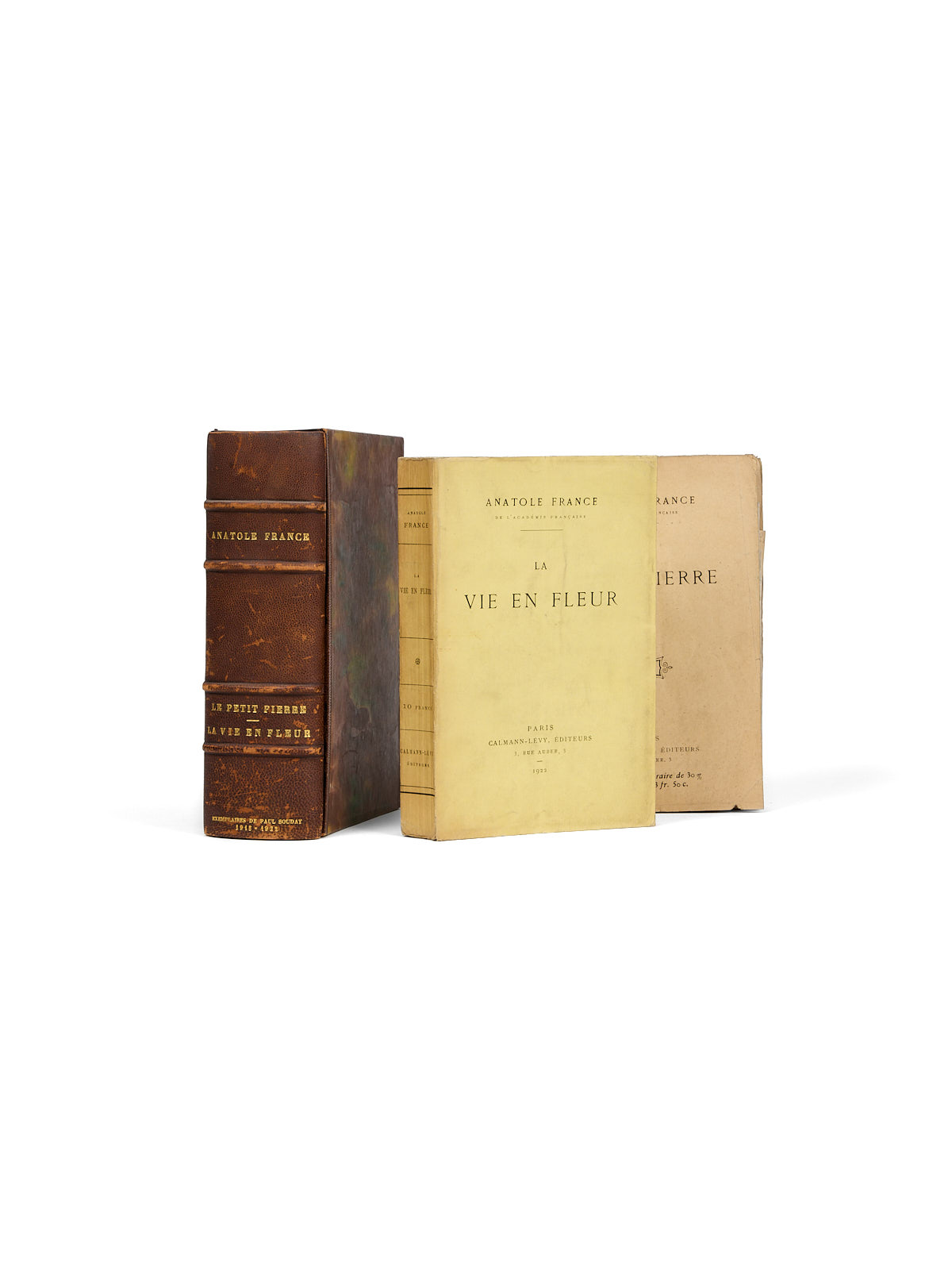
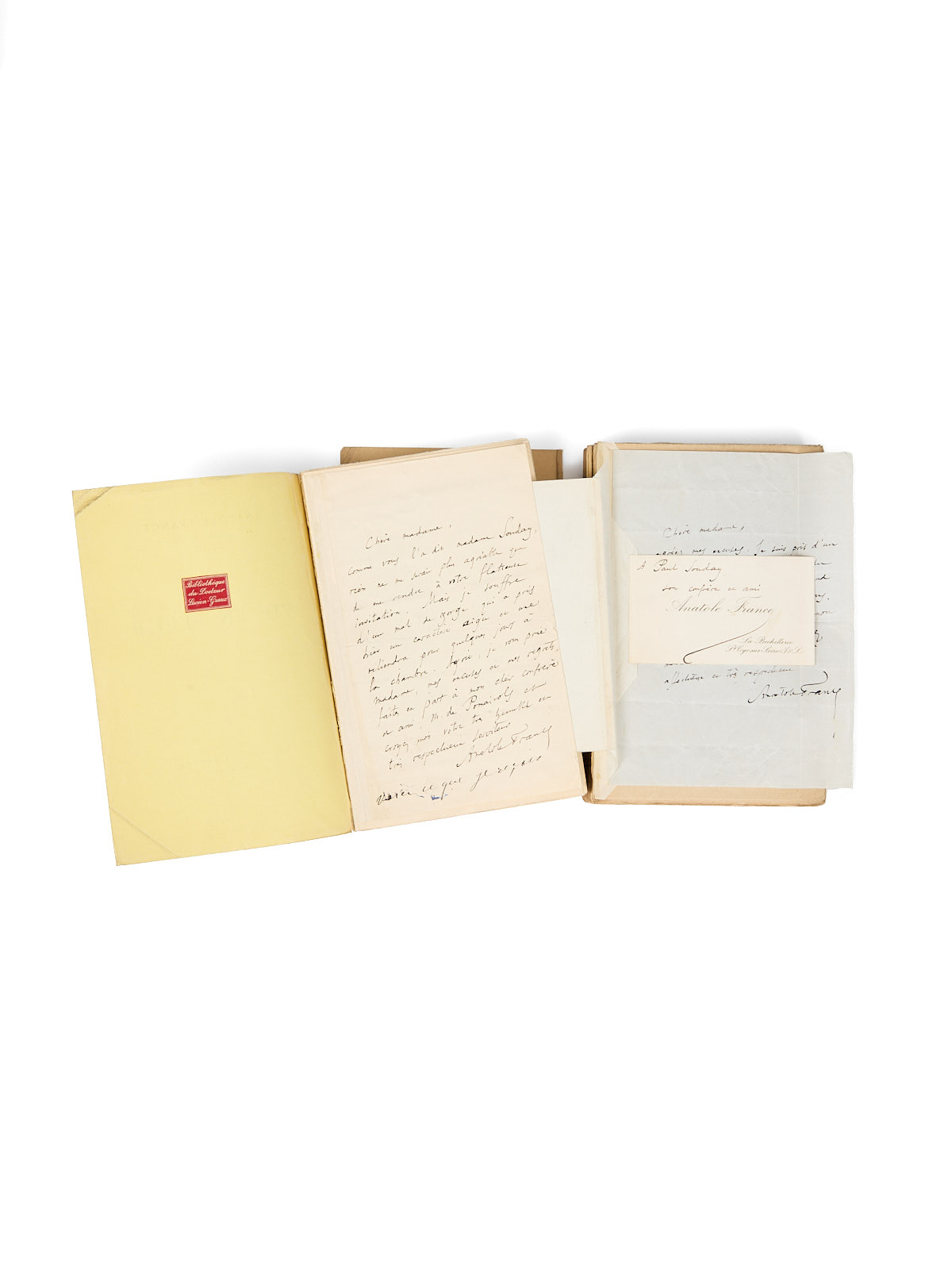
Both copies come from the library of Paul Souday. In the copy of Le Petit Pierre are bound an autograph note signed, in which the author sends the copy to his friend (a visiting card addressed to “La Bechellerie, St Cyr-sur-Loire”), together with an autograph letter to Souday's wife (1 leaf on blue paper, envelope preserved); in the copy of La Vie en fleur, an autograph letter signed to an unknown recipient. In both cases, Anatole France declines dinner invitations on account of illness. In each copy have also been mounted two portraits of the author, made in 1924 by Marthe Antoine Gérardin.
Anatole France was already seventy-four when he offered, in Le Petit Pierre (1918), a more detailed and confiding account of what he had earlier touched upon in Le Livre de mon ami (1885) and then in Pierre Nozière (1899). Unlike the two earlier books, Le Petit Pierre is far richer in observations revealing the author’s character. “France tells us there that his mind was shaped after that of his father — traditionalist, spiritualist, even Christian — but ‘like a cup molded on a lover’s breast’! That is, he reproduced in negative its sweetest curves. A curiously poetic way of saying that in all things he took the opposite view of the opinions […] of the man who raised him.”
A fine provenance for this set of memoirs, preserved in a chemise-slipcase bearing the name of Paul Souday. A literary critic and friend of the author, Souday is remembered, among other things, for the controversy that set him against Marcel Proust, whom he criticized in a column in Le Temps (10 December 1913) for the “errors of French” in Du côté de chez Swann. As the story goes, the author of the Recherche forgave him; the two even became friends, and the episode that had angered them became a standing joke between them.
From the libraries of Paul Souday, then Lucien Graux (bookplate).