

Le Marteau sans maître
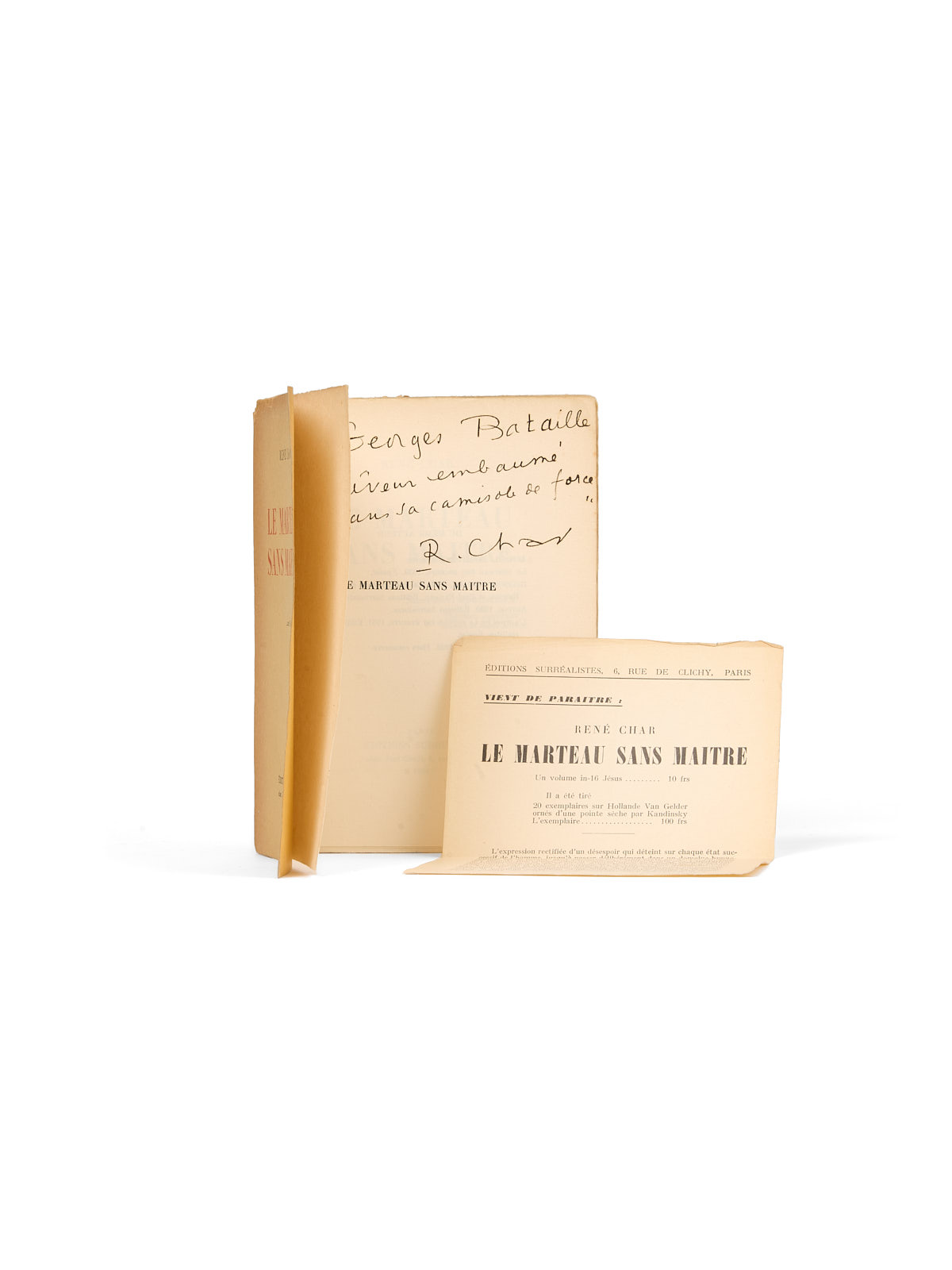
Presentation copy inscribed by Char to Georges Bataille: “à Georges Bataille ‘Le rêveur embaumé sans sa camisole de force’ R. Char.”
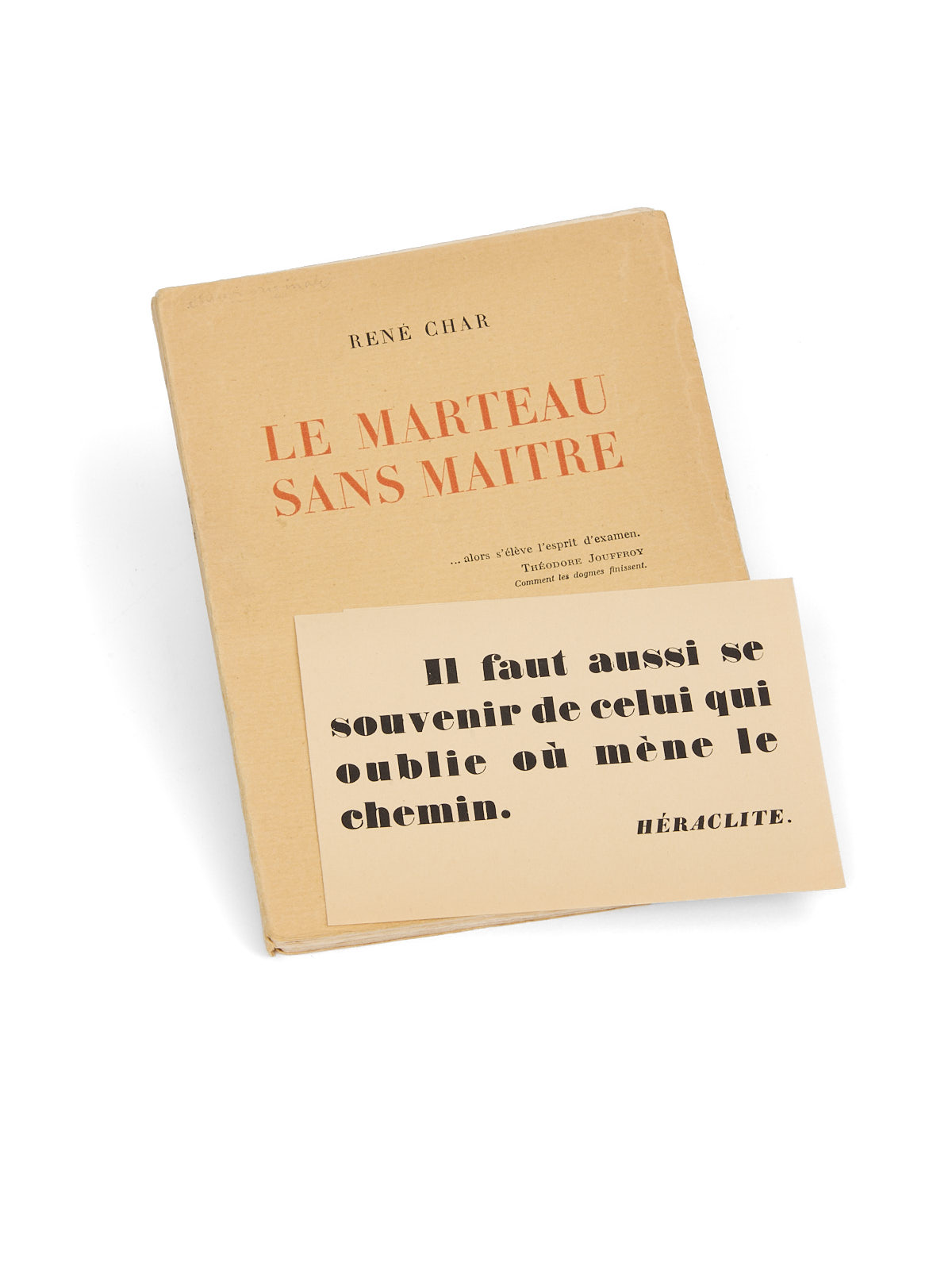
Publisher's wraparound band and publisher's insert preserved, written by Tristan Tzara.
Until now, Seuls demeurent (published in 1945) was the earliest René Char title recorded in Georges Bataille’s library, according to the inventory established in 2022 by the Librairie du Sandre and Henri Vignes (La Bibliothèque de Georges Bataille). This copy of Le Marteau sans maître would therefore revise that record and establish an earlier encounter between the two men, by nearly ten years — even if only at a distance, through the medium of a book. It is known with near certainty that the two men did not see each other during the war, and apparently met for the first time only in April 1945: “j’ai finalement à me réjouir d’avoir aujourd’hui rencontré René Char” (Bataille, quoted in Dans l’atelier du poète, p. 378). On that occasion they exchanged their books, Seuls demeurent and L’Expérience intérieure, with the inscriptions: “À Georges Bataille, intime de l’homme abrupt dans sa prison, René Char” and “à René Char, dont tout me rapproche, affectueusement, Georges Bataille.”
Was this copy of Le Marteau sans maître given to Bataille by Char after its publication (1934) — perhaps at the same time as Seuls demeurent? The wording of the two inscriptions, “intime de l’homme abrupt dans sa prison” and “rêveur embaumé sans sa camisole de force,” suggests as much. The choice of Le Marteau sans maître as the work through which Char represented his earliest period is significant: after Arsenal and Artine, it was a text especially close to his heart. “All the thoughts contained in Le Marteau sans maître, I never spoke of to anyone, not even to my close friend Éluard. It was a revolt I lived through alone, without sharing it,” Char later confided to Paul Veyne, at a time when he was distancing himself from the Surrealist movement, in which he had only ever been a temporary lodger.
“From the beginning of 1933, the chosen title was Le Marteau sans maître, as evidenced by a letter from Paul Éluard to René Char confirming that he would submit the manuscript to his own publisher, Gaston Gallimard […]. Gallimard’s response in March 1933 was less than enthusiastic, and faced with this refusal, Char turned to a publisher already deeply committed to Surrealist publications: José Corti. Corti agreed to publish, through Éditions surréalistes, Le Marteau sans maître as a partly original collective edition comprising: Arsenal, Artine, L’action de la justice est éteinte, and, for the first time, Poèmes militants […]. Paul Éluard immediately agreed to write the publisher’s insert. But Char also approached Breton before finally accepting Tzara’s text: ‘I am delighted, with all the gravity and wonder this word conveys, by your endless lines. I ask your permission, with Éluard’s agreement, to make them the sole text. I see no clearer frame with which to surround myself anywhere; diamonds must not be mixed together. So, you alone. And I am delighted, both for my book and for the reader’” (Marie-Claude Char, preface to Le Marteau sans maître, Poésie/Gallimard, 2002).
A choice copy.
Complete with the publisher’s wraparound band and the publisher’s insert written by Tristan Tzara.