

Paul Éluard first met Paul Bonet in the 1930s. Bonet had set up as a binder in 1924, four years after discovering the craft. He was then thirty-five, and his first bindings were shown the following year at the Musée Galliera and at the Exposition des Arts du livre français, where his talent went largely unnoticed. Nevertheless, as he notes in his Carnets, these exhibitions “brought me a few commissions for half-bindings (…). That was my real beginning, and I did not know a single bibliophile.” Invited to Brussels by the bookseller Simonson, he met René Gaffé there, who entrusted him with his first bindings of Surrealist authors: first the complete run of La Révolution surréaliste, then four titles by Aragon: Anicet, Le Traité du style, Le Libertinage and Le Paysan de Paris. The Manifeste du surréalisme and Ralentir travaux followed, leading to Bonet’s meeting with André Breton and Paul Éluard. Éluard was the first to entrust him with work — beginning with his own copy of Nadja in February 1931 — while Breton commissioned in October a group of bindings that Bonet records in his Carnets as “various other bindings on works by Breton and Éluard,” made for the two poets and for René Gaffé.
Thereafter, Paul Bonet was repeatedly drawn back to Éluard, both through friendship and through a shared affinity in bibliophily. Along with Guillaume Apollinaire — whom Bonet never knew personally — Éluard is the poet he bound most often: 75 entries. Only Apollinaire was treated (far) more generously, with 149 recorded bindings, owing to a larger number of patrons. Only Giraudoux, with 84 bindings recorded, surpasses Éluard in number.
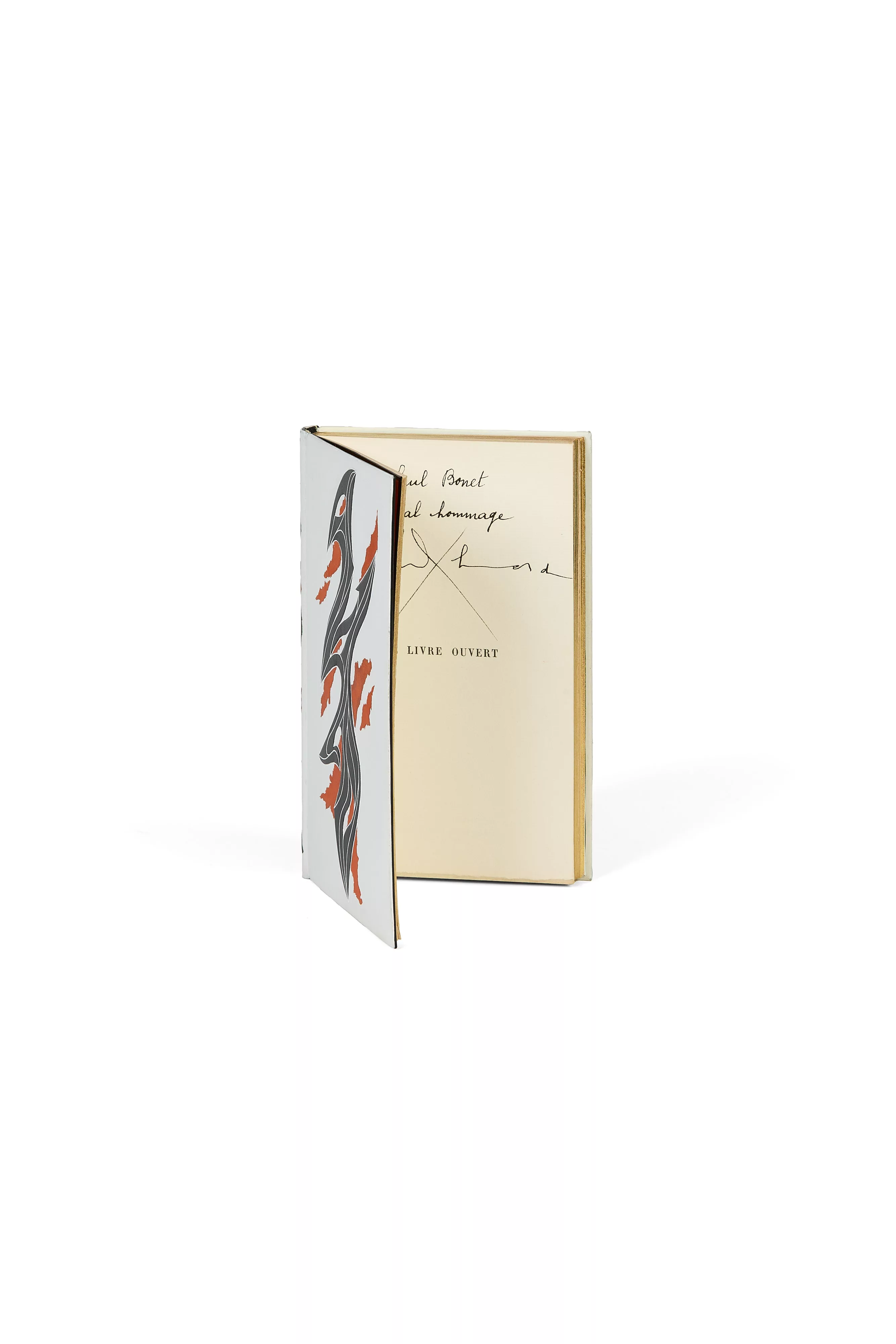
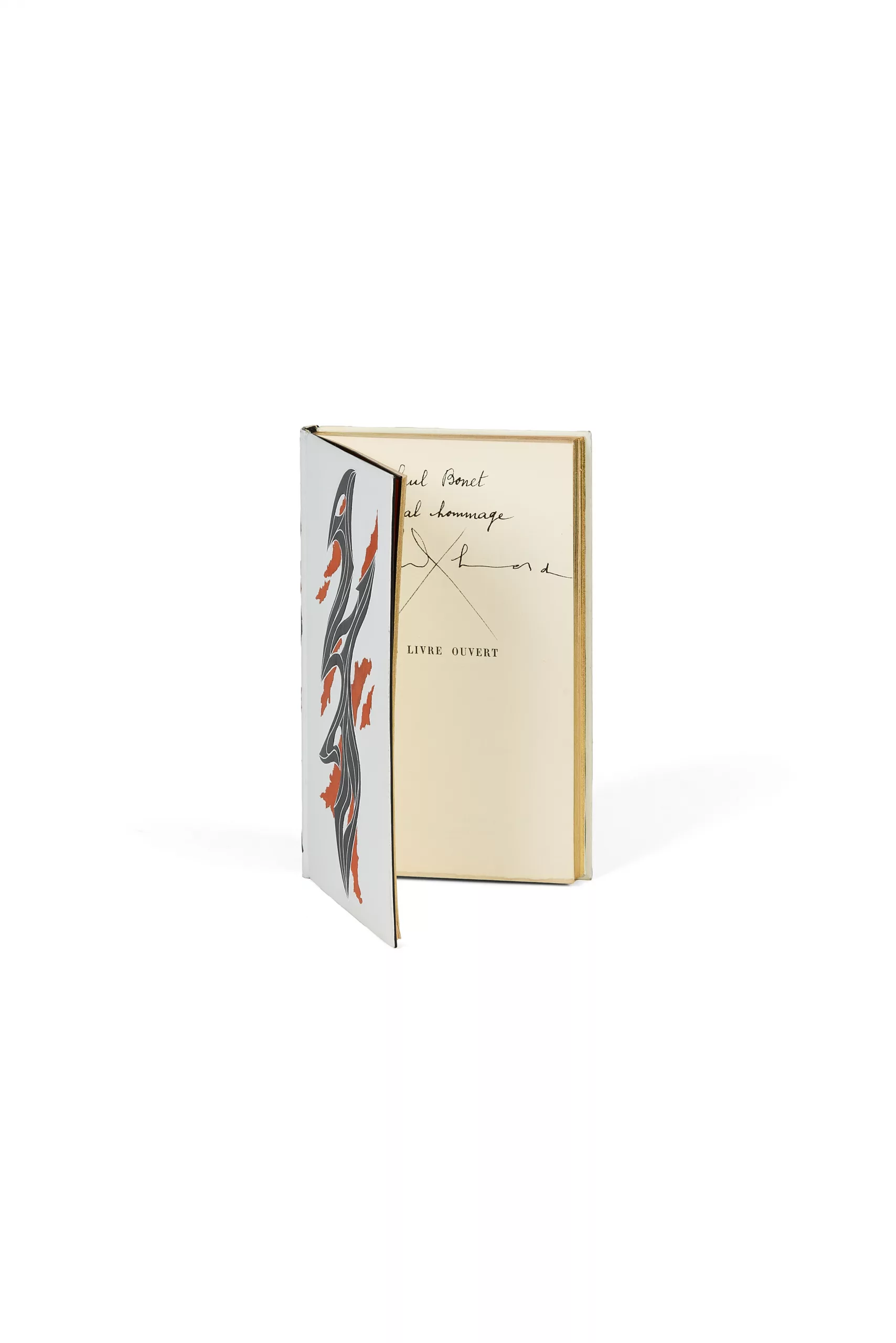
This binding is the only one made on Le Livre ouvert, after Bonet had bound the manuscript of the projected Livre ouvert III, at Éluard’s death, for Professor Millot. It is among the last bindings executed by Bonet, made by René Desmules and gilt by Balé. According to the Carnets, it was completed on September 23, 1970.