

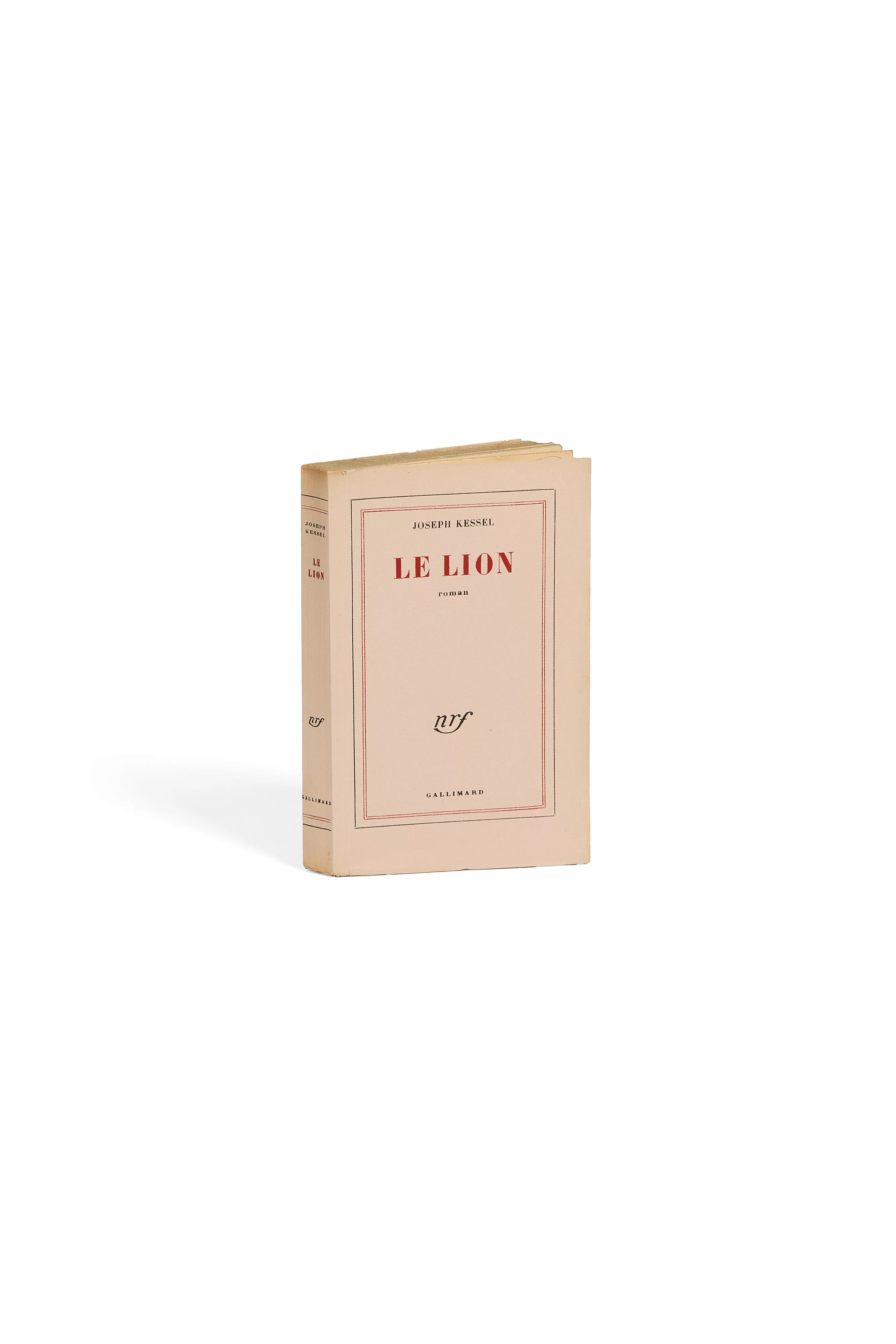
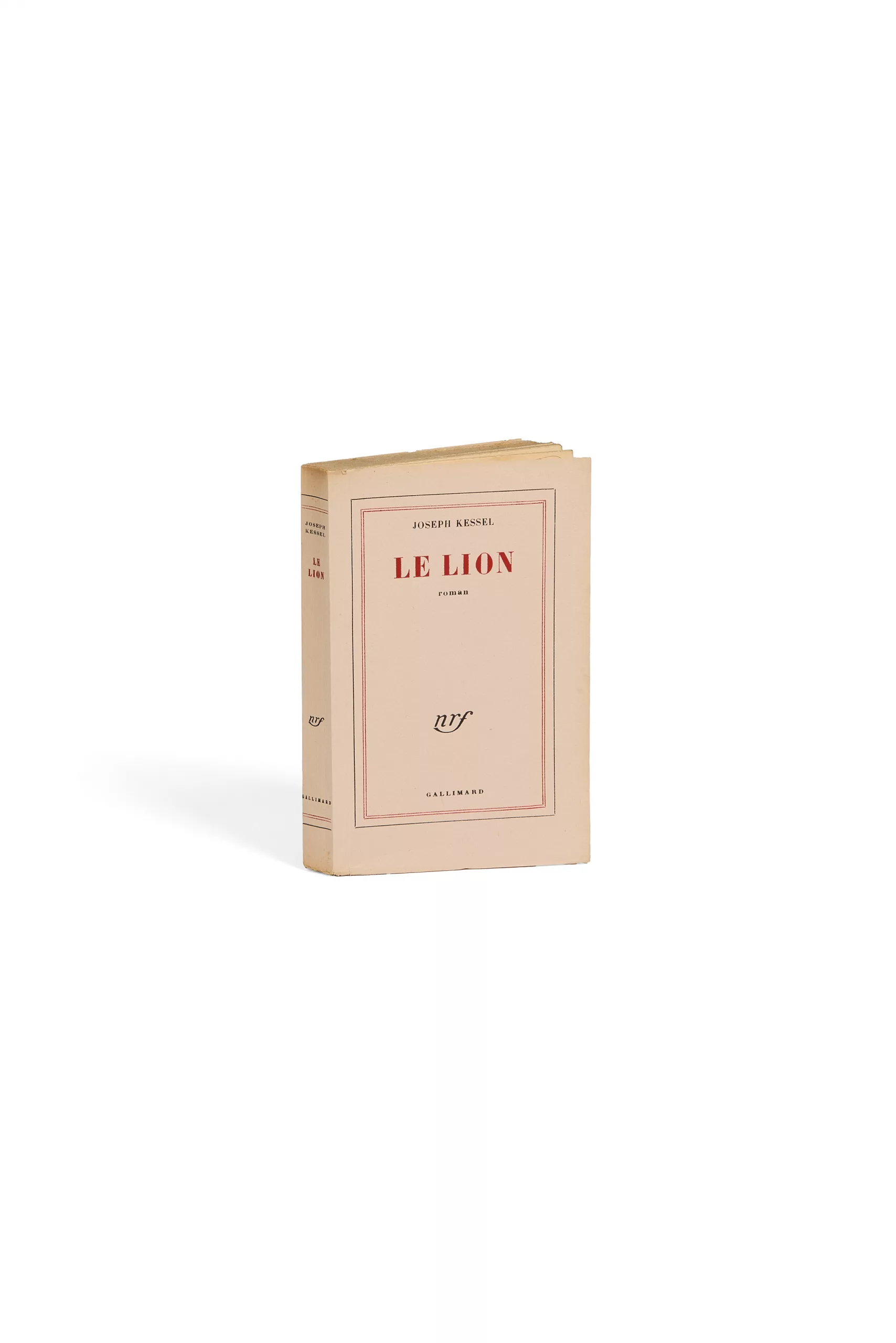
Le Lion
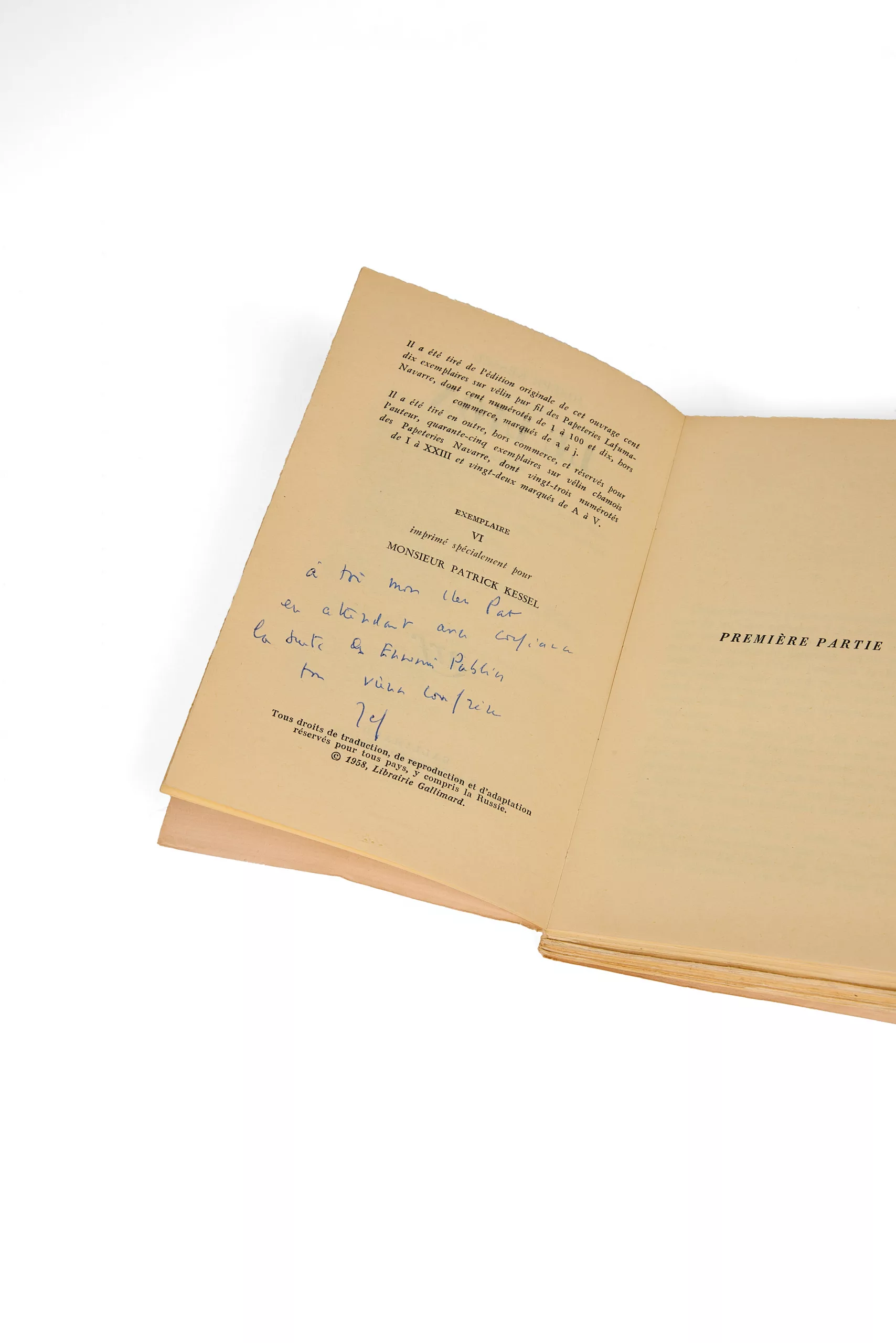
One of 45 deluxe copies on vélin chamois, all hors commerce and reserved for the author. This is one of 22 nominative copies: this one reserved for “Monsieur Patrick KESSEL,” with a signed presentation inscription:
“à toi mon cher Pat, en attendant avec confiance la suite des Ennemis publics. Ton vieux confrère, Jef.”
Since Le Tour du malheur (published in 1950), Kessel had not published a single novel, so much so that the postwar public knew him chiefly as the celebrated reporter whose articles appeared in France-Soir. Seeking material for a new narrative in the experience of his travels, he undertook the writing of what would become one of his most popular successes: Le Lion.
The book’s foundation was his 1953 journey to Kenya with his wife Michelle, during which he met, in the Amboseli reserve north of Kilimanjaro, the real-life protagonists of the story: a lioness named Iola and a little girl named Fiona. He had drawn nothing from this experience at the time, neither in La Piste fauve, published three years earlier, nor even in a newspaper article. He began writing the novel on rue Quentin-Bauchart, explaining that he owed his publisher a book. A month later, though usually reluctant to confide, he told the journalist Michel Droit: “I am leaving the day after tomorrow for Mary-sur-Marne, because I must finish, in peace, a book I promised my publisher, with whom I have an account to settle. He keeps pressing me to deliver it as soon as possible. It’s the story of a little girl and a lion, which I picked up rather vaguely in Kenya. A nice, amusing little thing, of no real interest. It won’t succeed at all, but at least I’ll have paid off my debt to Gallimard.” On 5 February 1958, he signed a contract with Gallimard for what was still called Le Signe du lion.
When the manuscript was delivered, Gaston Gallimard immediately recognized that he had a success on his hands. The book appeared in bookshops in April, just days before the events in Algiers, and a few days after publication Kessel received a letter from the man he admired above all others: “Le Lion is magnificent. It may be the finest of your books. It moves, runs, rises, bursts and resounds. Your talent is very great, and you distribute its fruits generously, straightforwardly, without artifice of thought or style. Thank you. […] Yours most warmly, C. de Gaulle.” (Letter of 5 May 1958.)
Gallimard had expected a success; what followed was a triumph, with 100,000 copies sold within the first few months, rivaling the records set by Le Grand Meaulnes, La Condition humaine, L’Étranger, La Peste, Le Petit Prince and Bonjour Tristesse, and eventually selling nearly two million copies.
A very fine copy with a distinguished provenance: Patrick Kessel, “his old colleague,” worked for several years as a journalist at France-Soir, L’Express, Libération (Emmanuel d’Astier’s paper), and finally France Observateur.
Joseph Kessel’s nephew — he was the son of Georges Kessel, Joseph’s younger brother — Patrick was also a writer: following the publication of the first biography of Antoine de Saint-Exupéry in 1954 (La Vie de Saint-Exupéry, Gallimard), his first novel appeared the following year at Julliard (Le Bénéfice du doute). His second, Les Ennemis publics (Julliard, 1957), to which Kessel alludes in his inscription by asking for a sequel, drew on his own experience in journalism and provoked considerable political comment, even in the USSR, where it was translated. Although sympathetic to the Communist Party (he took part in 1956 in the defense of the offices of L’Humanité when they were attacked following the Hungarian uprising), he was never a member: the PCF’s policy in France, and above all its perceived timidity on colonial questions, soon led him to distance himself from it.
From the early 1990s, he revived the Bulletin international and formed a collective aimed at continuing to promote a Centre for the Study of Workers’ and Peasants’ Movements, drawing on an extensive library and a wide-ranging documentary collection he had assembled over his lifetime. This collection, now owned by the Fondation Gabriel Péri, is held and available for consultation in Chauvigny, while his personal archives are held at the departmental archives of Seine-Saint-Denis.
He was the person to whom Kessel entrusted the moral right over the reissue of his books, jointly with Maurice Druon. It should be recalled that Kessel, by his will, had asked that his royalties be paid in full to the Irish Red Cross. Yves Courrière (literary pseudonym of Gérard Bon) was Kessel’s principal confidant in his final years, and Kessel named him literary mediator in his will in case of disagreement between Patrick Kessel and Maurice Druon, his two nephews and heirs to his moral rights. The two men, often at odds, cordially detested one another, but when the Prix Joseph-Kessel was created by Michèle Kahn and Yves Courrière in 1997, both gave it their approval.