

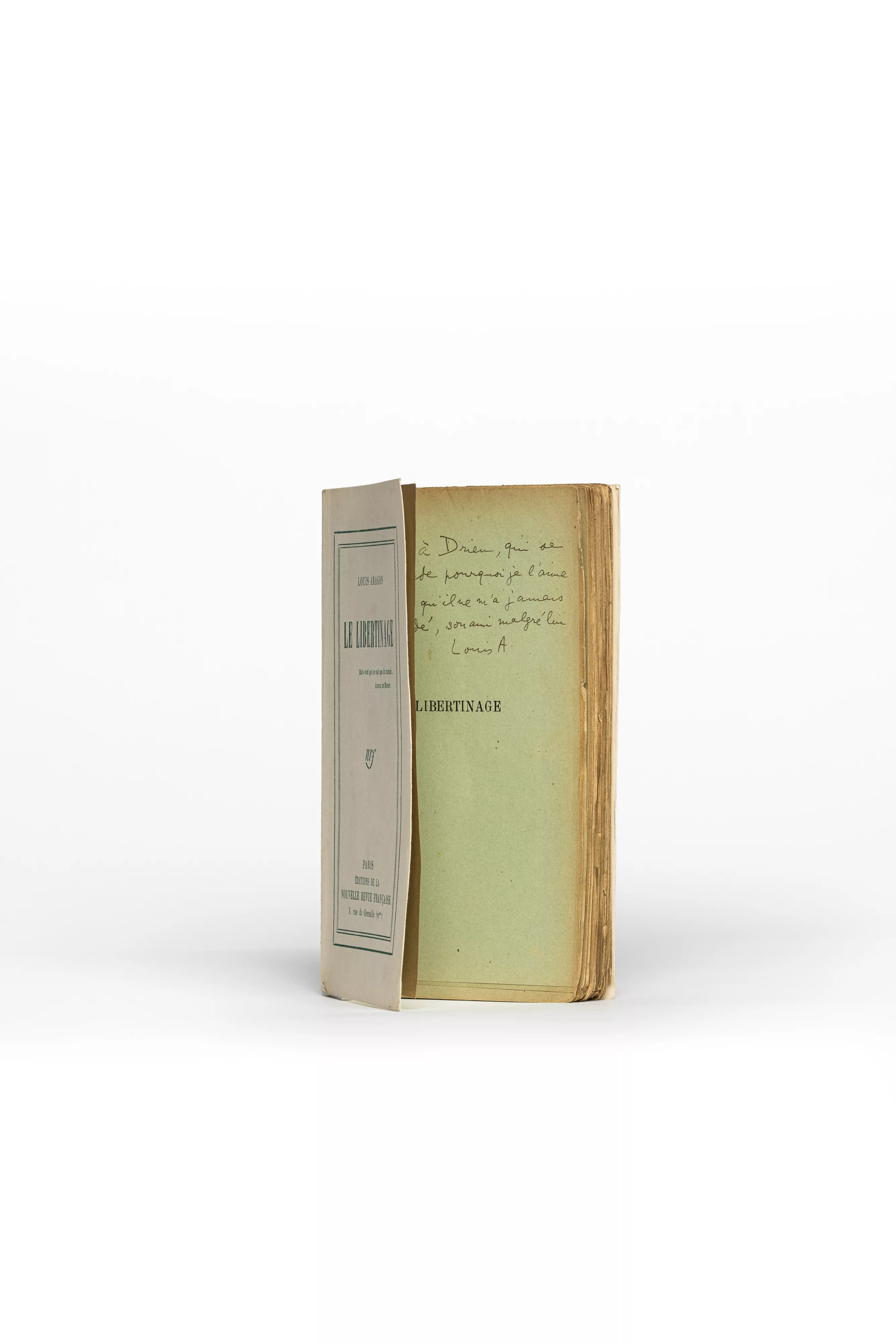
Le Libertinage
One of the rare copies on colored paper, this one on green paper, marked “exemplaire d'auteur.”
Signed presentation inscription: “À Drieu, qui se demande pourquoi je l'aime parce qu'il ne m'a jamais regardé, son ami malgré lui, Louis A.”
A precious presentation copy to Pierre Drieu la Rochelle, who would return the compliment a few months later by dedicating to him his first novel, L'homme couvert de femmes.
Aragon, a self-declared “champion of disorder,” rejected all constraints. His virulent preface, a provocative and brilliant apology for love and anarchy, makes this clear: “I understood that my thought was gradually being distorted […] the least unusual part of me was being singled out, and I was about to please the very people who could not have spoken with me for five minutes without anger […]. I have never sought anything but scandal, and I sought it for its own sake.”
The “little stories, tales, short stories, dialogued scenes” collected in Le Libertinage were written between the dispersal of the Dada movement and the formation of the Surrealist group, whose Manifesto would be published in October by André Breton.
The book is dedicated to Pierre Drieu la Rochelle. A passionate friendship had bound the two men for seven years. Both had fought in the war, one as a soldier, the other as an auxiliary doctor, and both came back with “hatred for the shirkers responsible for this slaughter.” Initially drawn to pacifism, Drieu mixed with the Surrealists in the 1920s after his wife Colette introduced him to Aragon in spring 1917. Aragon was not insensible to his charm, despite political views that would eventually diverge sharply. Drieu was drawn by Aragon into the Dada movement, with its absolute contempt for institutions, before Surrealism took over. Drieu moved as easily among the bourgeois intellectual world as among the parties of young Parisians and prostitutes, faithful to a rebellious pose of grand-bourgeois spirit above all norms.
The break came a year after the publication of Le Libertinage, on the occasion, on 1 July 1925, of an “Open Letter to M. Paul Claudel,” forming a “Surrealist Tract” to which Drieu violently objected. He published a kind of open letter in August 1925 in La Nouvelle Revue Française: “you are quite simply taking a position […] Now you are backing your poetic art with a political line, following a procedure periodically used by literary men in France. You are placing yourself opposite the neo-classicists, in the same narrow sector, cluttered with old corpses and the gibberish of the last century […].” Drieu attacked Aragon by name, while defining himself as a “national republican, influenced by Action française.” Shaken, Aragon replied as early as September, again in La NRF: “How afraid you are of being duped: the word République that you reproach me with might not be so Parisian, because I have never hidden from you, so much the worse for the ridicule, that I was ready to die for that word […]. I will not answer you by saying that I have not shouted: Long live Lenin! I shall bawl it tomorrow, since I am forbidden this cry, which after all salutes the genius and the sacrifice of a life; your flirtations with Maurras seem to me more self-interested. Long live Lenin, Drieu, when I see you thus indulging this vague intellectualism, this spirit of compromise in which no idea holds, no moral criterion […]. Look again, my friend, at what people you are allying yourself with, in what direction you are drifting […]. Well, go on then, my boy, since you have smiled at them, here is their lure. You know full well that I consider the people of Action Française to be scoundrels […]. I need this tone today to speak this language to you. But are you really the one who was my friend? That one was a sad man, without hope, who wore his life down like a brake, an irresolute man […]. You are only a man like others, and a pitiable one, ill-suited to show men their way, a lost man, whom I am losing. You are going away, you are fading. There is no one left in the distance, and, since you wished it, shadow, go, farewell.”
Drieu inspired Aragon’s character Aurélien, an embodiment of the postwar generation’s mal du siècle (through this character Aragon sought to reflect on the drift of part of that generation toward fascism). The admiration Aragon long held for Drieu no doubt delayed the latter’s rapprochement with Action française. Nevertheless, the break was brutal and final between these two inseparable brothers, bound by a deep, close and mysterious tie.
“I truly hoped that you were something more than mere men of letters, men for whom writing is action, and all action a search for salvation […]. It would be better to leave all that alone and sing of love, which suits us far better,” Drieu wrote in La NRF in August 1925.