

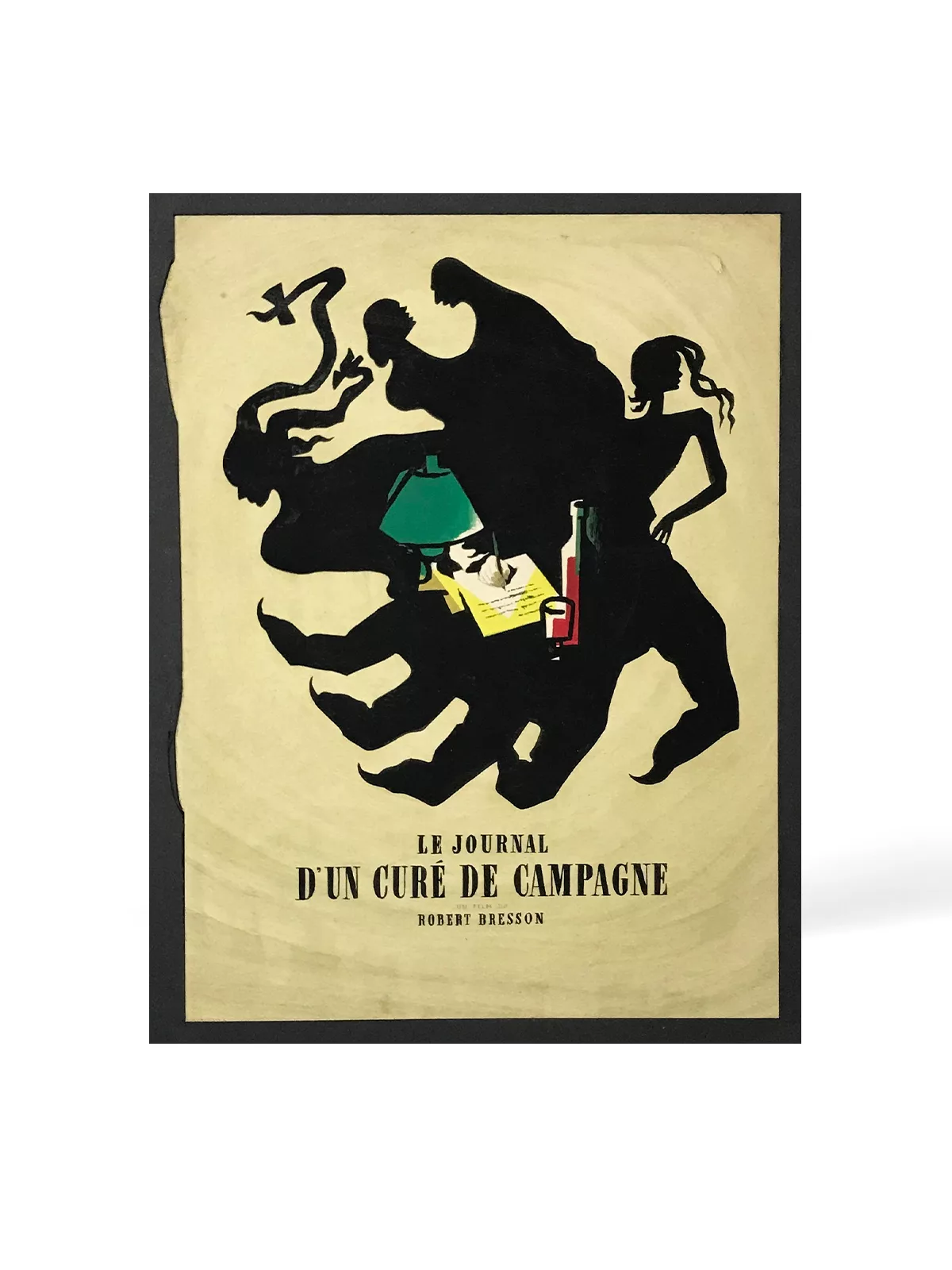
« Le Journal d’un curé de campagne »
In this Expressionist composition, Jacquelin distills the world of Journal d’un curé de campagne into an imagery of spiritual tension and moral abstraction: a stylized drawing of a gigantic black hand dominates the scene, forming a motif at once oppressive and mystical, evoking the hand of God — omnipresent yet mysterious — and that of the devil, a recurring metaphor in Bernanos. The shadow of the hand recalls the central theme of the novel: the solitary struggle of a young priest confronting suffering, doubt and grace.
Around the green lamp — the only source of light — the figures of the priest, the countess and the temptations of the world are arranged in chiaroscuro: the female silhouette, the wine, the writing.
The design is notable for its use of dark flat tints, its sharp outlines and its power of dramatic synthesis, characteristics of Jacquelin’s style. He worked on numerous auteur films in the immediate postwar period and produced many designs for Georges Simenon’s titles at Presses de la Cité. Although this version was not chosen for the final poster of the film (released in 1951), it stands as a rare testimony to the creative process behind this major work of French cinema.