

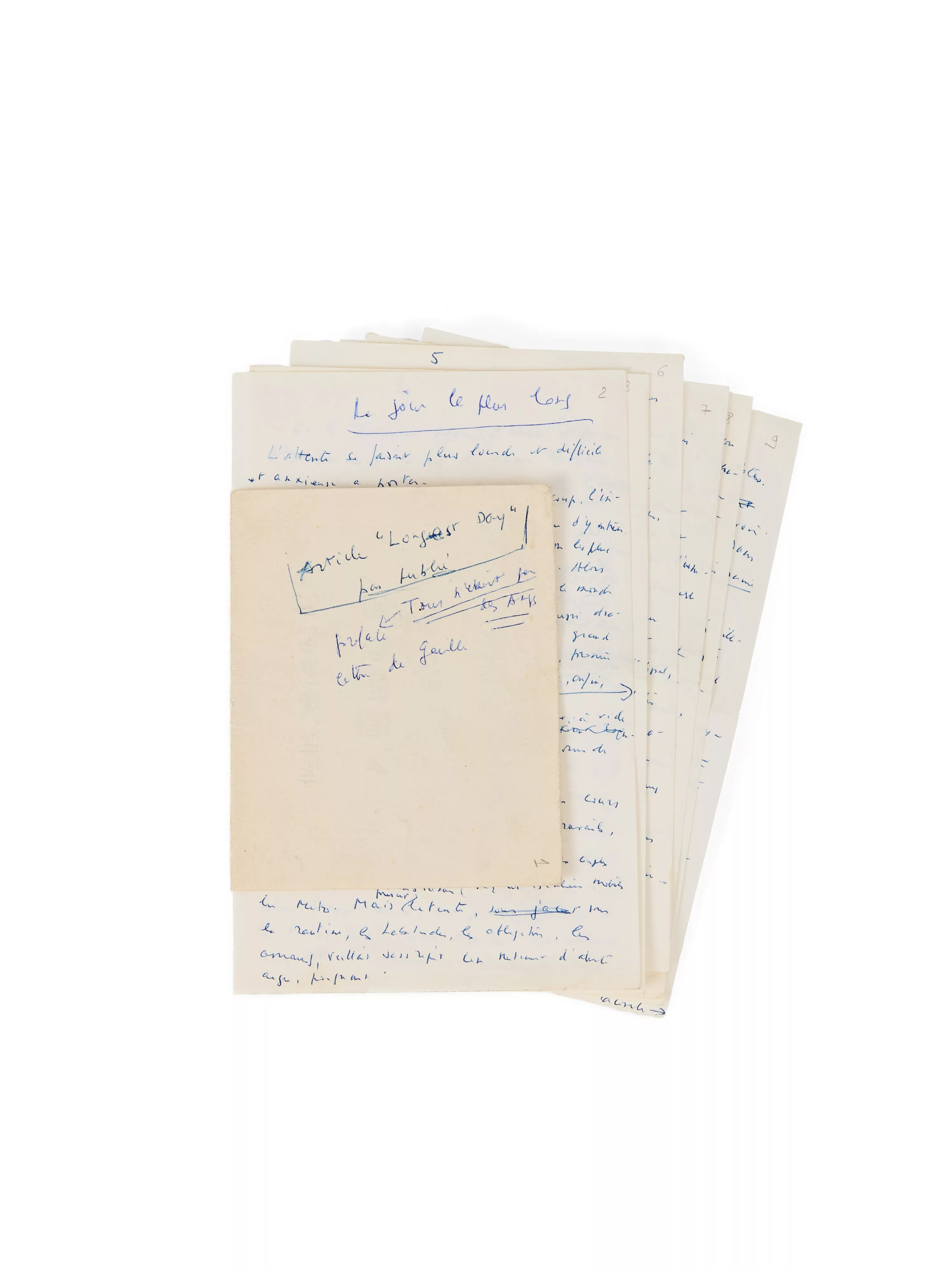
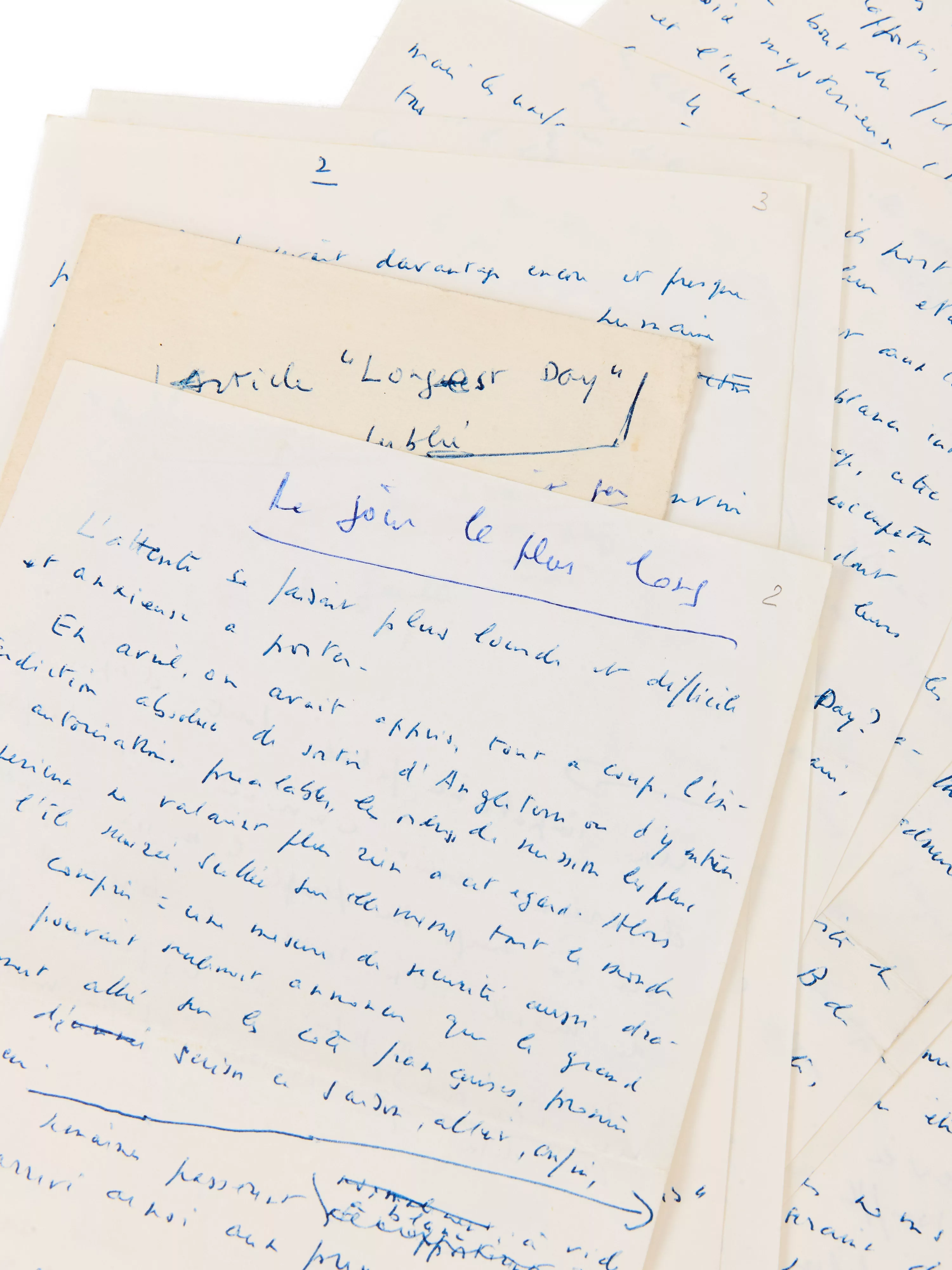
« Le jour le plus long »
A precious unpublished manuscript by Joseph Kessel, written on the occasion of the Paris preview of Darryl F. Zanuck’s film The Longest Day, adapted from Cornelius Ryan’s best-seller and presented at the Palais de Chaillot on 25 September 1962.
Nearly twenty years after the Normandy landings, Kessel here revisits his own memories of England during the last days before 6 June 1944, and of that morning itself. The text was intended to take the form of an article, for a newspaper Kessel does not name, but it was ultimately never published. This lack of publication gives it a singular interest and the status of a direct testimony, in which Kessel recalls RAF Hartford Bridge, an air base some sixty kilometers from London, where he was then stationed as Acting Captain. He took part in missions run by the special services, tasked in particular with collecting and transcribing messages sent from French soil by the Resistance. Around him, the crews, airmen, Free French officers and Allied units all sensed the decisive event approaching, and the manuscript admirably captures this atmosphere of the eve of battle: England closed in on itself by security measures, the absolute ban on entering or leaving the territory, the ordinary life of London continuing on the surface, couples in Hyde Park, the escalators of the Underground, leisures and habits — beneath this routine lay the acute anticipation of the great landing.
“The waiting grew heavier, harder and more anxious to bear. In April, we had suddenly learned of the absolute prohibition on leaving or entering England. Prior authorizations, even the most imperative orders of mission, no longer counted for anything in this respect. So, on the walled island, sealed upon itself, everyone understood: so dramatic a security measure could only mean that the great Allied landing on the French coast, promised and postponed from season to season, was at last about to take place (…) Life no doubt went on. Londoners went to work, to their leisure, to their pleasures. Couples kept kissing in Hyde Park and on the moving staircases of the Underground. But present, latent, underlying the routine, the habits, the obligations, the loves, watched without respite their sharp, poignant sense of waiting. One perceived it even more, almost physically, where human masses were gathered in barracks for the decisive action, the decisive leap. One of these places, about 60 km from London, was called Hartford Bridge. This immense air base had, since the Battle of Britain, received ever more numerous and varied air groups: reconnaissance, fighter, bomber. It was crammed, packed with them. But the squadron that had come last, and only very recently, to this field belonged to none of the large regular formations, and answered to no conventional command. It consisted of a very small number of RAF crews and half a dozen “parcels,” in flying slang, of whom I was one, all Free French officers. We depended on the special services (…) So when would the Great Day, D-Day, come? Tomorrow? The day after? Next week, the next hour? No one was privy to the secrets of the Gods (…) I fell asleep. Not for long. A strange prick woke me. Something had changed in the climate, the balance of Hartford Bridge. Yet everything around me was in its place. The early June morning had the same luminous tone as the day before. I dressed hastily, went out. At once, from faces, interactions, attitudes and gestures, I knew with total certainty: the landing had begun. A few minutes later I heard the radio proclaim it to the world (…) The announcer’s voice recited the names of unknown places that would henceforth belong to history. Sainte-Mère-Église, Omaha Beach, Pointe du Hoc, Ouistreham… The longest day was beginning.”
This precious manuscript thus stands at the crossroads of two moments: June 1944, lived from England, in the closest proximity to the Free French Forces; and September 1962, when Zanuck’s film transformed the Normandy landings into a great international epic. Between the two, Kessel resumes his natural role: that of the witness able to give history a uniquely novelistic breath.
The leaves are gathered together as a single unit, titled by Kessel on a leaf folded in two, bearing this note: “Article ‘Longest Day’ not published. They were not all angels. Preface, letter from de Gaulle.”