

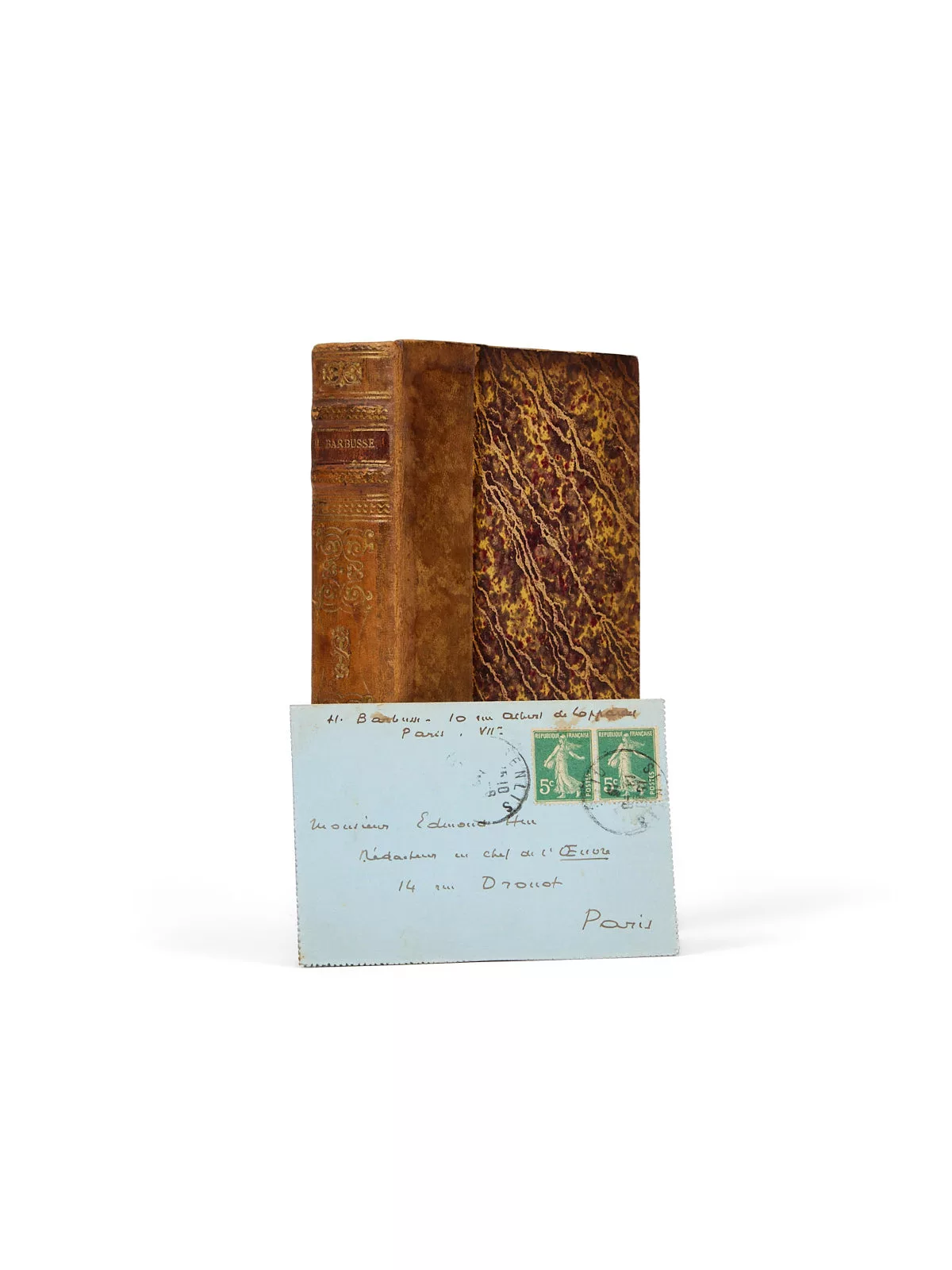
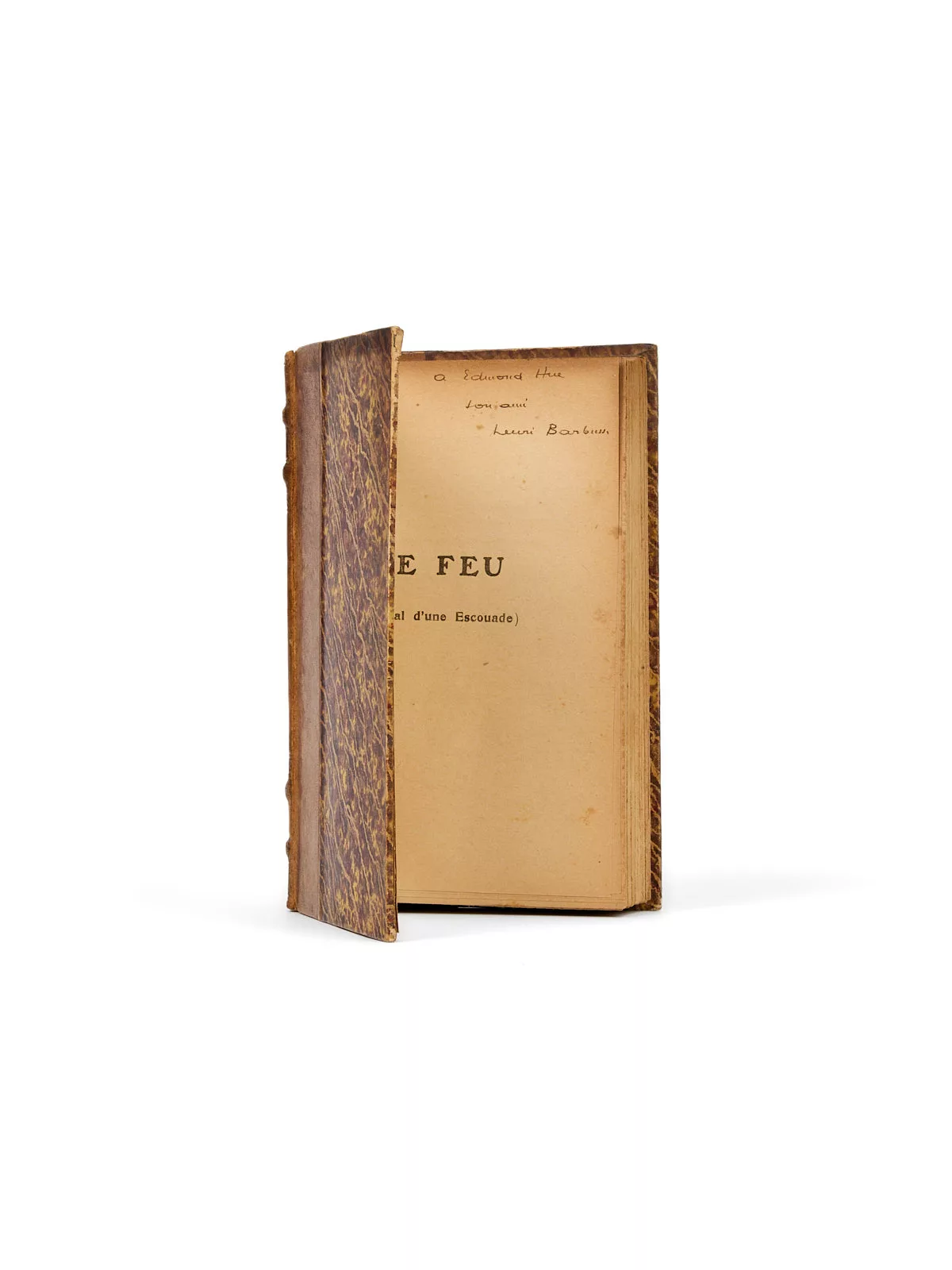
Presentation copy inscribed by Barbusse to Edmond Hué: “à Edmond Hue, son ami, Henri Barbusse.”
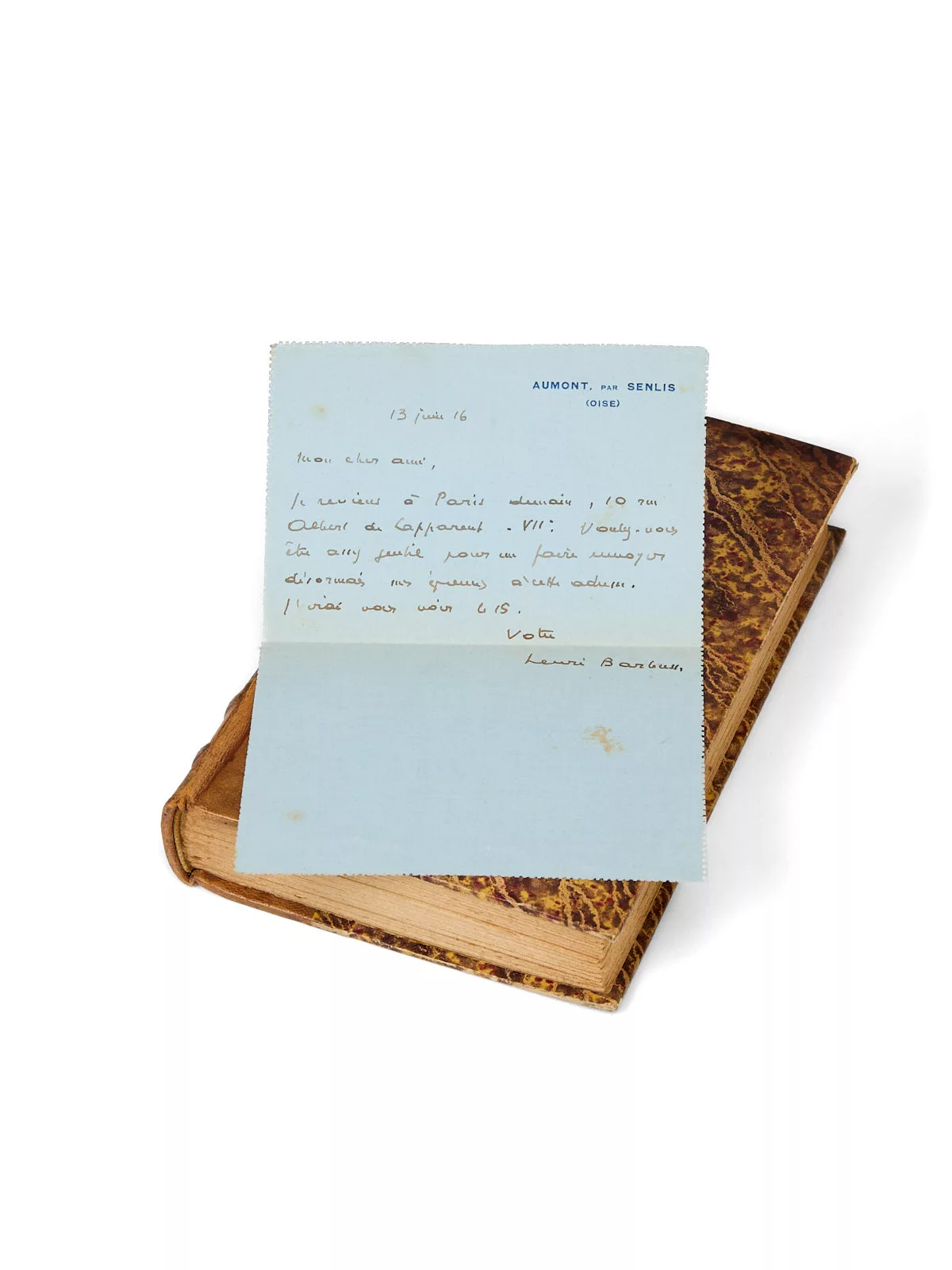
Preserved with the copy, an autograph letter signed to the same, dated 13 June 1916, informing him of the forthcoming installments of proofs of Le Feu, to appear in his newspaper L'Œuvre beginning 3 August.
Henri Barbusse had experienced the fire of the trenches from 1915, first as a soldier and then as a stretcher-bearer. It is mainly from hospitals that Barbusse, in twenty-four chapters, bears witness to his daily life at the front: “[…] appalling, unnatural exhaustion, and water up to the belly, and mud, and the stench and the foul filth, floating on the voracious earth,” writing from the war notebook in which he had recorded his experiences.
The novel was ready just before summer, and the first chapters appeared as a serial in the daily L’Œuvre, beginning 3 August 1916. It was an immense success, as Genevoix’s Sous Verdun had been a few months earlier.
A precious copy, a token of homage and friendship, to the man who had first agreed to publish his novel: Edmond Hué, editor-in-chief of L’Œuvre, who was responsible for overseeing the serialization, not without friction with Barbusse, who regularly complained about the cuts made to his text. This did not stop the Fischer brothers, literary directors at Flammarion, from sensing a good opportunity: as early as September they contacted Barbusse to buy the rights to the novel, even promising him, by October, the Prix Goncourt. “Certain conversations we have had these past days, notably with Paul Margueritte, lead us to believe we were not entirely mistaken. But we would need to move extremely quickly.” Barbusse hesitated, bound to other publishers, but the prospect of the prize decided him. A week later the contract was signed — six days before the end of the serial publication (93 installments); on 15 November the text went to press and appeared just in time from Flammarion in early December, in an initial printing of 1,000 copies.
Barbusse won the Goncourt on the first ballot a month later, on 15 December.
Edmond Hué had his copy bound with his initials added at the foot of the spine, also preserving one of the very first letters he probably received after the first proofs were sent, in June.
Jean Norton Cru, Témoins, pp. 555–565; Talvart, I, 239, “there exist copies of the first edition printed on glossy paper, before the Prix Goncourt was awarded. The other copies of the first edition are printed on lower-quality paper.”