

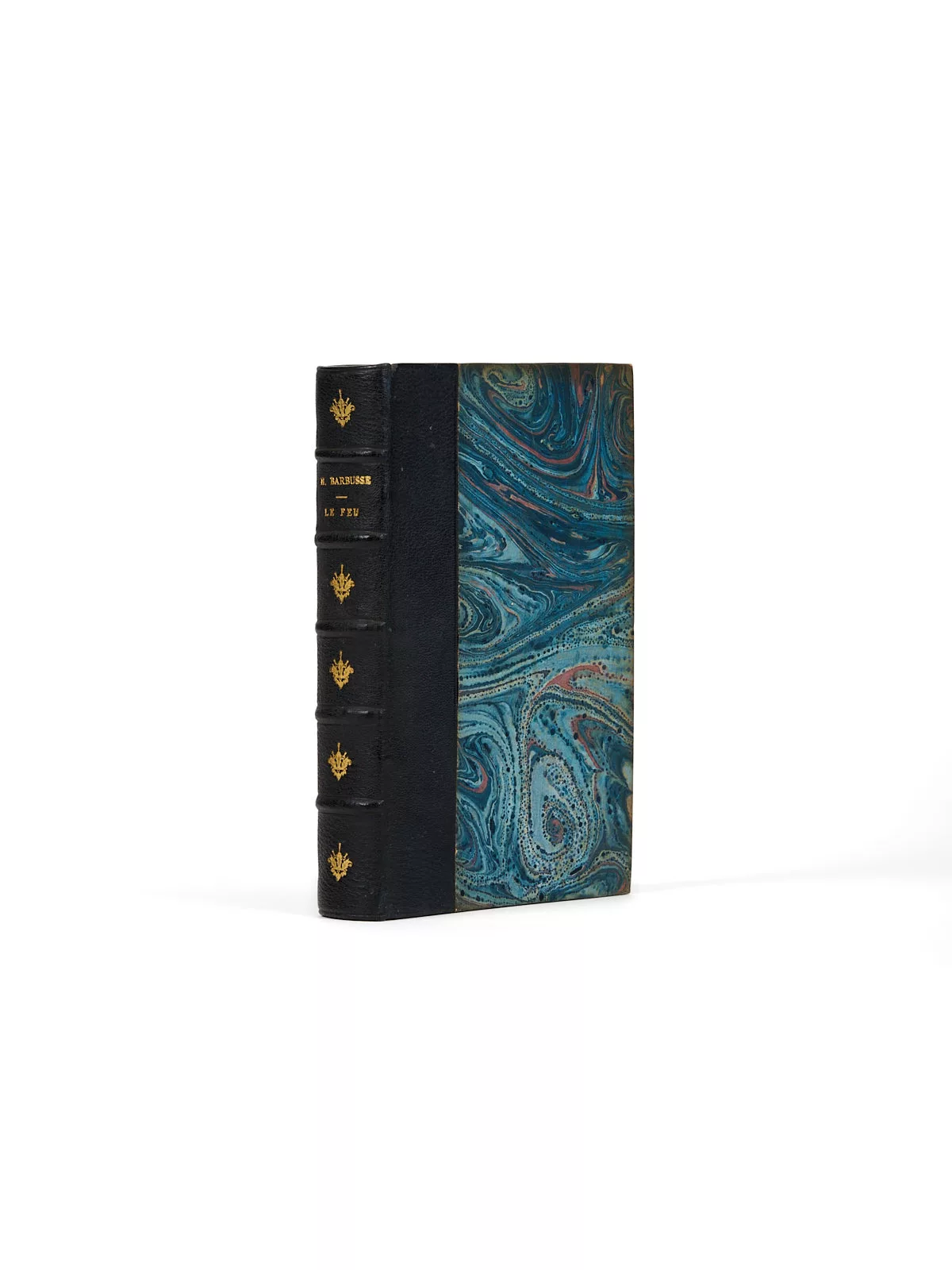
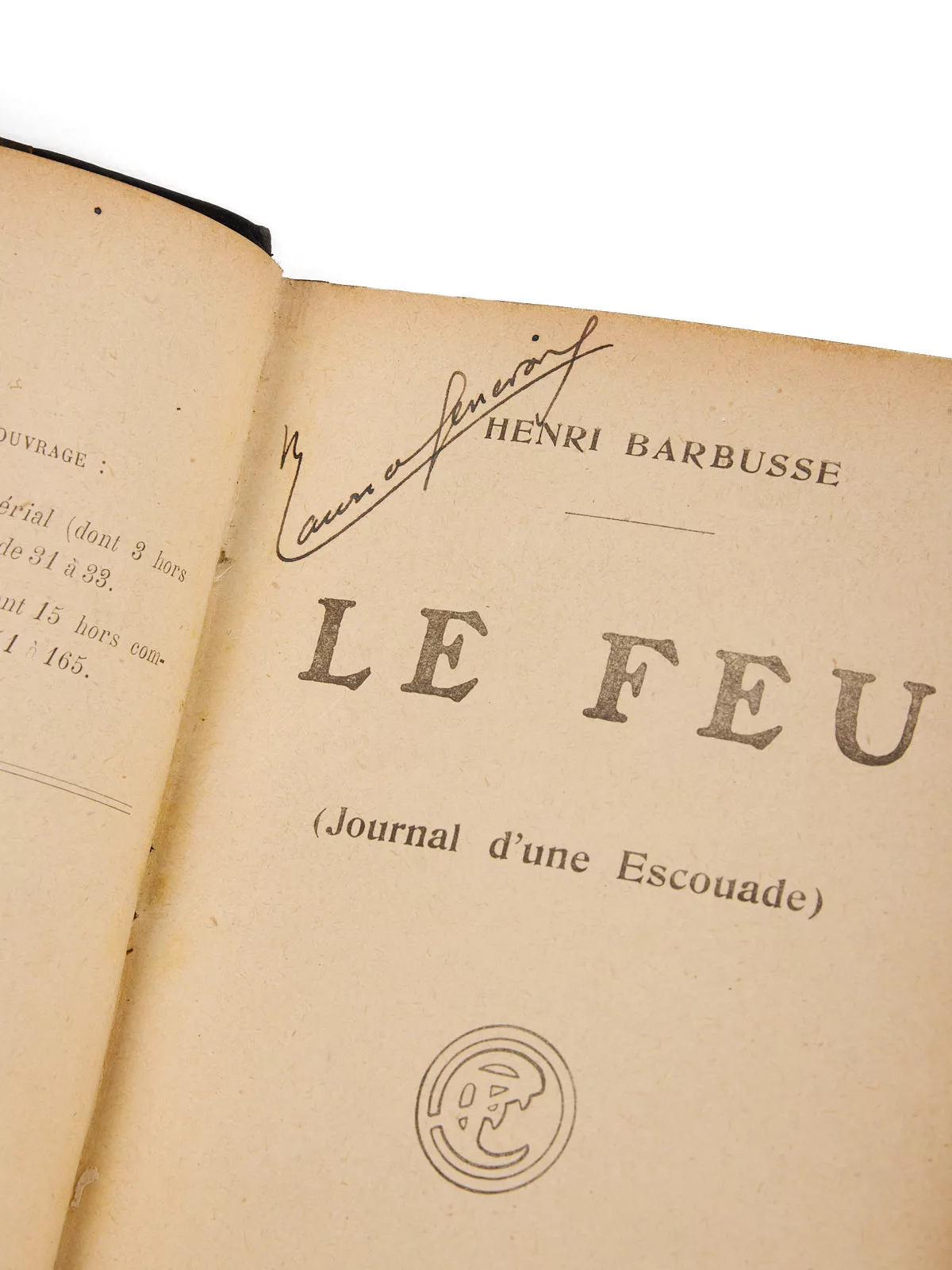
Rare first printing, on the slightly glazed paper characteristic of copies printed before the award of the Prix Goncourt.
Maurice Genevoix's copy, with his autograph bookplate on the title page.
Henri Barbusse had experienced the fire of the trenches from 1915, first as a soldier, then as a stretcher-bearer. Writing largely from military hospitals, Barbusse recounts his daily life at the front in twenty-four chapters: “[…] terrible, unnatural exhaustion, and water up to the waist, and mud, and the stench and the vile filth, floating on the voracious earth,” drawing on the war notebook in which he had recorded his experiences.
The novel was ready by spring, and the idea of the Goncourt Prize was already taking shape among his publishers even before the contract was signed. Serialization of the first chapters began in the daily L’Œuvre on August 3: the Fischer brothers, literary directors at Flammarion, sensed a good opportunity and contacted the author to buy the rights to Le Feu. On October 26, on the eve of a preparatory meeting of the Academy, they wrote to him:
“We spoke of the possibility we foresee regarding the Goncourt. Certain conversations we have had these past days, notably with Paul Margueritte, lead us to believe we were not entirely mistaken. But we would need to move very quickly.”
Barbusse hesitated, being bound to other publishers, but the prospect of the Goncourt decided him. A week later the contract was signed — six days before the serialization ended (93 installments). On November 15 the text went to press and appeared just in time from Flammarion in early December, in an initial printing of 1,000 copies, printed on slightly glazed paper.
Barbusse won the Goncourt on the first ballot, on December 15, with eight votes, lacking those of Léon Daudet and Elémir Bourges, as he had anticipated.
He was elected even though Maurice Genevoix’s Sous Verdun, published several months earlier, had been considered the favorite. Two novels, two styles, and two ways of approaching a conflict that until then had only been treated in propaganda works, or at least in works not written by direct witnesses, still less by frontline soldiers.
Barbusse is not Céline, and Le Feu does not have the brilliant violence of the opening pages of Voyage au bout de la nuit, nor even the raw force of Genevoix’s testimony. Granted. But the novel’s value lies above all in its documentary worth and in its denunciation of the deception of patriotic propaganda, then the official discourse, which would later lead to the heavy censorship of Ceux de Verdun. Barbusse went somewhat less far than Genevoix on this subject, and the Goncourt jury chose to honor the sacrifice of the hundreds of thousands of soldiers already fallen for France. Notably, the two books did not directly compete: that year the Goncourt jury decided to reward two laureates, one for the current year and one to make up for the prize not awarded in 1914. Probably to avoid a direct confrontation, Genevoix was weighed, for the final choice, against Adrien Bertrand’s L’Appel du sol, which won the 1914 Goncourt.
Historian Jean-Yves Le Naour notes how “Genevoix wanted to tell the truth and avoid fiction (…). Politically, Genevoix and Barbusse are even further apart. The man from the Loire was a moderate who displayed, in his writing, a constant distrust of the city and of modernity, seen as destroying nature. A reader of Barrès, he was a convinced patriot. In any case, politics hardly interested him. When left-wing students clashed with the royalist camelots du roi of Action française, the student preferred to climb onto the roof of the building and hose everyone down with a fire hose! Barbusse, by contrast, was a Dreyfusard socialist whose first public engagement came precisely with the war. Though 41 years old and in fragile health, and thus likely to be exempted, he chose to enlist voluntarily. He explained himself on 3 August 1914, in the tone of patriotic socialism, much like Péguy, who said he was leaving ‘for general disarmament and the last of all wars.’ (…) Genevoix’s Sous Verdun and Barbusse’s Le Feu were deeply unsettling. Here, for the first time, were accounts that concealed neither the misery of the soldiers nor the horror of war. Heroic warfare took a fatal blow.”
A fine copy of impeccable provenance, uniting the two emblematic titles of the period.
Jean Norton Cru, Témoins, pp. 555–565; Talvart, I, 239: “there exist copies of the first edition printed on glazed paper, before the award of the Prix Goncourt. The other copies of the first edition are printed on lower-quality paper.”