

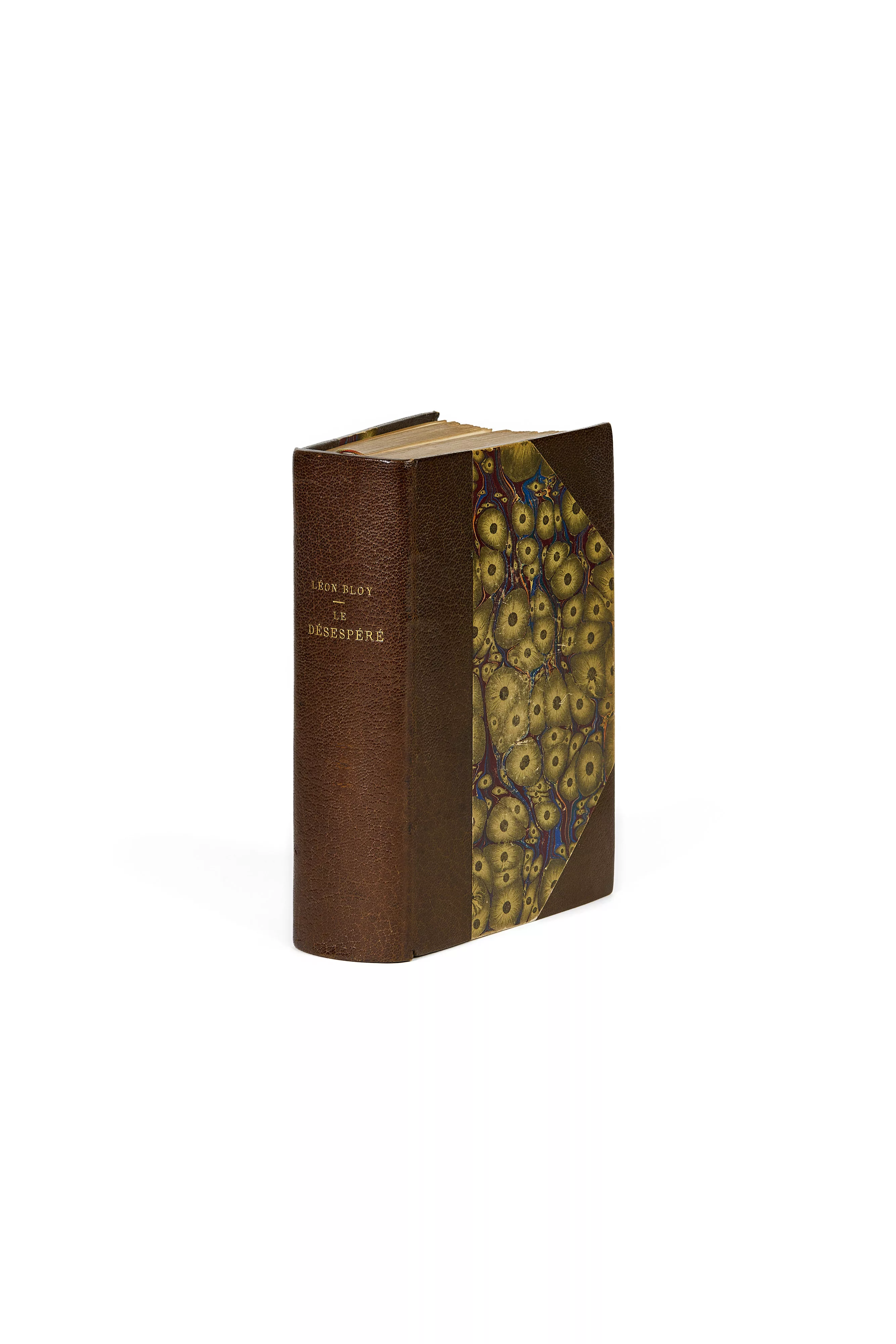
Le Désespéré
It does indeed contain the passage concerning Francis Magnard, editor of Le Figaro (here disguised as Magnus Conrart du Basile), occupying pages 400 to 402, following the text as given in the Soirat edition, in accordance with the corrections made by Léon Bloy.
Bloy’s first novel, largely autobiographical, transposes into fiction the drama he lived through with Anne-Marie Roulé, a relationship in which sensuality is gradually overtaken by mysticism.
Publication had been entrusted to the firm of Tresse et Stock, but as Bloy delivered his sheets to the printer Darantière, Stock discovered a violent passage attacking Francis Magnard, editor of Le Figaro, occupying pages 400 to 402. For the publisher, publishing such an attack was out of the question. Bloy, naturally, refused outright, even though the sheets were ready for binding. All the printed copies were therefore put into storage, and Bloy, determined to see his book published, turned to the publisher Soirat, who had Le Désespéré reprinted, though not without altering the offending passage to avoid a lawsuit. Le Désespéré thus appeared “officially” in 1886, in two thousand copies, with no deluxe-paper copies.
With the passage of time — and since the Soirat edition had given rise to no lawsuit — Stock decided in 1893 to exhume his own edition from the cellars where the copies had been slumbering. He had part of gathering 23 reprinted, containing the passages to be censored (pages 397–402), replacing them with the amended text conforming to the Soirat edition; these cancel leaves are recognizable by the double asterisk which replaces the original signature mark [23]. Stock had these new leaves bound together with the rest of the text printed in 1886, thereby publishing the book to Bloy’s great fury.
They were released under a new cover in the spring of 1893, including the 10 deluxe copies printed on Hollande paper, which had likewise been printed as early as 1886. A few copies — five have been recorded, including two on Hollande paper — were, however, preserved without the cancel leaves, and thus contain the original text in its entirety.
Bloy did not appreciate the maneuver and always maintained that the Soirat edition was the one and only true edition, “the so-called Tresse & Stock edition, very defective, having been odiously swindled” (in an inscription to Paul Fermiot, quoted in catalogue no. 7 of our colleague Éric Grangeon). This did not, however, prevent him from presenting several Tresse et Stock copies to friends.