

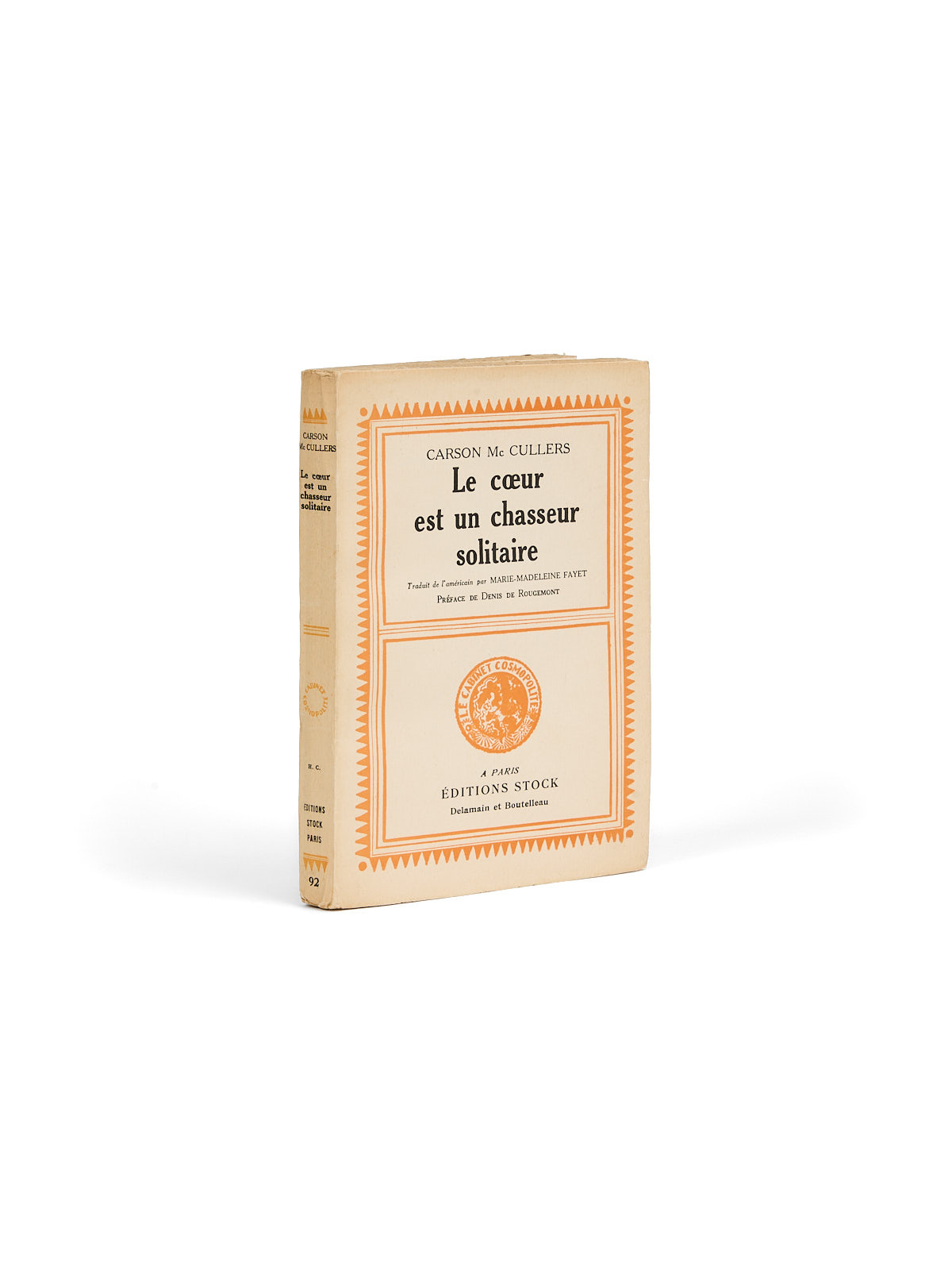
Le coeur est un chasseur solitaire
One of the first 100 hors commerce copies on Swedish vellum.
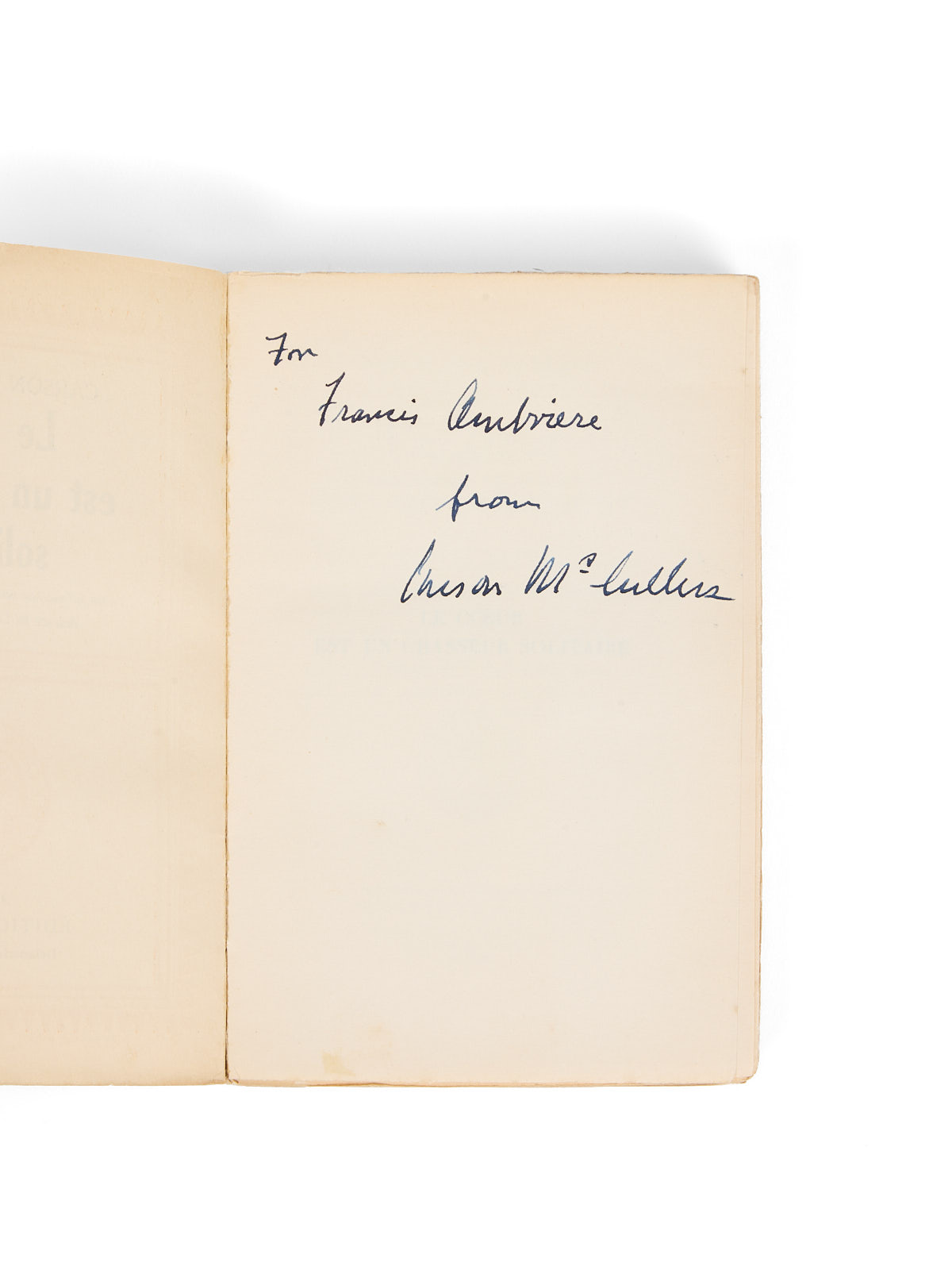
Signed presentation inscription: “To Francis Ambrière, from Carson Mc Cullers.”
The literary revelation of the year, The Heart Is a Lonely Hunter was published in the United States in 1940. A stunning novel of adolescence, it is set in a stifling small town of the Faulknerian South during the 1930s, where John Singer, a mysterious deaf-mute, becomes the confidant of a young girl lost in overly fanciful dreams. A largely autobiographical work haunted by waiting — for a departure or an encounter capable of breaking the stifling monotony of daily life — a theme McCullers would echo five years later in The Member of the Wedding.
Soon afterward came her meeting with Tennessee Williams, and then with the man who would become (twice) her husband, with whom she traveled to Europe just as her book appeared in France. The couple would eventually settle permanently in 1952 in the Oise, at Bachivillers, in a former presbytery some fifty kilometers from the hamlet of Bonvillers, where, at almost the same time, a certain Francis Ambrière had moved: the inscription in this volume is probably a trace of this neighborly proximity, unless it dates strictly from the first trip of 1947.
At that time, Francis Ambrière had a few months earlier received the Prix Goncourt for his Grandes vacances, officially honoring the year 1940, the prize having been “suspended” that year. His account prevailed over Pierre Guillain de Bénouville’s Le Sacrifice du matin and David Rousset’s L’Univers concentrationnaire, two other books resulting from a thematic pre-selection — an exception in the history of the Goncourt — intended that year to honor the combatants of the Second World War.
As a matter of trivia, it is worth noting that the expression “sucrer les fraises” first appears in Ambrière’s novel, even though it was Louis-Ferdinand Céline who, in 1936, had used “sucrer” to describe a drunkard’s trembling in Mort à crédit: “Il marchait à tout petits pas […]. Il tremblotait dans la serrure. Il pouvait plus sortir la clef, tellement qu’il sucrait.” Francis Ambrière added the “fraises” in reference to senile trembling, and the expression subsequently passed into common usage. It was immediately taken up by Marcel Aymé in Le Vin de Paris, in 1947 (“pauvre Achille, je me rappelle, il s’était mis à sucrer les fraises par là deux ans avant sa mort”).