

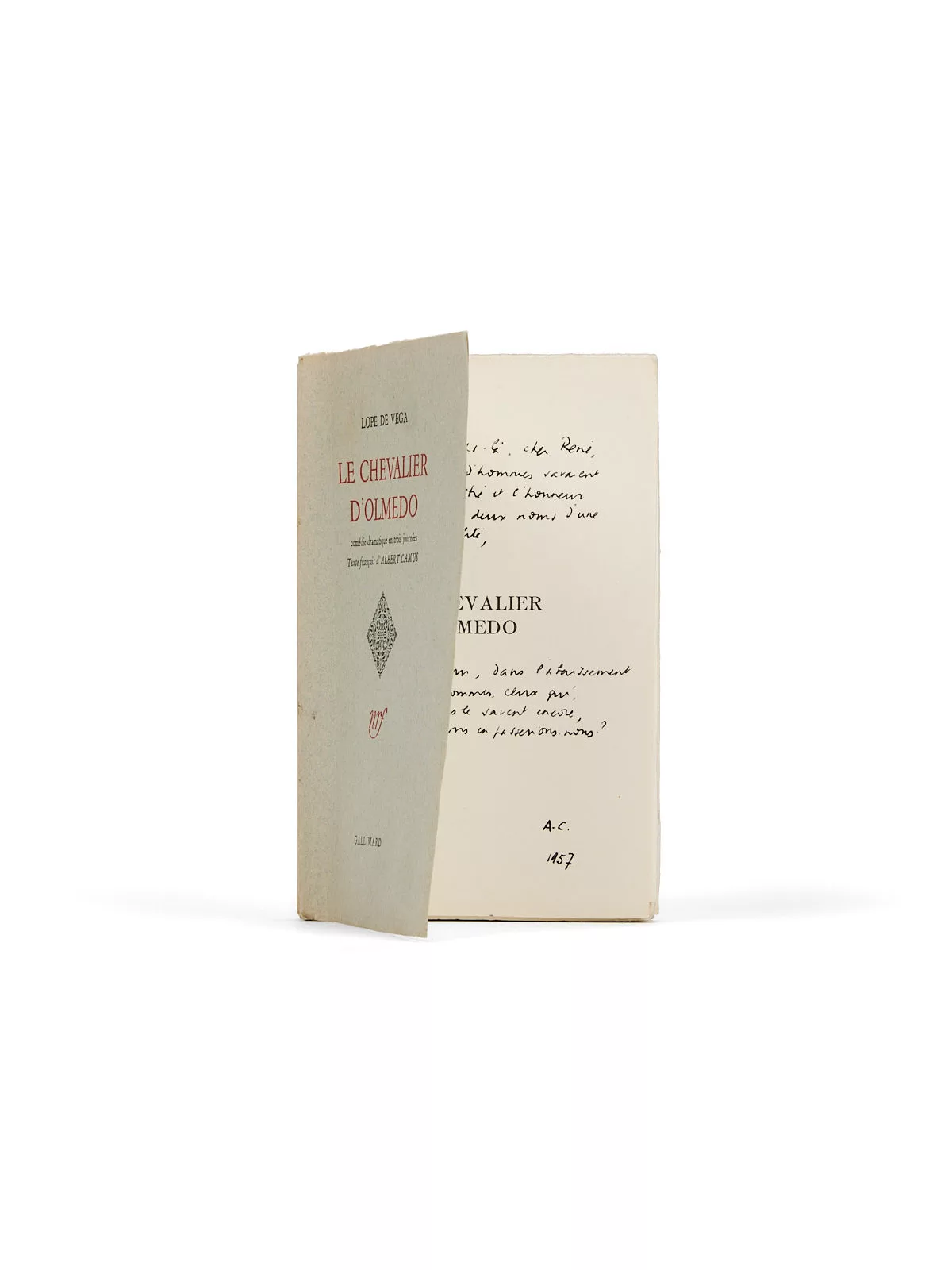
Le Chevalier d’Olmedo
One of the numbered copies on alfa paper.
Signed presentation inscription: “En ce temps-là, cher René, beaucoup d'hommes savaient que l'amitié et l'honneur étaient les deux noms d'une même fidélité ; aujourd'hui, dans l'abaissement où nous sommes, ceux qui comme vous le savent encore, comment nous en passerions-nous ? A. C. 1957.”
This dedication, at the heart of the Nobel Prize year, sums up the friendship, but above all the alliance of ethics and aesthetics that governs the period: Camus, playwright, director and translator, roots his work in a fidelity to friendship, history and theater. From his earliest days in Algiers, Camus dreamed of open-air theater, of a popular stage where the spoken word “walks toward its end”; Spain accompanied him from very early on (from Révolte dans les Asturies to La Célestine staged with l’Équipe), before a first decisive collaboration took place in 1953: Marcel Herrand commissioned him to adapt Calderón’s La Dévotion à la croix, launching a Hispanic cycle that would culminate with Lope de Vega in 1957 and this Chevalier d’Olmedo.
In Angers, Camus was the central figure of the 6th edition of the Festival (21–30 June 1957): he reworked and staged Caligula for the first time and directed his own adaptation of Le Chevalier d’Olmedo. The “premiere” remains, legendarily, dated to 21 June, but a storm of rare violence tore down the sets and flooded the stage and stands just as the ramparts were being lit: the performance was cancelled, so that the festival finally opened on the 22nd with Caligula, and the true premiere of Olmedo took place on 23 June (then again on the 26th and 29th) — without, as he wrote in the margins of his drafts on the play, “forgetting its popular side.” For Olmedo fed into his project for a modern tragedy in which “a single feeling walks ceaselessly toward its end,” and prefigures the repertoire that Camus, at the end of 1959, was outlining for the theater directorship about to be entrusted to him: Lope (again), Calderón, Tirso de Molina…
Robert Kemp, reviewing the play in Le Monde, praised the rhythm, freshness and innocence of the text, served by Camus’s “solid, incisive pen” — the same pen that had just written, on the death penalty, powerful and striking pages that would not convince the defenders of the guillotine, but would galvanize abolitionists. This is no incidental detail: Camus notes that the play’s last word — teatro — also means scaffold; the boards of the stage are a gallows. “It would be better if the execution were public. The actor in every man could then come to the aid of the terrified animal and help him keep up appearances, even in his own eyes,” he writes in Réflexions sur la guillotine, composed at strictly the same time. Thus the ending of the Angers adaptation cannot help but recall a motif running through the whole of Camus’s work, from Meursault’s last wish at the foot of the scaffold in L’Étranger, to the dream of public execution evoked by Clamence at the end of La Chute, published the previous year.
A magnificent provenance.
This inscription is one of 43 known copies inscribed to René Char, the friend, the brother: this dedication is by far the longest of the 43 recorded.