


Le Camp des saints
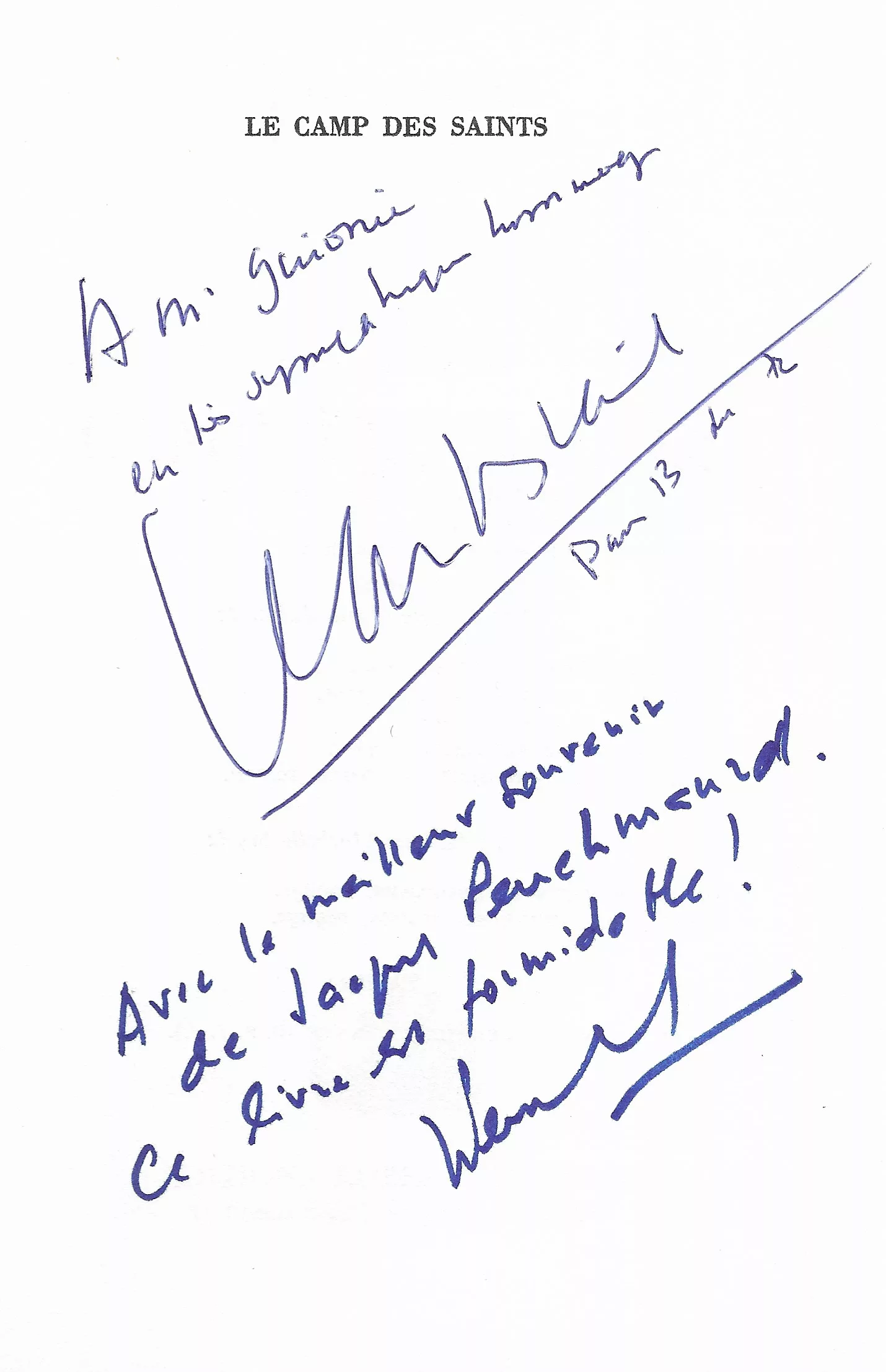
Presentation copy inscribed by Raspail: “à M. Guionie, en très sympathique hommage, Jean Raspail, Paris, 13 déc. 72”; and by the publisher: “Avec le meilleur souvenir de Jacques Peuchmaurd. Ce livre est formidable!”
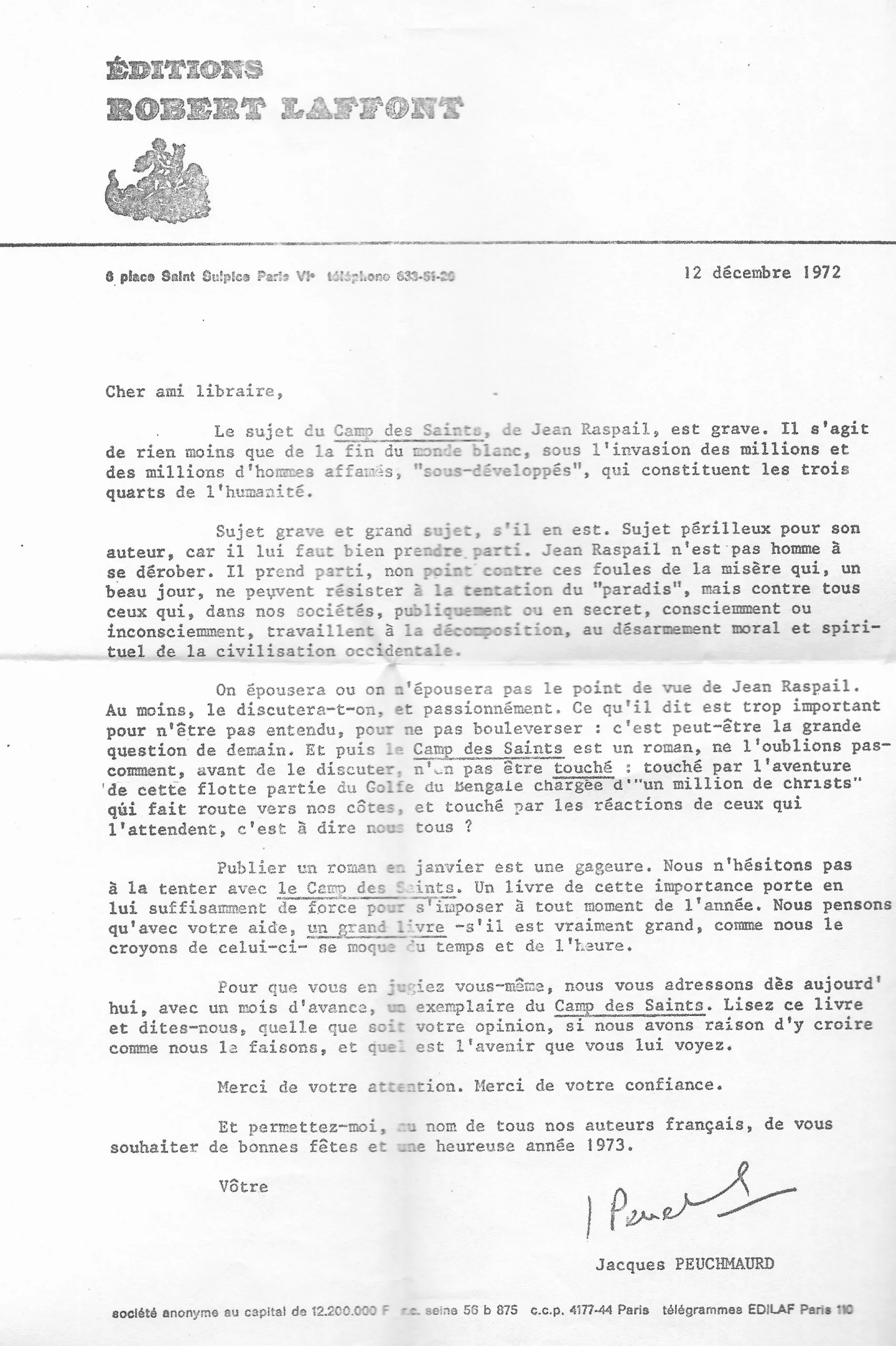
A double inscription from the author and his publisher, remarkably early: the date is the day after the printing of the first impression of the volume was completed (December 12); it is also the date of the letter sent to booksellers to promote the work, here enclosed: “Le Camp des saints. Sujet grave et grand sujet, si il en est (…) On épousera ou on épousera pas le point de vue de Jean Raspail. Au moins le discutera-t-on, et passionnément. Ce qu'il dit est trop important pour ne pas être entendu, pour ne pas bouleverser (…) Pour que vous jugiez vous-même, nous vous adressons dès aujourd'hui, avec un mois d'avance, un exemplaire du Camp des Saints. Lisez ce livre et dites-nous, quelle que soit votre opinion, si nous avons raison d'y croire comme nous le faisons.”
The letter is signed Jacques Peuchmaurd, literary director at Robert Laffont. A few months later he would become the founder and driving force of the École de Brive, established that same year, 1973, on the occasion of the first Festival du livre de Brive-la-Gaillarde — of which he was one of the ardent promoters — together with Claude Michelet, Denis Tillinac and Christian Signol.
And as history likes to come full circle, the copy was inscribed to one of the most emblematic booksellers of the Corrèze town at the time: Jean Guionie, who ran the eponymous bookshop on the rue de l'Hôtel-de-Ville.
Is this a book about the clear-sighted against the blindly idealistic, oblivious to a “migratory submersion”? “This book was born strangely,” the author explained in an interview with Le Point on 29 September 2015. “I was in the south of France, one day in 1972, at my wife’s aunt’s house near Saint-Raphaël, in Vallauris. I had a desk overlooking the sea and I thought to myself: ‘What if they come?’ This ‘they’ was at first undefined. Then I imagined the Third World rushing into this blessed country, France. It’s a surprising book. It took a long time to write, but it came all by itself. I would stop in the evening and pick up again the next morning without knowing where I was going. There is an inspiration in this book that is foreign to me. I won’t say it’s divine, but it is strange.”
Reviled by some, hailed as prophetic by others, this novel-turned-breviary resonates strongly with the times: “At first, Le Camp des saints didn’t do well. For at least five or six years, it stagnated. It sold very little. After three years, sales suddenly increased. Success came through word of mouth and thanks to the promotion given to it by right-wing writers. Until the day in 2001 when a boat of Kurdish refugees ran aground at Boulouris, near Saint-Raphaël, just a few meters from the desk where I wrote Le Camp des saints! This affair caused a huge stir in the region. As a result, my book was talked about again and reached a wide audience. It was the beginning of a wave of arrivals by sea from elsewhere. I am somewhat ashamed, because whenever there is a major wave of migrants, the book gets reprinted. It is consubstantial with what is happening.”