

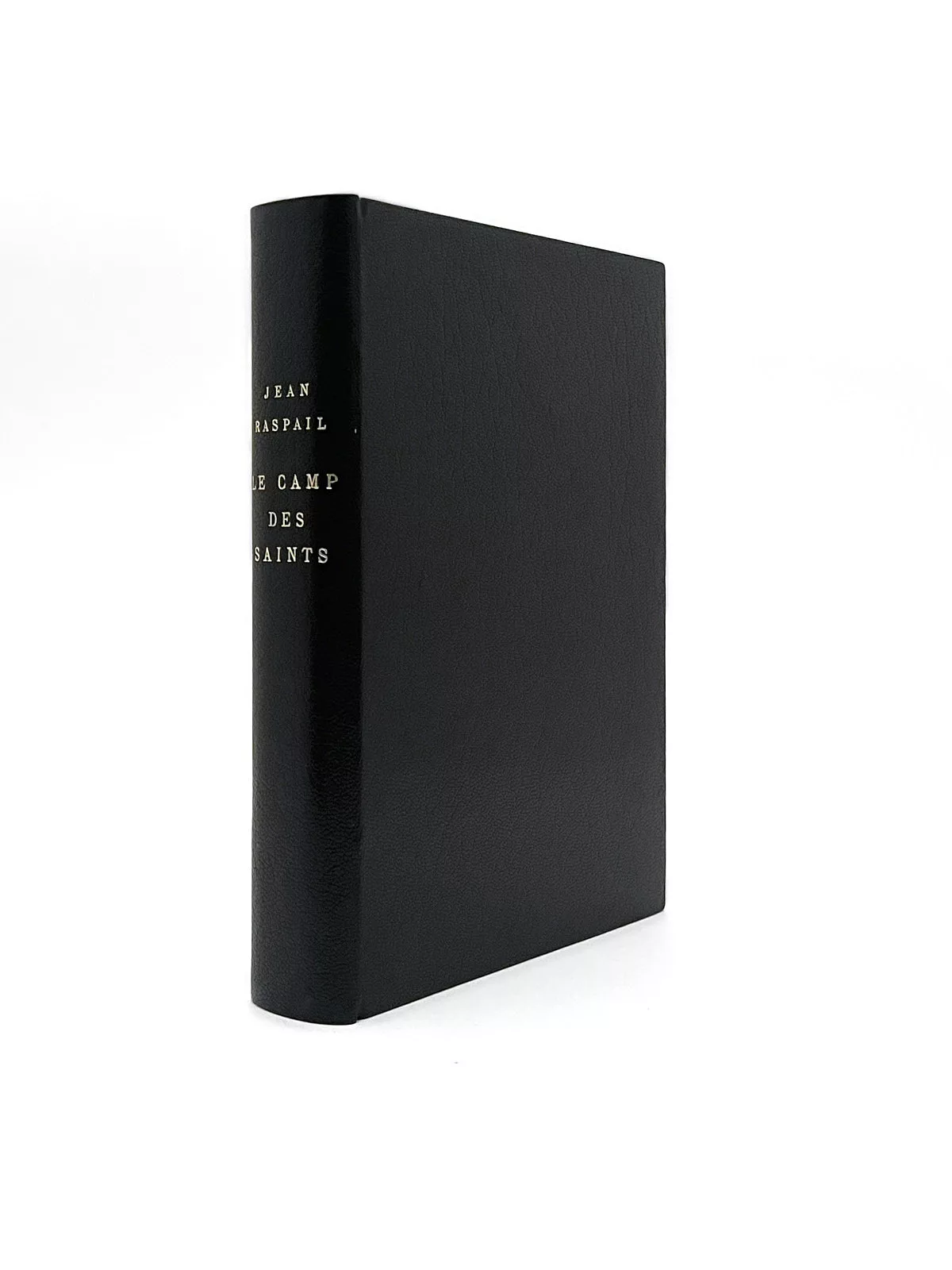
Le Camp des saints
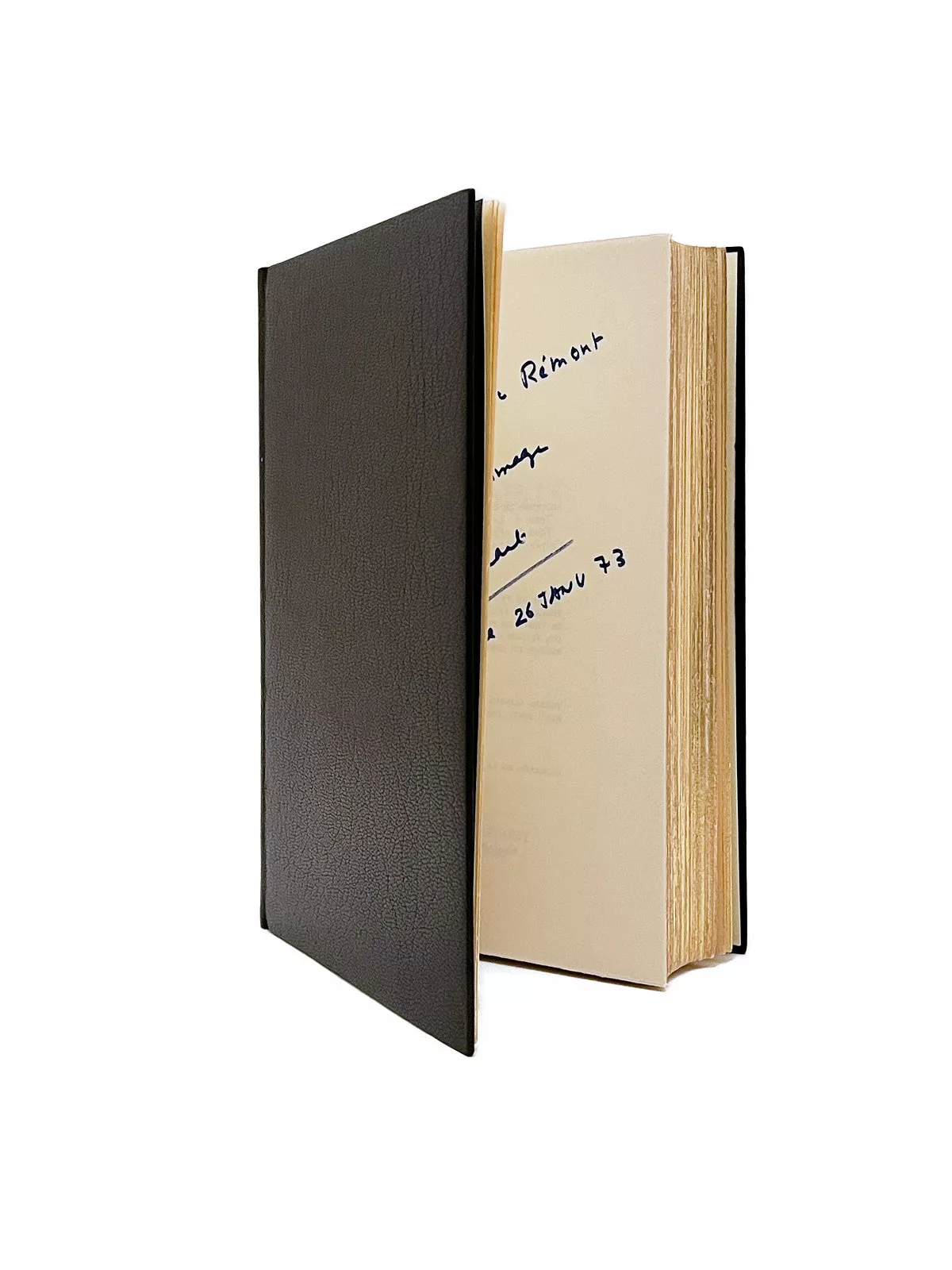
Signed presentation inscription: “Pour Huguette Rémont en amical hommage, Jean Raspail, Paris, le 26 Janv. 73.”
The camp of the clear-sighted against the camp of idealists blind to “migratory submersion”? “This book was born strangely,” the author explained in an interview with Le Point on 29 September 2015. “I was in the south of France, one day in 1972, at my wife’s aunt’s house near Saint-Raphaël, in Vallauris. I had a desk overlooking the sea, and I thought: ‘What if they come?’ At first ‘they’ was undefined. Then I imagined the Third World rushing into that blessed country, France. It’s a strange book. It took a long time to write, but it came by itself. I would stop in the evening and pick up again the next morning without knowing where I was going. There is an inspiration in this book that feels foreign to me. I won’t say it’s divine, but it is strange.”
A book reviled by some and hailed as prophetic by others, this novel-turned-breviary has resonated with the times: “At first, Le Camp des saints didn’t sell. For at least five or six years, it stagnated. Sales were poor. After three years, sales figures rose. Success came through word of mouth and thanks to promotion by right-wing writers. Until the day in 2001 when a boat of Kurdish refugees ran aground at Boulouris, near Saint-Raphaël, a few meters from the desk where I wrote the novel! The affair caused an uproar in the region. As a result, people started talking about my book again, and it reached a wide audience. I feel a little ashamed, because whenever there is a major wave of migrants, the book gets reprinted. It is bound up with what is happening,” published at a time when the immigration issue did not yet exist, and above all before the enactment of laws that would probably today prevent its publication.
To this end, in 2011 Raspail wished to issue an expanded edition with a new preface entitled “Big Other.” Necessary precautions were taken. “It is true that its content is not innocuous, since it all turns on the question ‘What if they arrived?’ — not extraterrestrials, but the dispossessed of the South, a million exhausted emigrants landing on the beaches of southern France, facing locals wondering whether to send them home, lock them in camps, or fire into the crowd, the solution eventually adopted by the last die-hards while the rest of the population takes refuge in the North (…).” Twenty-seven pages long, the preface is markedly less allegorical than the novel: it is the combative text of a man who disavows nothing regarding the “submersion” of France by foreigners. Mischievous and sly, he quotes letters sent to him by figures not usually associated with throne-and-altar conservatism, unlike himself (Malraux, Mitterrand, Jospin, Badinter, Pinault, etc., though some are merely polite acknowledgments of receipt); shrewdly, he reserves for himself an apology for the triple Angelus and leaves it to General de Gaulle to defend the French as a “European people of the white race, of Greek and Latin culture and of the Christian religion” (1959); provocatively, he points out to his detractors the pages that could today be prosecuted (87 grounds) under the Pleven, Gayssot, Lellouche and Perben laws, were the book published now for the first time: “Unpublishable unless severely amputated.” Leonello Brandolini, head of Éditions Robert Laffont, nonetheless asked that the preface be preceded by a two-page note signed by himself: “Jean Raspail knows my opinion, which is not the same as his,” it reads. Above all, no trouble, one senses between the lines. “It would have been dishonest of me not to reissue it, since it has never ceased to be reprinted,” he added. Not easy to take full responsibility for everything, contradictions included. In the month of this reissue, 30,000 copies were sold. Political scientists would do well to also study bestseller lists. Failing enlightenment, one sometimes finds reflections there.” (Pierre Assouline, Le Monde, 24 March 2011).
This printing on pur fil paper — the only deluxe issue — is of great rarity: we know only of copies numbered 2, 6, 14, 7, 18, and this single author’s copy. Of these five other copies, only two bear an inscription: one is much later, dated 2013; the other, copy no. 7, has an early inscription dated December 1974.
A strictly contemporary inscription remains altogether exceptional; ours was given a few weeks after the book’s publication, on 26 January 1973, to a close associate of Robert Laffont — the publisher who had defended Raspail through thick and thin before, during and after the book’s publication — Huguette Rémont. At the Laffont publishing house, she was in charge of drafting authors’ contracts.