

L’Ange garde-chiourme
This short text, written by Prévert in 1930, was originally titled “Souvenirs de famille ou l’ange garde-chiourme”; it appeared in issue no. 7 of the journal Bifur in December of that year. Anticlerical, antimilitarist and libertarian in spirit, this fierce pamphlet belongs to the Surrealist current — a group Prévert had frequented assiduously since 1925, before his independence of mind led him away from it in the early 1930s. In it, he attacks the model of the bourgeois family, denouncing traditional education, the Church and bourgeois morality as so many threats to the child, the designated victim of adult prejudice and dogma.
The text was reissued once by Fontaine in 1946, published on its own in the “L’Âge d’or” series launched by Max-Pol Fouchet. Prévert, who was very proud of this short piece, subsequently included it in Paroles in 1947.
“On allait se coucher, le lendemain on se levait. Ainsi tous les jours les jours faisaient la queue les uns derrière les autres, le lundi qui pousse le mardi qui pousse le mercredi et ainsi de suite les saisons. Les saisons, le vent, la mer, les arbres, les oiseaux. Les oiseaux, ceux qui chantent, qui partent en voyage, ceux qu’on tue : les oiseaux plumés, vidés, mangés, cuits dans les poèmes ou cloués sur les portes des granges. La viande aussi, le pain, l’abbé, la messe, mes frères, les légumes, les fruits, un malade, le docteur, l’abbé, un mort, l’abbé, la messe des morts, les feuilles vivantes, Jésus-Christ tombe pour la première fois, le roi soleil, le pélican lassé, le plus petit commun multiple, le général Dourakine, le petit Chose, notre bon ange, Blanche de Castille […], la retraite de Russie, clanche de Bastille, l’asthme de Panama, l’arthrite de Russie, les mains sur la table, J.C. tombe pour la Nième fois, il ouvre un large bec et laisse tomber le fromage pour réparer des ans l’irréparable outrage…”
The manuscript, bound by P. L. Martin in 1965, belonged to Colonel Daniel Sicklès (sale, Paris, 23–24 March 1981); it has more recently appeared at auction (Sotheby’s, Paris, 2 December 2015, lot 41).
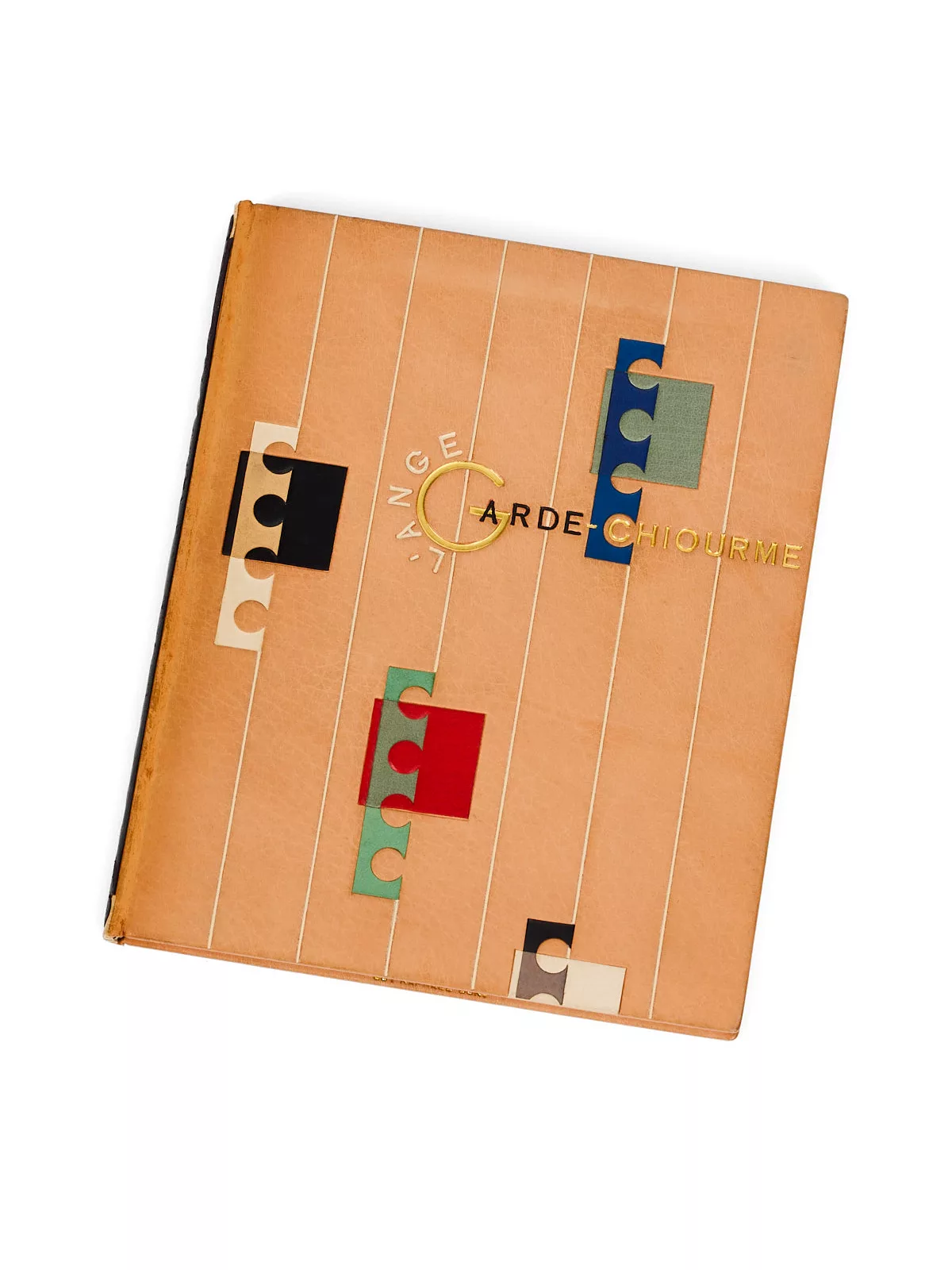
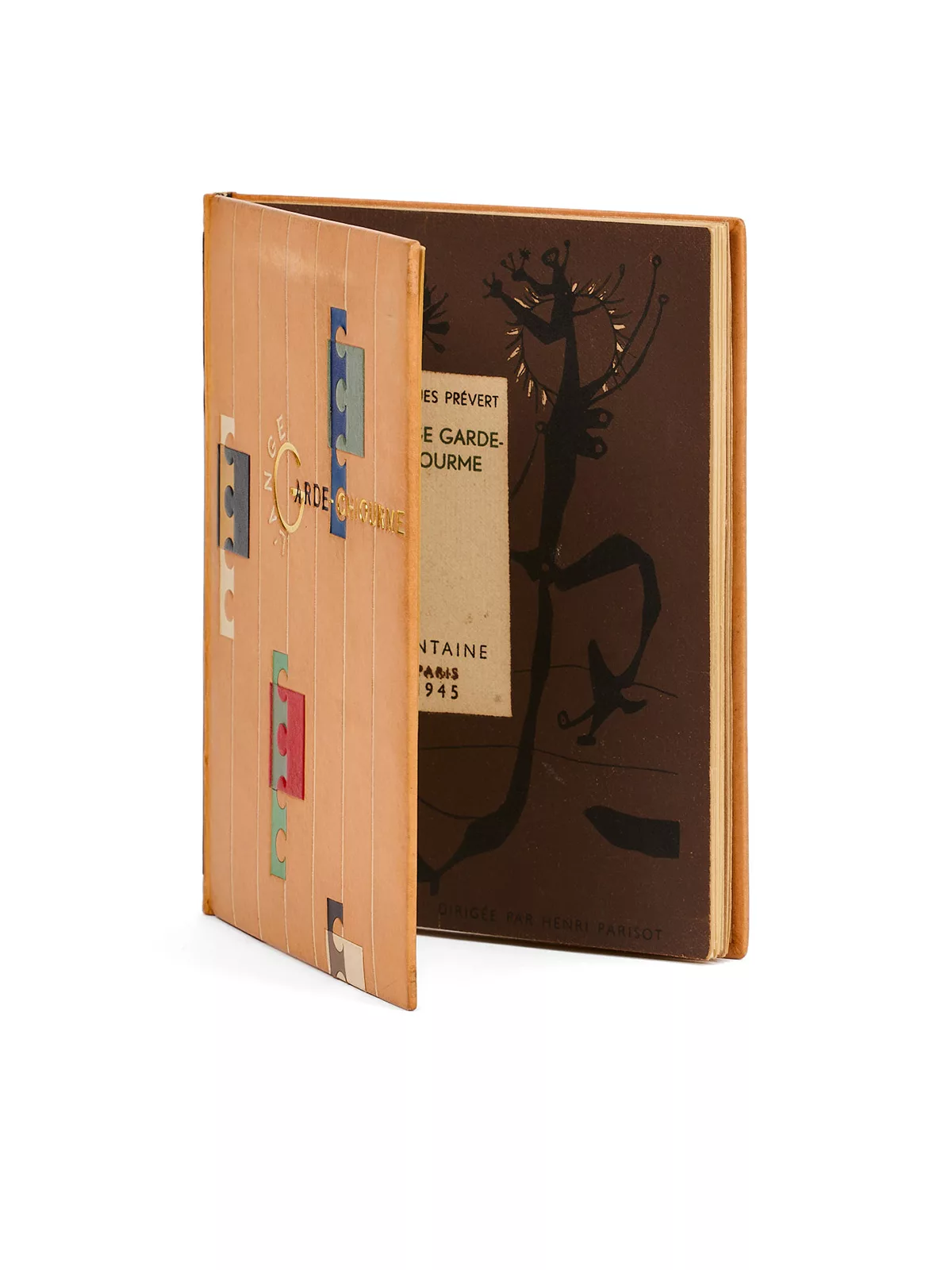
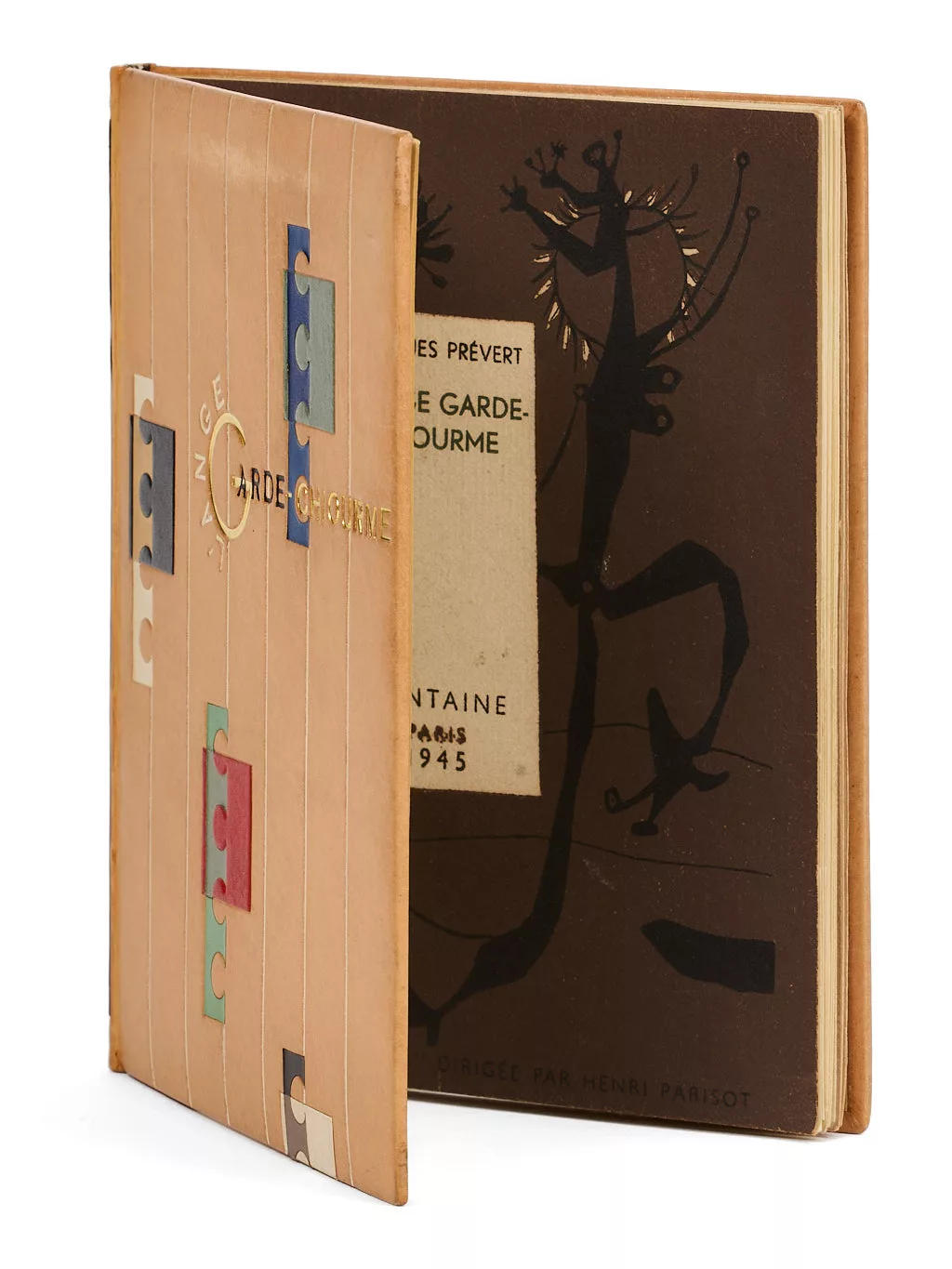
Provenance: Pierre Berès, with the bookshop’s label on the first page; this work was exhibited at the “exposition de la reliure originale” of 1953, under no. 121, cited as “à Pierre Berès.” Berès was very likely the one who commissioned the binding from Rose Adler, whom he had met in 1946. “From 1946 onward, Rose Adler gained a loyal customer who kept her working until her death in 1959: the bookseller Pierre Berès. A letter she wrote to Madame Solvay suggests that Berès and Rose Adler already knew each other before he began commissioning bindings from her, and that she did not think highly of him: ‘Berès the bookseller suddenly discovered that I had talent, and bought from me, waving banknotes, my copy of Suzanne et le Pacifique bound in yellow calf that had been in the shop window. I had to fight with him not to promise him a Éventail by Marie Laurencin, which I finished in pink kidskin lined with russet suede. He is very eager to see your bindings, but you will only receive him if you wish to. […] He is a young man who has had an extraordinary career. All the fine pieces go to him, just as the fine paintings inevitably end up with Wildenstein. He is very young […].’ Berès was indeed one of her most important patrons, from the second half of the 1940s onward. We have identified at least thirty-three bindings that belonged to him, fourteen of which were bought back from other book collectors.” (Alice Caillé, Les reliures de Rose Adler, École nationale des chartes, 2014, p. 334).
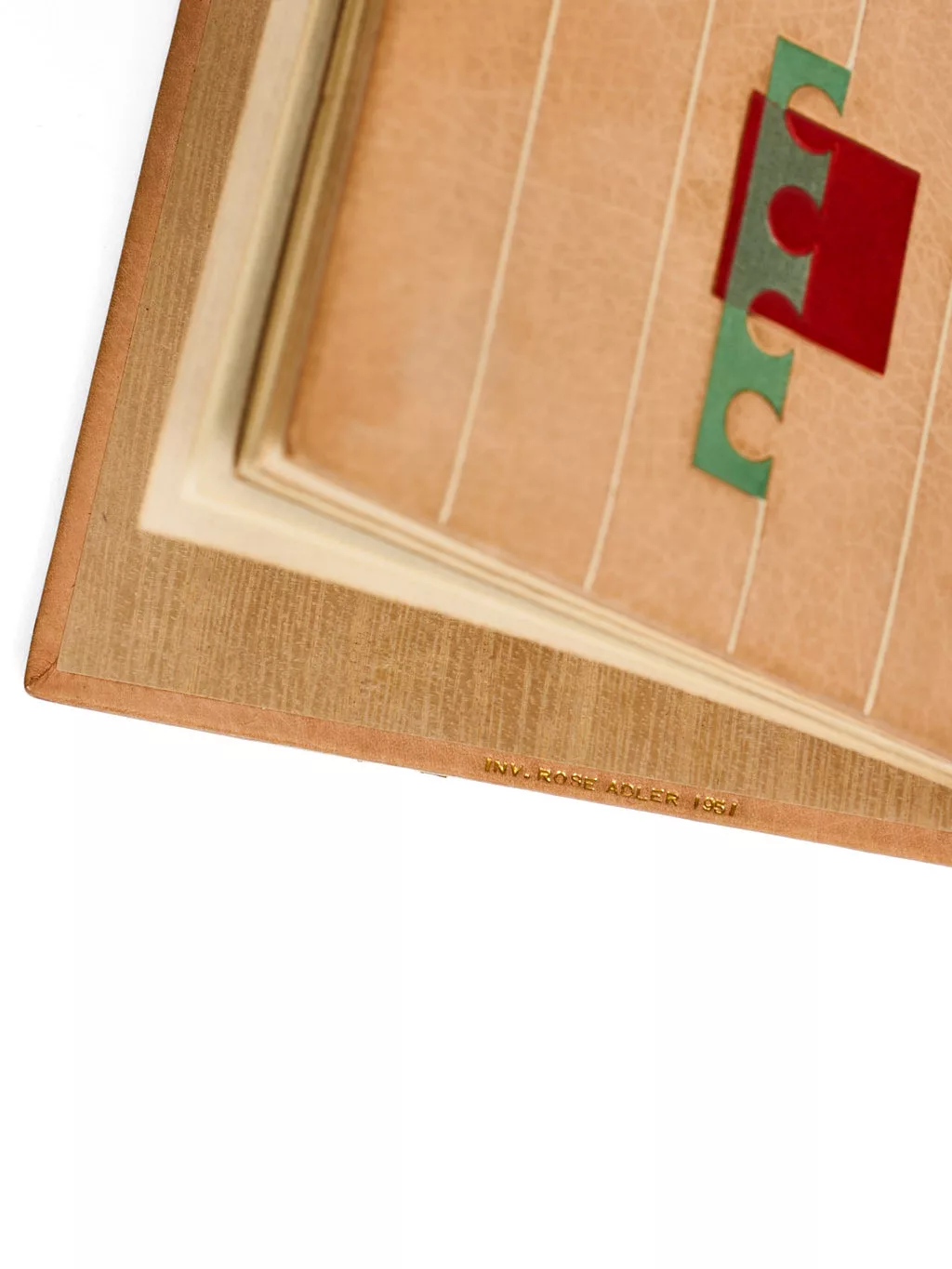
Alice Caillé dated this binding to 1953, on account of the exhibition where it was shown; in fact it dates from two years earlier, signed 1951 by Guy Raphaël, the last gilder with whom Rose Adler worked. This would make it, in the inventory of her work, the earliest binding gilt by Guy Raphaël for Rose Adler (predating Carmen in 1952, and Amitié cachetée, Je l’aime elle m’aimait and La Chanson du mal aimé in 1953). Raphaël had in fact been working with Rose Adler since 1949, but earlier collaborations, perhaps more minor, are not signed with his name. Alice Caillé lists nine bindings that are. “It should nonetheless be noted that it is entirely likely that the gilders she employed did not systematically sign the bindings they gilt: of the one hundred and forty-five works listed in our catalogue, one hundred bear a gilder’s initials, or just under 70%. It is therefore possible that they actually gilt more than we have recorded.” In fact, the bindings gilt by Guy Raphaël are among the rarest, as well as the most accomplished, with Rose Adler continuing to add her own personal touch to the making of the binding.
The Rose Adler collection at the Bibliothèque littéraire Jacques Doucet holds, under the shelfmark Ms 40-773, a 60-page album of photographs of bindings, in which L’Ange garde-chiourme appears. The subsequent history of this copy is unknown: it does not appear in the Berès sales, and it is very likely that the bookseller later sold it to one of his many clients passionate about Rose Adler’s bindings. There were many such clients, particularly during her final period, from 1951 to 1959, “considered, in Rose Adler’s art, as a period of renewed inspiration, which had suffered from the economic crisis and the war. It is true that the technical difficulty of the unusual formats she had to bind certainly posed problems that she took pleasure in solving, and that the poetry of several of these works stimulated her mind and imagination” (Alice Caillé). She was awarded the Légion d’honneur that July.