

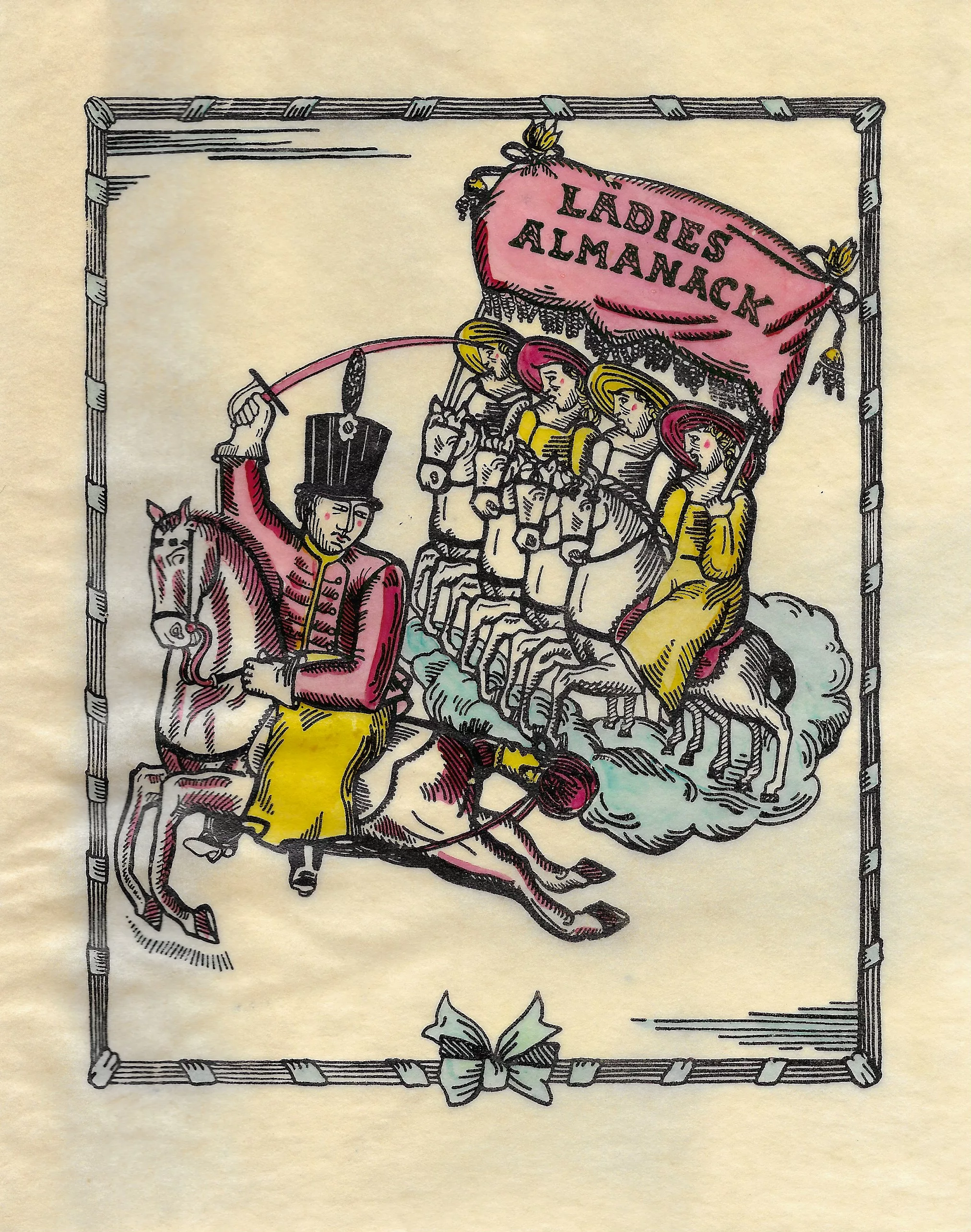
Ladies Almanack
The 22 illustrations are hand-colored by the author, as are the two designs on each side of the cover. Each copy was colored differently by Djuna Barnes, who varied the colors of her compositions from one copy to another.
An extremely rare deluxe copy of this roman à clef of the late-1920s modernist, lesbian and American circle in Paris. Published at the author’s own expense, and Sold by Edward W. Titus, 4 rue Delambre, at the sign of the Black Manikin, [Dijon, Imprimerie Darantière].
A fantastic copy in absolutely pristine condition — arguably the finest known. The colors remain remarkably fresh, both on the text leaves and on the parchment wrappers, and are more carefully fixed than in other copies.
The Ladies Almanack, a typically nineteenth-century form, is here revised and modernized to create the first manifesto of its kind, published anonymously by “a Lady of Fashion,” that is, Djuna Barnes, the American novelist, playwright and artist. She began her career in New York in 1915 with A Book of Repulsive Women, which she illustrated herself. In 1921, on assignment for McCall’s magazine, she traveled to interview her expatriate compatriots who were thriving in the artistic and literary community of Paris. Armed with a letter of introduction to James Joyce, she met him almost immediately, for Vanity Fair, and became his friend; he opened the doors of the American community to her. She thus met Natalie Clifford Barney, Gertrude Stein, Berenice Abbott and Sylvia Beach. Drawn by the freedom of morals there and by the life led by her compatriots, she decided to settle in Paris, joined the avant-garde and the modernist movement, and tried her hand at every genre — journalism, the novel, the short story, poetry, theater — producing an experimental and subversive body of work, free of the social and literary codes of her time, just like her companion, the sculptor Thelma Wood, with whom she lived at 9 rue St-Romain until their break in 1931. In 1936, thanks to T. S. Eliot, she published her masterpiece, Nightwood. But it was a book issued eight years earlier that made her famous: Ladies Almanack. The work is a celebration of female sexuality and a rebuke to heterosexual patriarchy, depicting in disguised form much of the cultural and artistic elite of the Parisian avant-garde of the time, in particular the lesbian circle that gathered around Natalie Clifford Barney — Janet Flanner, Romaine Brooks, Solita Solano, Dolly Wilde (“Doll Furious”), Lady Una Troubridge (“Lady Tilly Tweed-in-Blood”) and Radclyffe Hall. Barney’s character here is called “Dame Evangeline Musset,” described as a “pioneer,” now a mentor whose aim is to rescue women in distress and dispense wisdom. The style is rooted in in-jokes and maintains a constant ambiguity, Barnes opting for a modernist experimentation inspired by her meeting with James Joyce. It was written in a few weeks in the spring of 1928 “as a joke,” a diversion during her companion Thelma Wood’s hospitalization, before being distributed under the counter in Paris and later New York by the same circle of friends.
The book was originally to be published by Edward Titus at the Black Manikin Press in Paris. The impoverished husband of the wealthy Helena Rubinstein, Titus had opened a rare book shop in 1924 while also venturing into publishing English-language authors; he was notably the publisher of the first French edition of D. H. Lawrence’s Lady Chatterley’s Lover, preceded by the essay Pornography and Obscenity, long banned in English-speaking countries. But the printing costs Titus quoted Barnes proved too high: advised by Sylvia Beach (who had published Joyce’s Ulysses), Robert McAlmon and Nancy Cunard, she turned instead to the expertise of Maurice Darantière, in Dijon.
It was there that the book was printed, with a fragile parchment cover. Only the deluxe copies were hand-colored, sold at the then very high price of $50 — out of a print run of 1,000 copies on alfa paper, 40 on Rives paper and 10 on laid paper.
“The Ladies Almanack is a singular book in Djuna Barnes’s œuvre: reappropriating the codes and forms of earlier centuries’ bawdy literature, it saturates the text with sexual allusions and ambiguities and constructs an entirely new topography of the female body, from the point of view of the ‘lesbian eye’” (Michèle Causse, preface to the French translation). It is a satirical tribute to the women who frequented Natalie Barney’s Parisian salon in the 1920s.
The white blackbird of lesbian literature, in this condition.
Only one copy appears to have come up at auction in more than fifty years (no. 9, New York, 2019, “A landmark title in lesbian literature, with no other copies of the deluxe issue appearing at auction according to Rare Book Hub and ABPC”); copy no. 4 is also known, discovered in 2002 by Martin Stone and since passed into an American public collection: both were in markedly worse condition than the present copy. Copy no. 2 is also known, its parchment jacket being a facsimile.
The 22 engaging illustrations accompanying the text (feminized zodiacs, medieval grotesques, sexual caricatures, baroque cherubs, parodic iconography and other archaic and obscure emblems) have been the subject of several reprints, sometimes as separate plates.
An unnumbered “passe” copy: it comes from the library of Gaston Gérard, former mayor of Dijon, no doubt presented to him by the book’s printer, Maurice Darantière.