

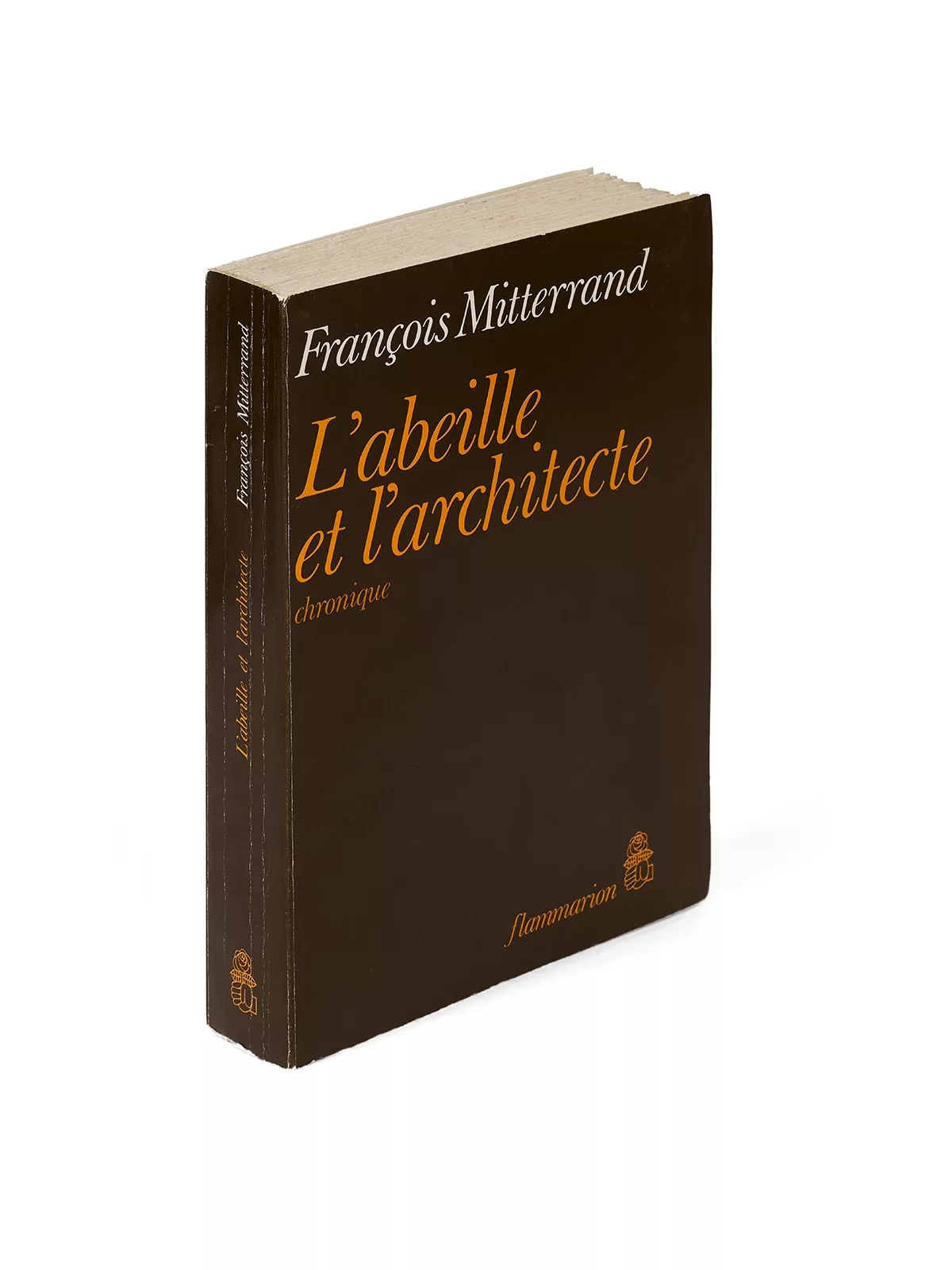
L’Abeille et l’Architecte
One of 25 copies on vélin d'alfa paper, this copy no. 14.
“What distinguishes, from the outset, the poorest architect from the most skillful bee is that he has built the cell in his head before building it in his hive.” It was from this sentence, drawn from the work of Marx, that François Mitterrand took the title of this book: “In short, the law of necessity — the bee — and the law of initiative, however modest, but nonetheless presupposing the richness of life — the architect — seemed to me to describe rather well what I wanted to say,” explained the then First Secretary of the Socialist Party.
These selected chronicles cover the period 1974–1978, though they do not form a diary: “a minor genre that prevents the writer from carrying his subject through to the end (…). As for writing itself, I feel increasingly free (…). I have no taste for idle talk; as soon as I see a writer lingering instead of saying what he has to say, in the language of our country as it is actually used, I tend to think he is evading the point, and that he is not a very good writer. I am particularly harsh in judging someone reputed to be a very great writer, precisely because to my mind he is merely eloquent — I apply this judgment to Malraux (…). Writing in an eloquent or oratorical manner has a way of exasperating me, to the point that I exasperate myself, and so I remain vigilant” (in Apostrophes, September 15, 1978).
A political book, certainly, but one in which literary figures are extensively evoked, from Ambrose Bierce to Saint-John Perse, from Segalen to Mauriac, and Romain Gary among them.