

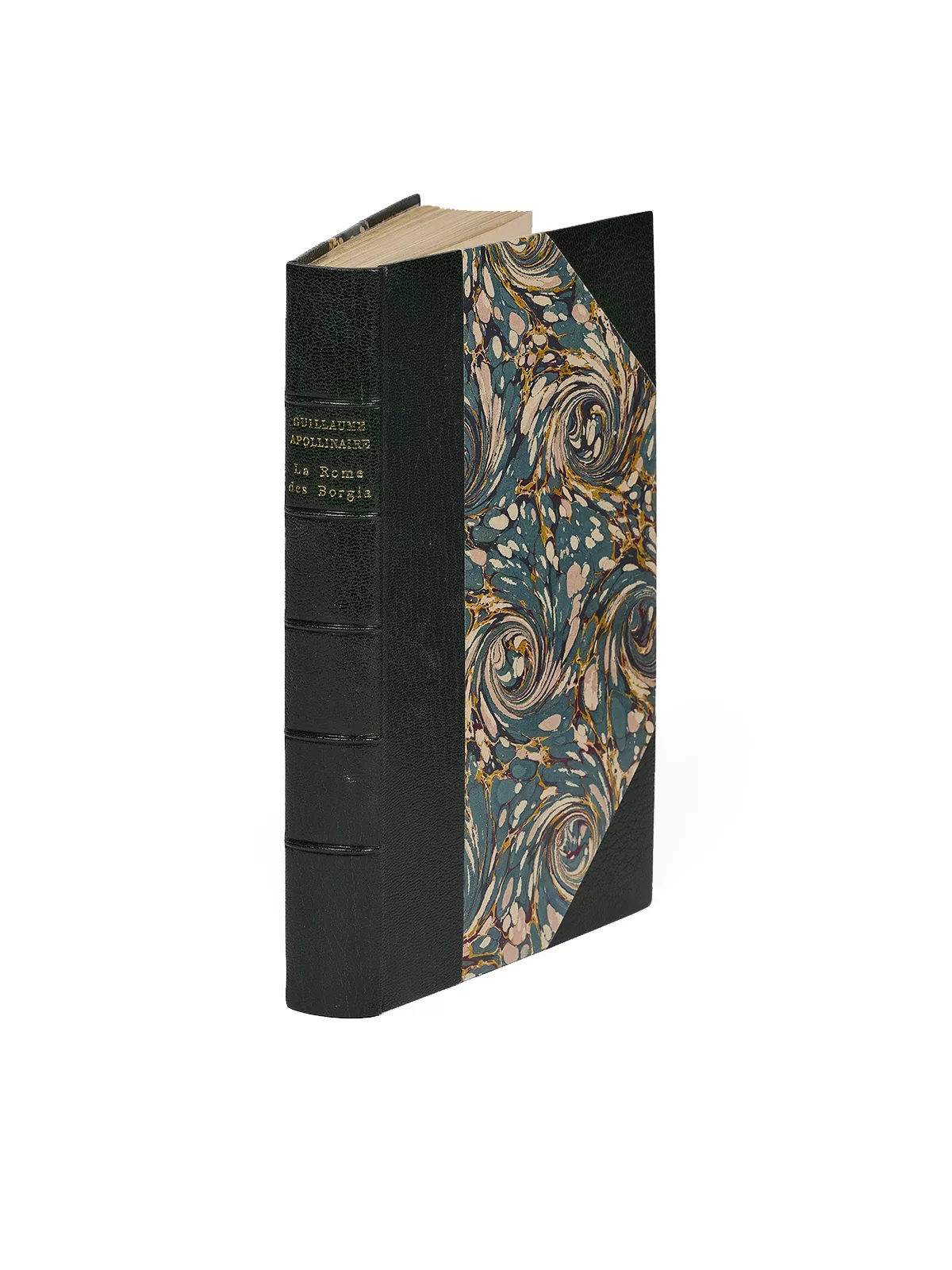
La Rome des Borgia
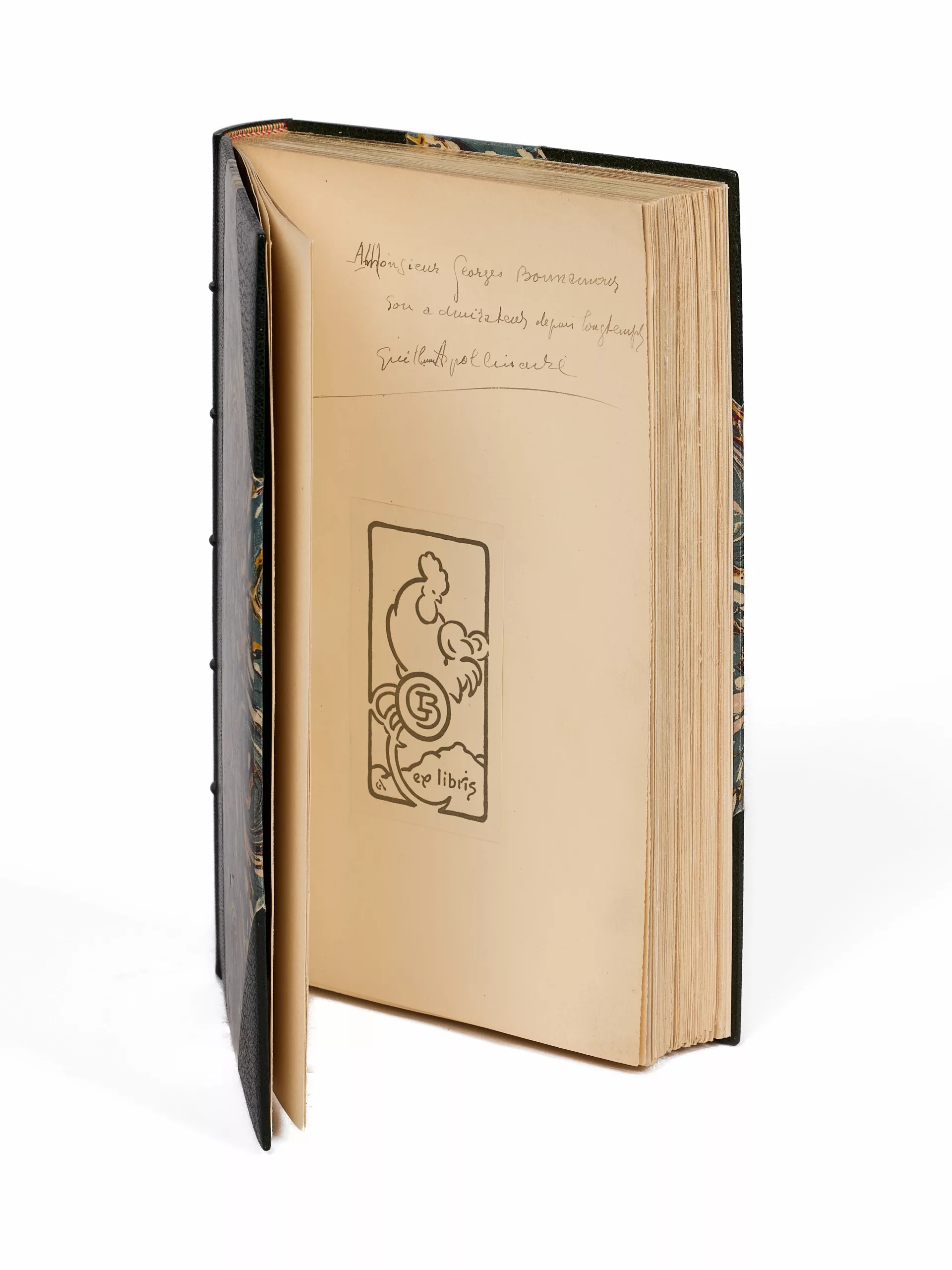
Presentation copy inscribed by Apollinaire to Georges Bonnamour: “À Monsieur Georges Bonnamour son admirateur depuis longtemps. Guillaume Apollinaire.”
The edition was compiled together with René Dalize, a Creole-born poet born in Paris in 1879 and, with Apollinaire, founder of the review Les Soirées de Paris. The two poets explore the possibilities of evil through the moral decay characteristic of absolute power — that of the Prince — which alone suffices to suggest dread.
“The manuscript of La Rome des Borgia, which belongs to romanticized history, was given to us by the widow of a celebrated historian […]. We have added a number of documents which can only increase the historical interest of a book that is in no way directed against religion or its ministers, but which simply relates customs very different from our own,” Apollinaire warns.
Dalize, to whom Calligrammes would be dedicated, died in 1917 “in the desolate obscurity of a December battle,” killed by a shell on the Californie plateau, the eastern part of the Chemin des Dames overlooking the village of Craonne: “Besides a delightful companion, I lose my oldest, my best friend. He cannot be replaced, and he was of a unique quality” (letter of 21 May 1917 to Georgette Catelain). His friendship with Apollinaire dated back to 1892, at the Catholic college Saint-Charles in Monaco. This period is evoked in the poem “Zone” from Alcools, and Dalize is also mentioned in Le Poète assassiné and in the poem “La Colombe poignardée par la paix.”
A fine copy of the first printing, with the date 1913 and the mention “dix illustrations hors texte”: a second state, dated 1914 and mentioning “huit illustrations hors texte,” is the one commonly encountered. The deluxe copies (10 on Japanese paper and 10 on Arches laid paper) all appear to belong to the first, 1913, issue.
Georges Bonnamour (1866–1954) was a journalist and writer, active at La Plume and then La Revue indépendante.
His attractive bookplate, designed by Georges Auriol, appears on the leaf bearing the inscription.